

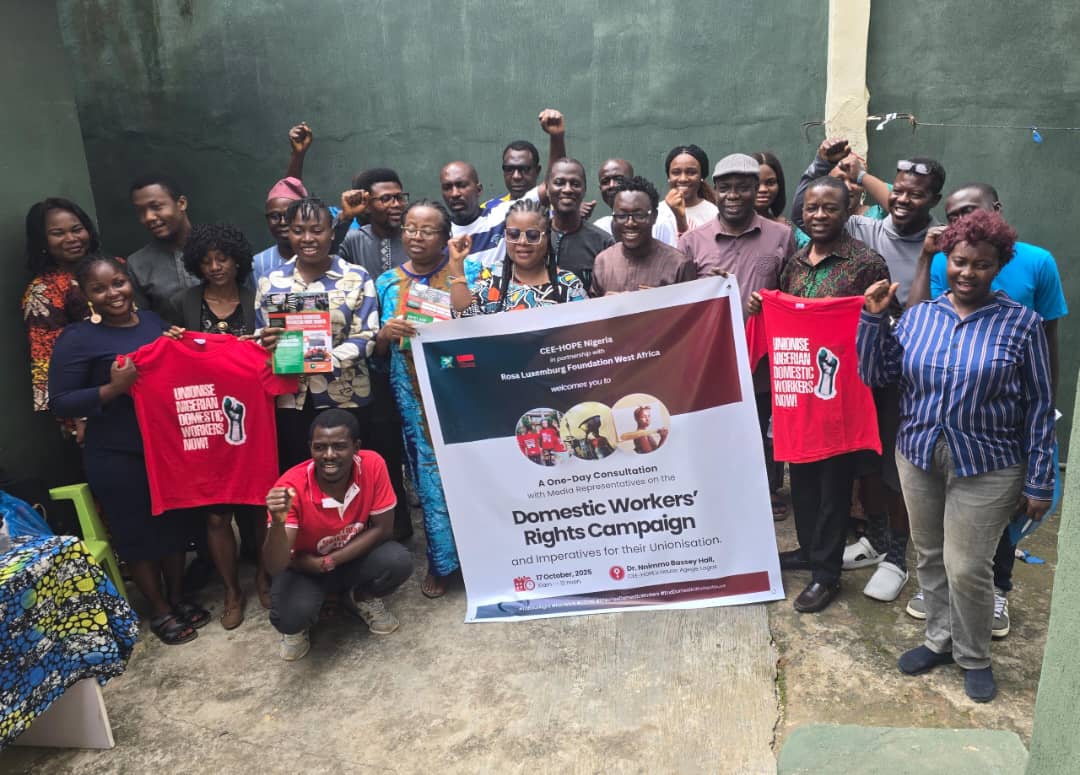
A Non-Governmental Organisation, Centre for Children’s Health Education, Orientation and Protection, CEE-HOPE Nigeria, has called for stronger legal protection, improved working conditions and the unionisation of domestic workers in Nigeria, describing them as ‘the invisible backbone of society’.
The call was made during a consultative meeting with media representatives in Lagos on the campaign for domestic workers’ rights and imperatives for their unionisation.
While addressing the media representatives, Betty Abah, Founder and Executive Director of CEE-HOPE Nigeria, emphasised the urgent need to recognise domestic workers as legitimate members of the labour force deserving of dignity, fair wages, and legal protection.
Describing the valuable roles of domestic workers, Abah said, “they care for our homes, nurture our children, and support our families — yet they remain among the most unrecognised, undervalued, and vulnerable workers in Nigeria.”
“For too long, their labour has been invisible and unprotected. That must change,” she added.
Abah noted that CEE-HOPE’s campaign aligns with ILO Convention 189 on decent work for domestic workers, stressing that protecting their rights is not just a social cause but a matter of justice, equity, and human dignity.
Legal pathways for change
Mr Monday Ashibogwu, Advisor to CEE-HOPE Nigeria, noted that the recurring abuse of domestic workers is caused by Nigeria’s weak legislative framework on the subject.
He said, “if there is no legislative framework or policy guidelines for how domestic workers should be treated, their rights will continue to be violated. The rights of a Nigerian worker are not negotiable.”
He also called for setting a minimum age limit for domestic workers and protecting them from child abuse and sexual exploitation.
Abah highlighted two pending bills before the National Assembly that, if passed, would transform the legal landscape for domestic workers in Nigeria.
In the House of Representatives, HB.1765, sponsored by Hon. Akin Alabi, seeks to domesticate the Domestic Workers Bill of Rights and establish minimum employment standards. Meanwhile, in the Senate, SB.629, sponsored by Senator Sani Musa, aims to regulate and formalise the employment of domestic workers and other informal sector employees, empowering the National Directorate of Employment to monitor private employment agencies.
According to Abah, if passed, “they will ensure fair wages, safe working conditions, social security, and legal recourse for domestic workers. They will also formalise a sector that has long existed in legal limbo.”
Importance of unionisation
Abah further stressed the importance of unionising domestic workers as a means to end isolation and exploitation.
She said, “when workers come together in a collective, they can negotiate better terms, resist exploitation, and build solidarity. Without a union, domestic workers remain isolated and voiceless; with one, they gain structure, voice and protection.”
She urged Nigeria to follow the example of other countries where domestic worker unions have successfully improved wages, working hours, and respect.
Mrs. Ngozi Okoro, former coordinator of the Child Protection Network in Lagos, corroborated the need for unionisation of workers, adding that “every human has a right that must be respected, including those of domestic workers.”
She shared that unionisation will help to address the challenges faced by domestic workers, especially the child domestic workers, who are most often subjected to sexual abuse, emotional abuse, physical abuse, neglect and bullying.
The media’s role
Acknowledging the media’s pivotal role in shaping public perception, Abah appealed to journalists to partner in amplifying domestic workers’ voices and mobilising public support for the passage of the bills.
She urged consistent and strategic media coverage to spotlight both abuses and success stories, adding that such visibility would help shift cultural attitudes toward valuing domestic labour.
Similarly, labour activist, Hassan Soweto, urged the media to shine the light on domestic workers’ conditions.
“When it comes to public perception, the media can frame public opinion,” he said. “More investigative reporting is needed to expose injustices and highlight positive changes.”
He also buttressed the importance of the unionisation of domestic workers, stressing that it will also benefit their employers.
Veteran journalist and board member of CEE-HOPE Nigeria, Mr Lekan Otufodunrin, advised media practitioners to approach the subject with depth and understanding.
He said, “the best way to report an issue is to understand it thoroughly, including the laws that guide it.”