

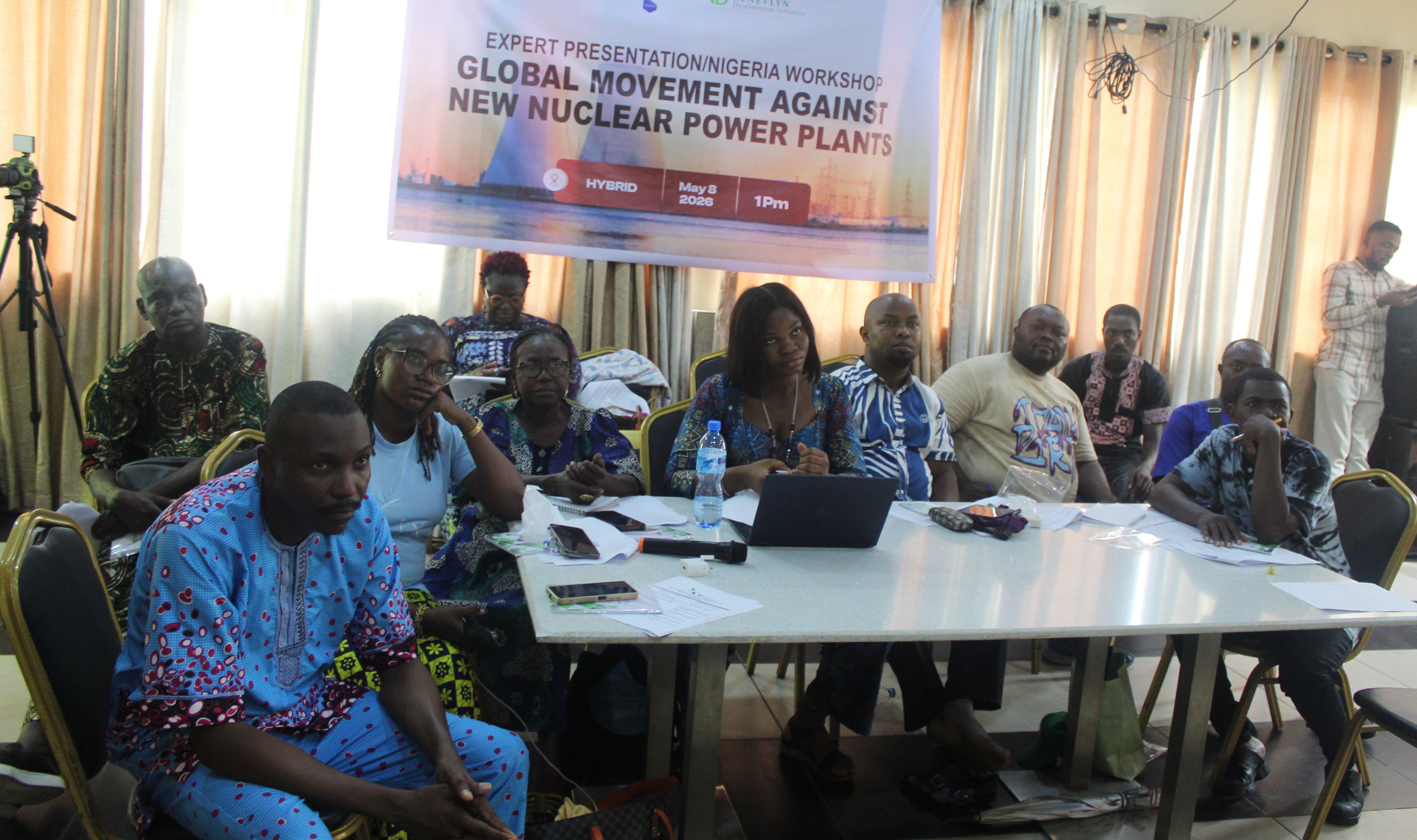
Environmental experts and anti-nuclear energy advocates have warned that transitioning to nuclear energy in Africa is a dangerous, expensive and false solution, which has limited known benefits for the populace.
The experts, drawn from Germany, Ghana, Kenya, Nigeria, South Africa, the United Kingdom, the United States of America and Zambia, explained that transitioning to nuclear energy in Africa would reinforce global economic dependency.
They shared their position during an Expert Workshop/Presentation on Global Movement Against New Nuclear Power Plants (Nigeria Training), organised by the Renevlyn Development Initiative, with support from Tipping Point North South UK.
In his presentation, Fadhel Kaboub, Associate Professor of Economics, Denison University, explained that the push for nuclear power across Africa was less about solving the continent’s electricity challenges but more about preserving global geopolitical and economic hierarchies.
According to him, Africa stands at a historic crossroads where it must balance energy governance with ecological, food and economic governance.
“The debate around nuclear energy in Africa is not fundamentally about solving Africa’s energy crisis. It is about preserving a global economic and geopolitical hierarchy. It is about maintaining systems of technological dependency, financial extraction and geopolitical control,” he said.
Kaboub thereafter called for greater investment in renewable energy systems, green cooking infrastructure and green industrial ecosystems capable of driving inclusive development across the continent.
In her presentation titled ‘Africa’s Nuclear Misadventure’, Deborah Burton, the Co-founder, Tipping Point North South UK, said that Africa must resist the pressure to adopt nuclear power because it is a distraction for a continent that has an abundance of renewables that can power it and reduce the energy poverty of its people.
Burton noted that there have been seemingly unending announcements to roll out nuclear power in Africa, with little or no information afterwards.
Stating that there is a need for governments to inform the people about any nuclear power projects on the continent, Burton explained that “nuclear energy is toxic, harmful to your health and the environment, it is a waste of money and the root through which corruption can flourish.”
Burton buttressed the recommendations made in a 2025 report titled ‘The Alarming Rise of False Climate Solutions in Africa’, and called for an end to plans to spend billions on building new nuclear power plants and advocated instead for funding of clean, safe renewable energy sources, of which the continent has an abundance.
Philip Jakpor, the Executive Director of Renevlyn Development Initiative (RDI), buttressed that nuclear power is expensive and would not provide the necessary services to Nigerians.
Jakpor noted that proposed nuclear plants in Nigeria would cost $80bn. He alleged that discussions surrounding the projects had remained largely secretive and excluded members of the public.
“The Nigerian Atomic Energy Commission (NAEC), which has the mandate to develop the framework and technical pathway to explore, exploit and harness atomic energy for peaceful application in all its ramifications, signed an MOU with ROSATOM, a supposed Russian company, on May 31, 2016, for the construction of four nuclear power plants in Nigeria.
“The plants would cost about $80bn and will have a total capacity of 4,800 megawatts by 2035, with each facility costing $20bn. It is to be built by the Russian firm -ROSATOM.”
Other experts at the workshop who resisted the nuclear energy transition were: Anthony Kingi, Uyombo community leader and frontline defender; Lance Mbani, Program Officer, Center for Justice Governance and Environmental Action, Kenya; Chansa Kaluba, Southern African Faith Communities Environment Institute; and Vladimir Slivyak from Ecodefense, Russia.
Others were: Makoma Lekalakala, Earthlife Africa, South Africa; Stephan Singer, Anti-Nuclear Activist, Germany; Barr Chima Williams, Executive Director, Environmental Defenders Network, Nigeria; and Abubakar Maidala, Climate Action Network.