

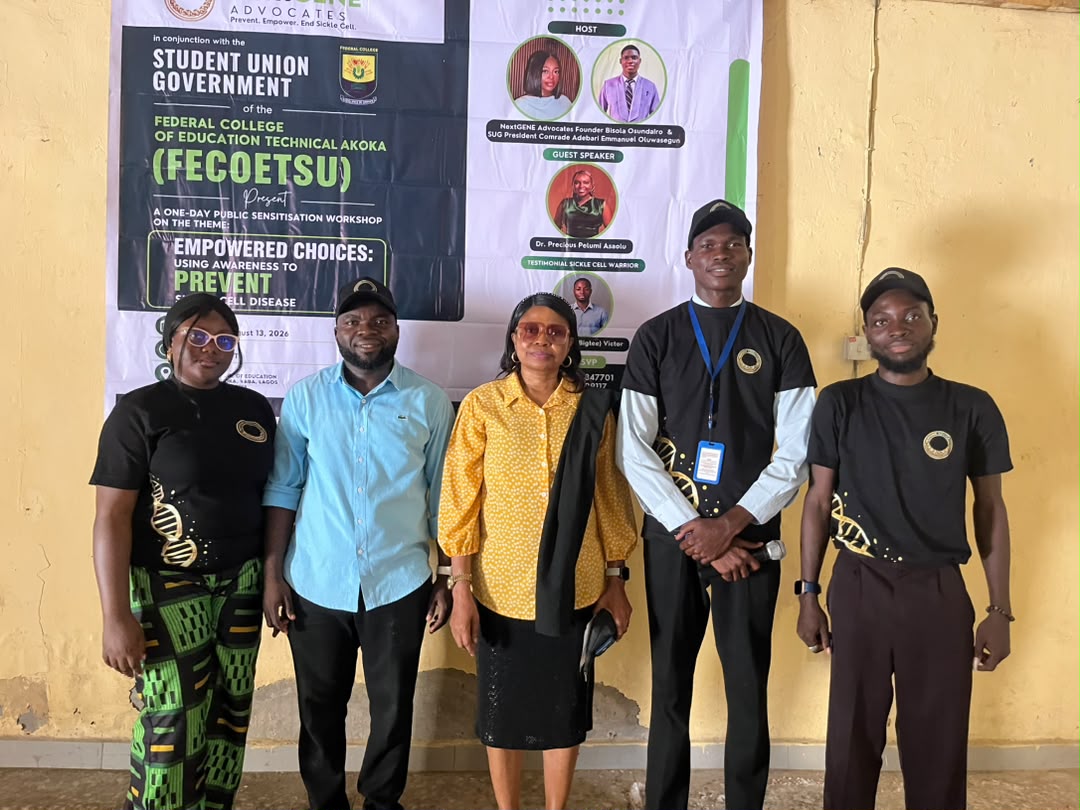
Public healthcare advocacy group, NextGENE Advocates, has urged Nigerian youths and intending couples to prioritise genotype and blood group testing before entering relationships that could lead to procreation.
The group made the call on Thursday in Lagos during the second edition of its public healthcare awareness workshop, held in partnership with the Students’ Union Government of the Federal College of Education Technical, Akoka.
Themed “Informed Choices: Awareness as the Tool for Preventing Sickle Cell Disease,” the campus-based intervention sought to raise awareness among young people about genotype compatibility, sickle cell disease and the consequences of uninformed reproductive decisions.
Founder of NextGENE Advocates, Ms. Bisola Osundairo, represented at the event by development expert and Executive Director of Frontline Advocacy Initiative, Shakirudeen Bankole, said the campaign was driven by concerns over persistent ignorance about genotype compatibility among young couples.
Osundairo said public education had become increasingly important given the challenges facing Nigeria’s healthcare system, including inadequate infrastructure and a shortage of medical professionals.
She stressed that preventive health knowledge could help Nigerians make informed decisions and reduce avoidable health challenges.
“The thing is that the health of each and every individual Nigerians matter. Because it is the smaller unit that makes of the multitude that we call the large population today. So, if everybody is healthy, the population becomes healthy. But if otherwise, then problem comes. And in situations where there is problem, Nigerians are in bad situations because the infrastructures are not there. The experts are not there.
“This is why everyone must be careful and make informed decision especially regarding the health of their partners, which would have bearing on the type of children they make sooner or later,” she explained.
Speaking on the theme, medical doctor Dr. Precious Dasaolu urged intending couples and adults entering relationships with the potential for pregnancy to undergo appropriate genotype and blood group screening.
She stressed the importance of obtaining accurate test results from reputable medical facilities and warned against relying on questionable laboratory testing.
Dasaolu also linked genotype-related complications to some cases of paternity disputes and medical emergencies, noting that inaccurate test results could have serious consequences for families.
She advised individuals to verify their genotype through reputable hospitals or laboratories before making reproductive decisions.
However, some of the genotype claims made during the presentation require clarification against current clinical guidance. In particular, AC and AS are not equivalent to SS, and reproductive counselling should be based on medically accurate genotype combinations and individual circumstances rather than a blanket claim that only AA individuals can have healthy children.
A sickle cell advocate and survivor, Mr. Boluwatife Victor, shared his personal experience living with the condition, describing the recurrent crises associated with sickle cell disease as physically and emotionally challenging.
He recounted experiencing episodes involving severe pain, breathing difficulties and other complications.
He also narrated how he lost his undergraduate girlfriend to one of the crises, explaining that what would have become a private moment for two lovers was abruptly truncated by crisis.
“It was one of the most embarrassing moments of my life,” he said, explaining that after getting together, I suddenly started experiencing profuse sweating and improper breathing. I lost my composure immediately. The lady had to run away,” he narrated.
Victor also spoke about the social and psychological challenges associated with the condition, using his experiences to encourage young people to take genotype screening seriously before making reproductive decisions.
President of the Students’ Union Government of the Federal College of Education Technical, Mr. Adebari Emmanuel, described the partnership as part of his administration’s commitment to promoting health awareness among students.
He said young people needed accurate information to make decisions capable of protecting their health and contributing to a healthier society.
According to him, health remains a fundamental resource for individuals seeking to pursue their educational, professional and personal aspirations.
“I believe that health is the first human resource. It is only a healthy person that has the capacity to chase his or her dream into fruition. A sick and incapacitated person would only dream but immobile to chase the dreams. This is why we embraced the partnership with NextGENE Advocates to bring the enlightenment campaign to our campus. To help educate our students so they take informed decisions as save themselves and the country from this preventable crisis. And I can assure you that we will definitely take it up from here,” he said.
The institution’s Dean of Education, Dr. (Mrs.) Christiana Ijeoma Ajaps, also underscored the importance of health education among young people.
Ajaps urged students to embrace scientific knowledge and move away from traditional misconceptions surrounding sickle cell disease.
She encouraged participants to apply the knowledge gained from the workshop when making decisions about relationships, marriage and family planning.
The workshop forms part of NextGENE Advocates’ broader public health awareness efforts aimed at equipping young Nigerians with information to make informed health and reproductive choices.