
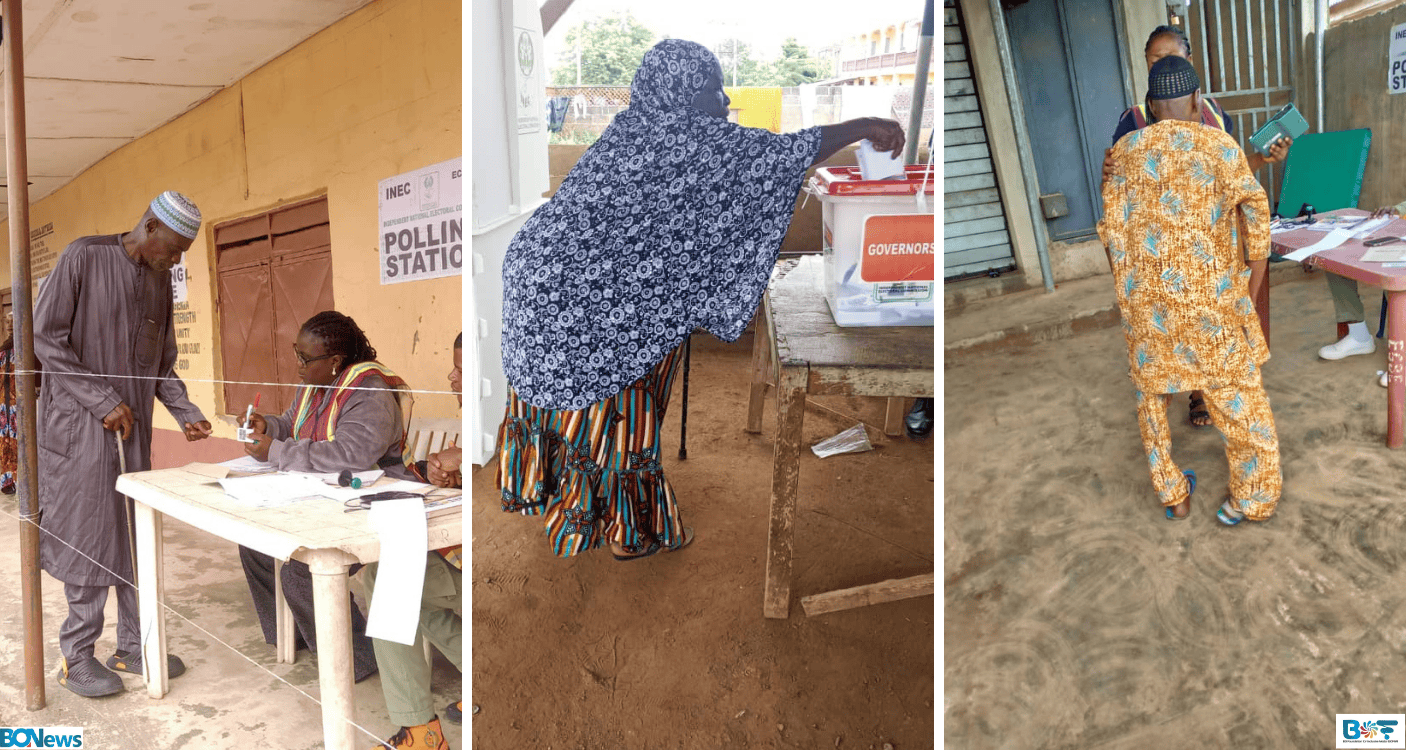
More than 70 percent of persons with disabilities (PWDs) turned out to exercise their franchise at designated polling units monitored during the August 15 Osun State governorship election.
This is according to the European Union Support to Democratic Governance in Nigeria Election Observation Hub (EU-SDGN EOH).
The development signals a significant level of political participation among voters with disabilities, even as election observers called on the Independent National Electoral Commission (INEC) to strengthen measures aimed at ensuring that PWDs and other vulnerable voters can participate in elections without barriers.
The observation was contained in the Hub’s preliminary election-day statement presented in Osogbo by representatives of the Kukah Centre (TKC), TAF Africa, the Nigerian Women Trust Fund (NWTF), Yiaga Africa, the International Press Centre (IPC) and the Centre for Media and Society (CEMESO).
The statement was presented by Samson Itodo of Yiaga Africa, Barrister Asabe Ndahi of the Kukah Centre, Akin Akingbulu of CEMESO, Lanre Arigbunde of IPC, Brenda Anugwom of the Nigerian Women Trust Fund and Jake Epelle of TAF Africa.
PWD Participation Records Encouraging Turnout
According to the Hub, its observers found the voting process to be largely inclusive, with noticeable participation by women and persons with disabilities across the polling units monitored.
More than 70 per cent of PWD voters reportedly turned up at the 12 designated PWD polling units observed by the Hub’s field teams.
For disability advocates, the figure is significant because it demonstrates that when persons with disabilities are provided with opportunities to participate, they are willing and able to exercise their democratic rights.
However, the observers stressed that participation should not end with simply showing up at the polling unit.
They urged INEC to ensure that accessibility, priority voting arrangements and assistive devices are not only provided but are also functional and effectively used.
Women Also Record Strong Participation
Women were also prominent in the voting process as the Hub reported that women accounted for approximately 59 per cent of voter turnout across the polling units monitored, while women represented about 36 per cent of polling officials and played important roles as polling agents.
The observers described the participation as encouraging but emphasised that greater attention must be paid to the specific needs of vulnerable voters.
INEC was particularly urged to strengthen arrangements for elderly voters, pregnant women and persons with disabilities to ensure that physical, communication and procedural barriers do not prevent them from exercising their franchise.
Accessibility Must Go Beyond the Polling Unit
The Hub specifically recommended that INEC monitor the availability and utilisation of priority voting arrangements and assistive devices for PWDs and other vulnerable voters.
The observers stressed that it is not enough for electoral facilities to exist on paper.
They must be available, accessible and usable by the people they are intended to support.
This is particularly important for voters who may face barriers relating to mobility, vision, hearing, communication or other forms of disability.
Election Marred by Security Concerns and Irregularities
While inclusion remained one of the positive features highlighted by the observers, the election was not without challenges.
As of noon, the Hub reported 38 security incidents, including 25 cases of thuggery, 12 attacks on electoral officials and nine cases of voter intimidation allegedly involving security personnel.
Across the 726 polling units observed, the Hub also documented 323 cases of electoral offences and irregularities.
Among the incidents recorded were:
- 103 cases of vote trading;
- 12 cases of multiple voting;
- 28 incidents involving inducement of polling and security officials;
- 38 cases of campaigning at polling units;
- 14 cases of voter impersonation;
- Seven cases of misconduct by election officials;
- 31 cases of obstruction of voters; and
- 85 cases involving exposure of ballot papers.
The figures underline the need for stronger enforcement of electoral rules and greater professionalism by all actors involved in the electoral process.
Security Agencies Told to Remain Neutral
The Hub urged security agencies to maintain professionalism and neutrality throughout the electoral process.
It called for security personnel to remain visible enough to protect voters and election officials, while ensuring that their presence at polling units remained restrained and non-intimidating.
Political parties and candidates were similarly urged to ensure that their agents focused on lawful observation rather than intimidation, vote inducement or vote trading.
Message to Voters, Including PWDs
The observers also urged voters to protect the integrity of their votes by rejecting inducements and reporting incidents of vote buying and other electoral offences.
PWD voters, in particular, were encouraged to exercise their franchise independently and to report any barriers, discrimination or electoral violations encountered at polling units.
The Hub advised voters to report incidents to INEC officials, security personnel or accredited election observers.
INEC Urged to Strengthen BVAS and Results Management
Beyond accessibility and security, the Hub called on INEC to address technical challenges that could disrupt voting.
It recommended that the commission deploy necessary technical support and backup BVAS devices to polling units where biometric accreditation equipment fails.
INEC was also urged to ensure the timely deployment of electoral materials and personnel to all polling units.
On results management, the observers called on the commission to ensure that results forms are displayed at polling units after voting and that relevant results are promptly uploaded to the INEC Result Viewing (IReV) portal.
Inclusion Must Translate Into Real Political Participation
The strong turnout of PWD voters in the monitored polling units represents an encouraging development for disability inclusion in Nigeria’s electoral process.
But the observers cautioned that participation must be accompanied by genuine accessibility, security and electoral integrity.
For millions of Nigerians living with disabilities and other vulnerabilities, the right to vote must mean more than being physically present at a polling unit.
It must mean being able to arrive, access the polling environment, receive necessary assistance, vote independently and securely, and have that vote counted without discrimination or obstruction.
As the electoral process continues, the EU-SDGN Election Observation Hub stressed that sustained attention to inclusion, accessibility, security and electoral integrity will be critical to ensuring that the encouraging participation of persons with disabilities and other vulnerable groups translates into meaningful and unhindered political participation.
This story was first published on Qualitative Magazine and written by Chris Agbo.