

For 38-year-old Ogbo Godwin, going to the polls during the 2026 Osun State governorship election was about more than choosing a candidate. It was an opportunity to make his voice count in a political process that would determine the leadership and direction of the state.
A member of the Joint National Association of Persons with Disabilities (JONAPWD), Godwin lives with an injury affecting one of his legs, a condition he said can sometimes make it difficult for him to participate alongside other people. Yet on Saturday, August 15, he came out early to vote and was given priority as a person with a disability.
His experience offers an important perspective on the progress and remaining gaps in disability-inclusive elections in Nigeria. Unlike cases where persons with disabilities are prevented from voting or face obvious physical barriers at polling units, Godwin was able to participate. He was prioritised, completed the voting process and left having exercised his franchise.
But the experience was not entirely easy.
“Ìrírí tí mo ní níbẹ̀ kò rọrùn,” Godwin said in Yoruba, describing the experience as difficult.
For him, the motivation to participate was nevertheless strong. “Mo fẹ́ kí won gbọ́ tiwa” — “I wanted our voices to be heard.”
That message captures an important reality about disability and democracy. Persons with disabilities are not simply people for whom electoral institutions must make special arrangements. They are citizens with political choices, expectations and a legitimate interest in who governs them. The question, therefore, is not only whether they can reach a polling unit and cast a ballot, but whether the electoral system allows them to participate with the same sense of dignity, confidence and ease expected by other voters.
From Physical Access to Meaningful Participation
Ahead of the Osun election, the Independent National Electoral Commission (INEC) highlighted several measures intended to support the participation of persons with disabilities, including priority voting and the provision of assistive materials such as Braille ballot guides and magnifying glasses. The commission also said polling officials would be trained on priority voting and that voters requiring assistance would be allowed to receive support in line with electoral procedures.
At some polling units, these measures appeared to translate into practice. Reports from election day indicated that persons with disabilities and elderly voters were prioritised in some locations, while Godwin’s own experience showed that priority voting could make participation easier when properly applied.
This is significant because priority voting is not merely a gesture of courtesy. For voters with mobility difficulties and other disabilities, reducing the time spent standing in crowded queues can remove a practical barrier to participation. It can make the difference between a voter completing the process comfortably and one being discouraged from remaining at the polling unit.
Godwin’s experience therefore demonstrates what accessibility can look like when a provision works: he arrived early, was recognised as a voter with a disability, received priority and was able to vote.
Yet his account also shows why accessibility should not be measured solely by whether a person eventually casts a ballot.
What 131 Field Reports Reveal
Provisional field observations from the EveryVotes platform deployed by Legis360, with multiple partners, provide another layer of evidence from the election. The platform was used to document conditions at polling locations and monitor aspects of the electoral process during OsunDecides 2026. Its data is provisional and should therefore be understood as an observation of the locations covered rather than a definitive assessment of every polling unit in the state.
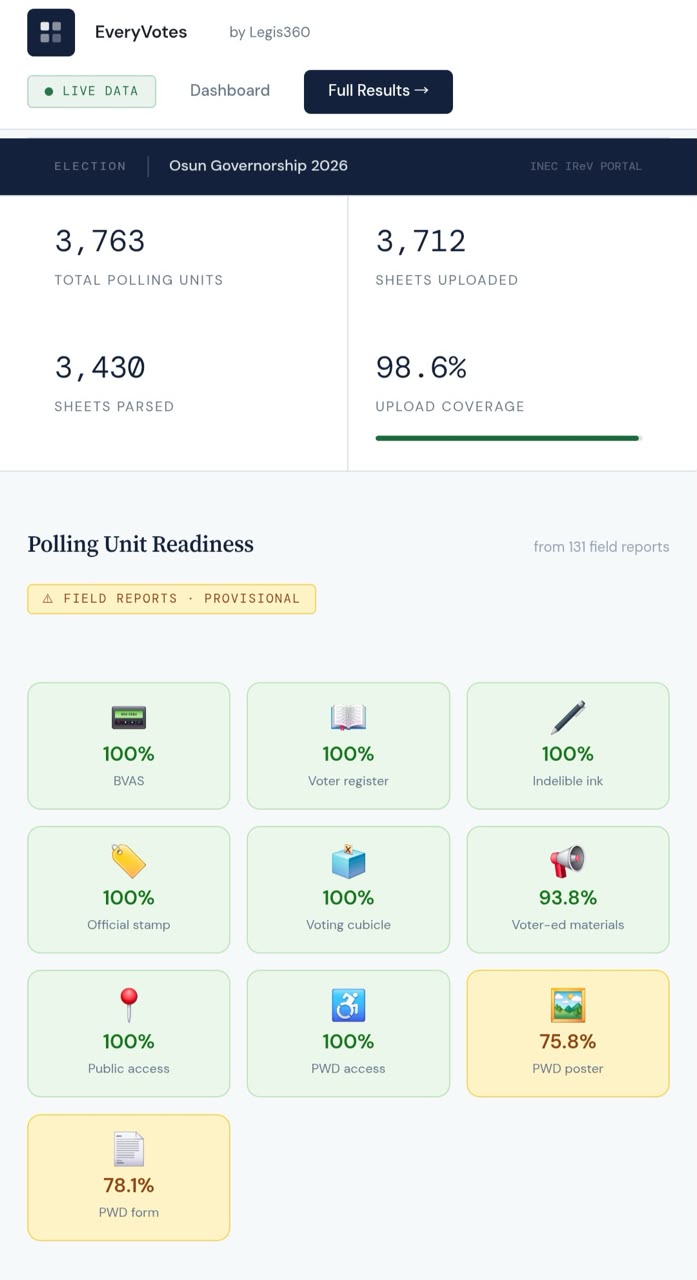
Across 131 field reports, PWD access was recorded at 100 per cent of the monitored locations. Other indicators of polling-unit readiness were similarly high, with BVAS, voter registers, indelible ink, official stamps, voting cubicles and public access each recorded at 100 per cent, while voter education materials were available in 93.8 per cent of the locations observed.
These findings suggest that basic polling-unit preparedness was relatively strong among the locations covered by the observers. However, the disability-specific indicators present a more nuanced picture. PWD posters were recorded at 75.8 per cent of the monitored locations, while PWD forms were recorded at 78.1 per cent.
The figures should not be interpreted to mean that one in four polling units in Osun was inaccessible to persons with disabilities. Rather, they highlight an implementation gap that deserves attention: even where physical access was recorded, disability-specific materials were not consistently observed across all the locations covered.
That distinction is important because accessibility is broader than the physical ability to enter a polling unit.
A voter may be able to reach the polling location but still encounter difficulties understanding procedures, accessing information, using assistive materials or navigating the process without unnecessary assistance. For disability inclusion to be meaningful, each part of the voting journey must be considered.
When Access Exists but the Experience Is Still Difficult
Godwin’s experience illustrates this distinction particularly well.
He was not denied access to the polling unit. He was not prevented from exercising his franchise. He received the priority expected of a voter with a disability and was able to vote early.
Yet he still described the experience as difficult.
Some portions of the interview recording were unclear, making it inappropriate to attribute specific procedural failures to election officials without additional evidence. What is clear, however, is that the overall experience left an impression on him. He referred to something that had happened to him previously and explained that it had affected his willingness to return.
This is an important reminder that accessibility has an attitudinal and procedural dimension alongside the physical one.
A polling unit can have enough space for a wheelchair user and still be difficult to navigate. An official can provide priority voting but fail to communicate procedures clearly. A disability-specific form can exist without a voter knowing when or how to complete it. An assistive device can be supplied but not be readily available to the person who needs it.
In Godwin’s case, although he received priority and voted, he had not completed the PWD form before he was called for the interview. The detail may appear minor, but it raises a broader question about how disability-related provisions are communicated to voters and integrated into the actual voting experience.
The existence of an accessibility mechanism is only the first step. Voters must also know about it, understand it and be able to use it.
The Election Was Also a Test of Institutional Learning
OsunDecides 2026 provides an opportunity for INEC and other electoral stakeholders to examine what worked and what did not.
The evidence emerging from polling units should not be reduced to a binary conclusion that the election was either accessible or inaccessible to persons with disabilities. The reality is more complex. There are clear signs of progress, including priority voting and reported PWD access across the monitored locations, alongside gaps in the consistent availability of disability-specific materials. This is precisely why post-election assessment matters.
INEC’s accessibility commitments should be evaluated against what voters and observers actually experienced. Organisations of persons with disabilities should be part of that assessment, not simply as beneficiaries of an electoral policy but as stakeholders capable of providing evidence about how those policies functioned in practice.
The experiences of voters such as Godwin can help identify where the system needs improvement. Field observations from platforms such as EveryVotes can provide additional evidence of patterns across polling locations. Together, these sources can help move the conversation from general assurances about inclusion to specific questions about implementation.
PWDs Are Citizens Beyond Election Day
There is also a larger issue embedded in Godwin’s decision to vote.
He said he came out because he wanted his voice to be heard. Like other voters, he was not simply choosing a candidate; he was expressing an expectation about what the government should deliver.
He hopes the candidate he supported will emerge victorious and that the resulting government will be able to deliver what citizens deserve, the citizen dividend of good governance.
That expectation should be central to conversations about disability inclusion.
The political participation of persons with disabilities should not begin and end at the polling unit. The same citizens who are encouraged to vote should also be visible in the policies and programmes that follow elections. Their concerns should inform decisions on healthcare, rehabilitation, education, employment, social protection, accessible infrastructure, transportation and representation.
A government cannot meaningfully claim inclusive governance if persons with disabilities are considered during elections but remain peripheral to policymaking after the votes have been counted.
The Standard Should Be Dignity
OsunDecides 2026 shows that Nigeria’s efforts to make elections more accessible are producing some tangible results. Persons with disabilities came out to vote, priority arrangements were observed in some polling units, and Godwin’s experience demonstrates that a voter with a physical disability can receive priority and participate successfully.
But successful participation should not be the ceiling of ambition.
The goal should be an electoral process in which persons with disabilities can participate without having to negotiate unnecessary barriers at every stage—from accessing election information and reaching the polling unit to completing verification, voting and leaving the location.
The provisional EveryVotes observations provide useful evidence for that conversation, while the experience of voters such as Godwin gives it a human dimension. Together, they suggest that the next phase of electoral accessibility should focus less on whether provisions exist and more on whether they work consistently for the people they are intended to serve.
Godwin’s message is ultimately not one of withdrawal from democracy. It is a demand to be included in it.
He came out despite his physical challenge because he wanted his voice to count. He received priority, voted early and participated in the election.
Now, the responsibility extends beyond the ballot.
If Nigeria is serious about inclusive democracy, persons with disabilities must not only be enabled to vote. They must be able to participate with dignity, and their voices must continue to matter long after the polling units have closed and the results have been announced.
This story was first published on PWD Spotlight.