
Disability-inclusion and budget stakeholders have said that Organisations of Persons with Disabilities (OPDs) must be more involved in deciding how disability-related funds are allocated and spent.
They warned that poor consultation between disability organisations and government agencies could result in budgets that fail to address the actual needs of persons with disabilities (PWDs).
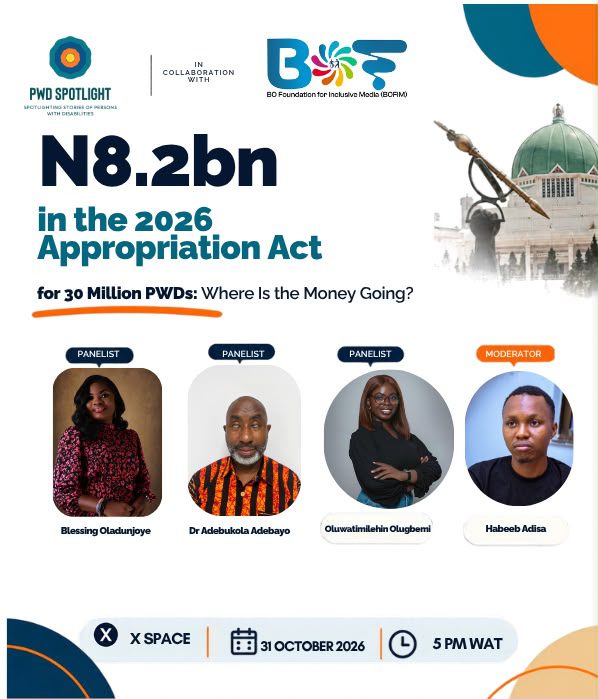
The stakeholders made the call during an X Space hosted by PWDSpotlight in collaboration with the BO Foundation for Inclusive Media (BOFIM), where they discussed Nigeria’s N8.2 billion disability-related allocation in the 2026 Appropriation Act.
Dr Adebukola Adebayo, a disability-inclusive development specialist and Founder of Inclusive Development Consults Ltd., said there was a significant disconnect between OPDs and government disability agencies, despite the role disability organisations played in advocating for the establishment of such agencies.
“There’s a huge disconnection between the two at state and national level. And if this is happening, how will disability commissions and agencies take into cognisance the actual needs of persons with disabilities, let alone put it in their budget and let alone implement the budget?” he asked.
Adebayo said the lack of consultation meant that some disability-related budgets were drawn up without adequate consideration of the needs of the people they were intended to serve.
He urged OPDs and government disability agencies to strengthen their engagement, particularly during budget consultations, to ensure that the concerns of persons with disabilities are reflected in government spending plans.
“We want to see more consultations between disability agencies and OPDs, so that actual needs and concerns of PWDs will get into budgets, and we won’t be seeing budgets that don’t meet the needs of persons with disabilities,” he said.
He also called on OPDs to hold disability agencies accountable and make deliberate efforts to contribute to budget formulation and monitoring, stressing the inadequacy of the N8.2 billion allocated for disability-related interventions in the 2026 federal budget.
Blessing Oladunjoye, the Executive Director of BO Foundation for Inclusive Media (BOFIM), said disability inclusion should not be treated as the responsibility of a single government agency because it cuts across diverse sectors such as education, health, transportation and infrastructure.
She noted that funding was needed not only for disability commissions but also for making existing public services and infrastructure accessible.
“It is also important that budgetary provisions address specific service and accessibility needs rather than serve as token allocations,” Oladunjoye added.
Oladunjoye also questioned the assumption that an approved allocation automatically translates into support for persons with disabilities, noting that the amount budgeted, the funds actually released and the amount eventually spent must be examined separately.
She urged journalists to scrutinise budget implementation reports, compare previous allocations with actual spending and investigate whether interventions have improved access to education, healthcare and accessible infrastructure.
Oluwatimilehin Olugbemi of BudgIT said government transparency should extend beyond publishing approved budget figures to providing information that allows citizens to follow the money and assess its impact.
“Government transparency should go beyond publishing the amount approved for a project because Nigerians should be able to follow the money, understand what it is intended to deliver, and establish whether the intended beneficiaries have received the expected support,” she said.
Olugbemi said government institutions should publish clear breakdowns of disability-related allocations, project descriptions, expected deliverables, fund releases, actual expenditure and procurement records.
She also highlighted the need for information about beneficiary selection, the number of people expected to benefit and the geographical distribution of interventions.
According to her, some budget items identify several beneficiary groups without indicating how much is specifically intended for persons with disabilities, making it difficult to establish the level of funding committed to disability inclusion.
Earlier in his opening remarks, Habeeb Adisa, Project Manager at PWDSpotlight, said the organisation reviewed the 2026 Appropriation Act and identified N8.2 billion in disability-related allocations. He said the discussion was intended to examine what the allocation meant for persons with disabilities, particularly as the country approached another election cycle.