

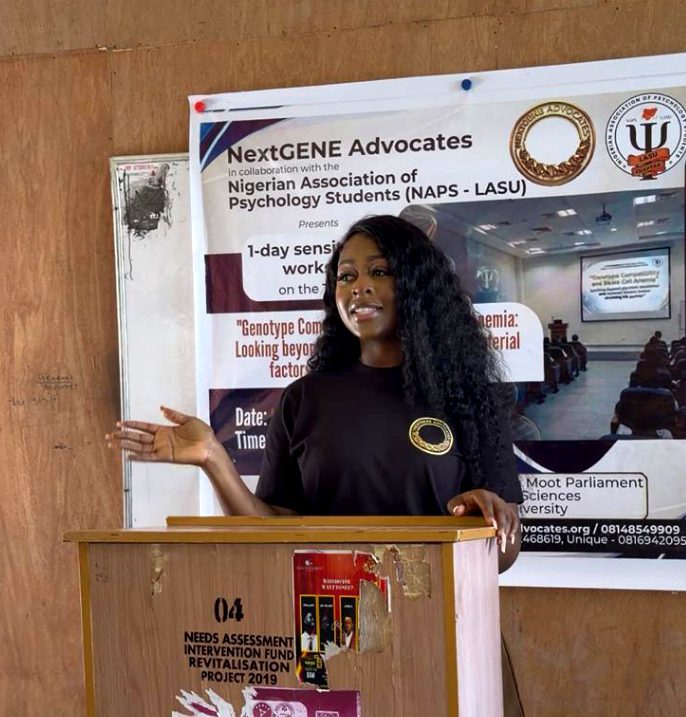
NextGENE Advocate, a Nigerian US-based non-governmental organization, has admonished the Nigerian youth to prioritise, among others, genotype compatibility before choosing their life partners.
The advice was given at a 1-day sensitization workshop organized by NextGENE Advocate, in collaboration with the National Association of Psychology Students (NAPS), LASU Chapter. The event was held Wednesday, May 20 at the faculty of Social Sciences of the Lagos State University (LASU), Ojo Campus, with the theme: “Genotype Compatibility and Sickle Cell Anemia: Looking beyond physical, emotional, and material factors before choosing life partner.”
In her remarks, the convener of the workshop and Founder of NextGENE Advocate, Miss Bisola Osundairo, said acting foolishly while in love and choosing wrongly matched genotype, would lead to far-reaching personal and social consequences.
“The stats are griming. The excruciating pains that sickle cell patients and survivors go through is heartbreaking. The cost of maintaining them is totally out of pocket. We can’t continue to act ignorantly,” Osundairo warned.
Stressing the emergency status of the subject matter, Osundairo noted that “It is high time we make informed decisions about choosing our life partners. Health status, genotype compatibility, among others, are priorities that we must not joke hence.”
According to World Health Organisation, Nigeria hosts the world’s largest and contributes roughly one-third of global annual Sickle Cell Disorder (SCD) births. 40-50 million Nigerians, about 1/7th of the entire population, carries sickle cell genes (AS trait). Roughly 4-6 million Nigerians currently living with SCD and about 150,000 Nigerian children, from the 7-8 million born annually, according to UNICEF, are birthed with SCD.
Statistics also show that in most African countries, including Nigeria, 50% to 90% of children born with SCD may die before age five, suggesting about 100,000 or more infant mortality annually in the country.
“This scary reality can be prevented with knowledge to aid informed decisions.Students and young adults must embrace the importance of premarital counselling, genotype screening, new born testing, and public healthcare awareness campaign as this one,” Mr. Tayo Sekoni, a Psychology Lecturer at LASU, told the listening students.
Miss Modupe Adedayo, President, NAPS-LASU, who was accompanied by the Speaker of the parliament of students group, Francis Abiola, said it was important for young people to look beyond the surface before considering a life partner.
“All that glitters are not gold. We must use the knowledge being passed here wisely and make informed decisions in choosing our life partners. We must not base everything off of social media frenzies. Life is much more complex than that,” she said,
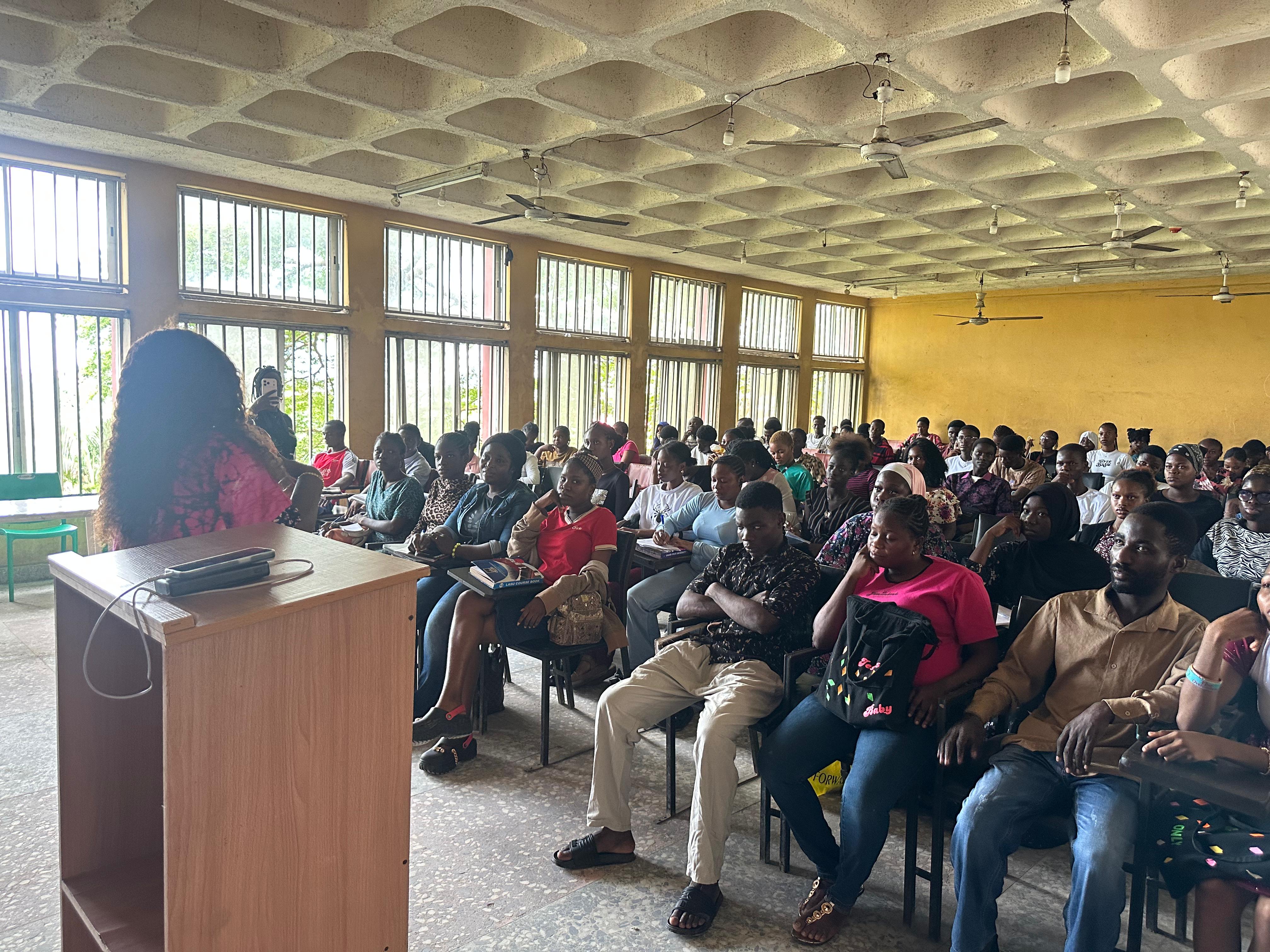 In their submissions, the duos of Dr. Precious Pelumi Dasaolu, the Founder of Your Pad Partner, who delivered the keynote address, and Miss Anabaraonye Oluchi Mercy, a sickle cell warrior, provided illuminating context and vivid visualization of the topic sentence.
In her lecture, Dasaolu defined Sickle Cell disease as an inherited blood disorder caused by abnormal hemoglobin called “sickle-shaped” cells.
According to her, the infected “sickle-shaped” cells does a lot of damages to the smooth operational activities of the entire body system by “blocking blood vessels, reduce oxygen supplies, damage organs, and causes body breakdown frequently and rapidly.”
The Medical Doctor stressed that often times, this situation leads to a dilemma for sickle cell patients and survivors, as they experience unbearable and recurrent pains all over their body, regardless of whether or not they have access to quality medical care. She said this pain is medically classified as Vaso-Occlusive Crises.
According to her, “the pain would trigger when the sickle cell becomes rigid and sticky due to the blockage of blood flow in their typical tiny vessel, thereby causing severe bone pain, chest pain, abdominal pain, joint pain, stroke risk, and organ damage.
“This is why the theme of this event – Genotype Compatibility and Sickle Cell Anemia: Looking beyond physical, emotional and material factors before choosing life partner” is apt and very important. We must realise our marital actions carry weighty consequences. For us and for our unborn children. This is why we must act right and take informed decisions,” Dasaolu pleaded with the students.
She explained that in all the classifications of blood groups and genotypes available, “AA genotype with positive Rhesus factor, is the only healthy and safer blood type that can cohabit and successfully produce healthy offspring without sickle cell disease.”
The workshop became emotionally sobering, when Miss Anabaraonye, took her turn, to share what she has been going through as a sickle cell carrier and survivor.
“Yes, I am a beautiful young lady. I have dreams and desires just like every one of you. But my condition – sickle cell disorder – has stripped me off the opportunity to live the kind of life I have wanted to live,” she started, sobbing quietly and fighting off balls of tears rolling down her cheeks.
She said everything was normal with her, as she had a memorable childhood, filled with parent love and care, until two years ago, well into adulthood, when the Vaso-Occlusive Crises begun.
“You would say I look beautiful, yes I know that, but If I open my body to you, you will all cry for me,” she exhaled.
According to her, the regular, compulsory and frequent injections she takes have damaged her skill tissues, have caused sourness and inflicting unhealed scars al over her delicate and tender skins.
“I have open wounds all over me,” she added, making the audience pay more attention.
She said her situation is a normal occurrence for every SCD carieer, particularly those with crises.
“This is because sickle cell patients have tiny and invisible veins. It is always difficult to locate it during injections. Yet, one must take injection multiple times to prevent serious crises.,” she noted.
Anabaraonye said she used to be a Caterer with busy schedules to cater for client, until her crisis started two years ago.
“In the last two years ago, my life has turned upside down. I have lost my business because I do not have the energy and health to cater for my clients anymore. I have also lost my relationship.
“Nobody is willing to marry me because SCD is quite expensive to manage. You have to visit the hospital every time, take injections, run tests, abstain from certain foods, drink certain water, always in a ventilated and airconditioned environment and in addition, providing emotional supports. No man seems to be willing to do this,” she added, forcing the listening students into emotional display.
END