
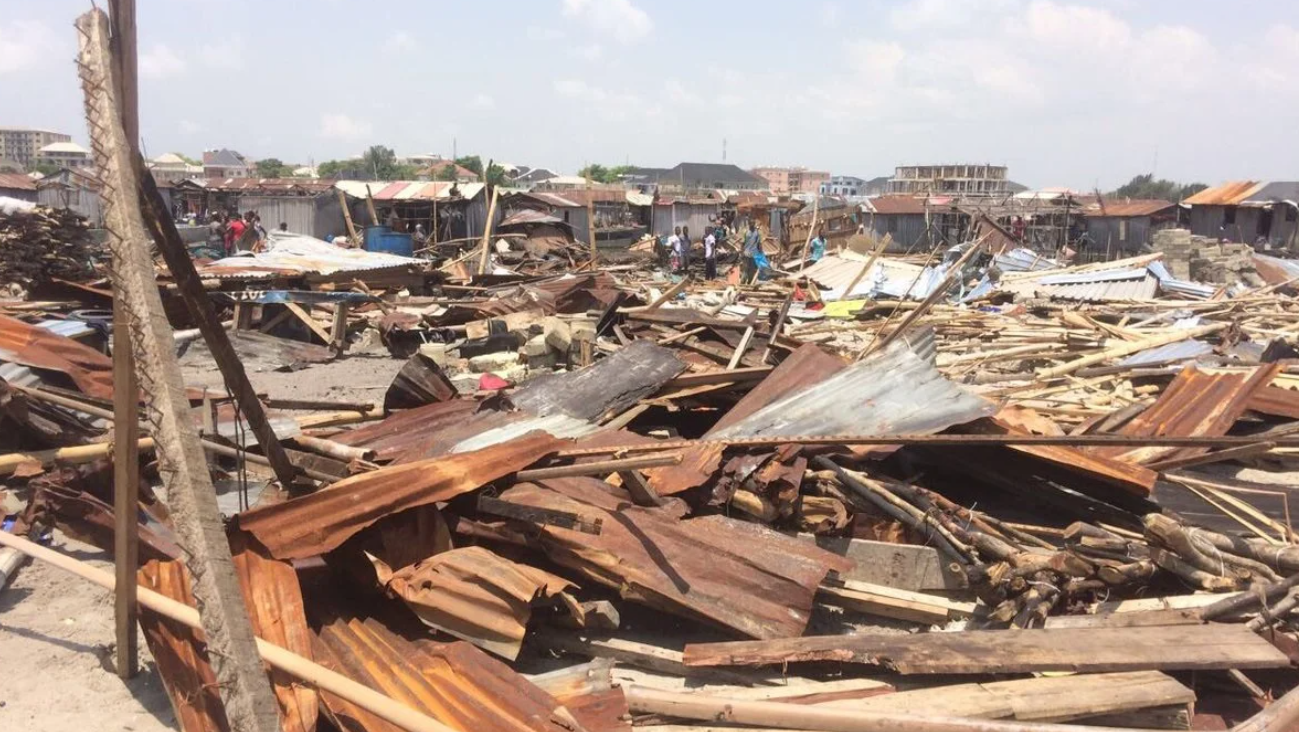
Civil society organizations have condemned the ongoing mass forced eviction by the Lagos State Government in Makoko, Oko Agbon, and Sogunro communities, which threatens to displace tens of thousands of residents.
The groups – Justice & Empowerment Initiatives, the Nigerian Slum/Informal Settlement Federation, Centre for Children’s Health, Education, Orientation and Protection, Lagos Urban Development Initiative, and Global Rights, in a joint statement said the demolitions violate subsisting court orders as well as Nigerian and international law.
The groups also described the forced eviction as heartless, taking place during the festive period and the worst economic crisis Nigeria has seen in decades.
The organizations said the demolition began two days before Christmas to clear a 30-meter setback from the high-tension powerline passing between the waterfront communities and the Third Mainland Bridge.
According to the groups, community leaders had received assurances from the Lagos State Government that only the 30-meter setback prescribed by the Building Control Regulations would be cleared, with some form of compensation for those affected.
The first phase of demolition continued until January 3, 2026 displacing thousands and leaving them with no option but crowding into other people’s homes or sleeping in open canoes.
However, on January 4, 2026, the demolition unexpectedly extended beyond the 30-meter setback prescribed by law, according to the statement.
Community members rose up in urgent protest from January 4 to 5, 2026, but were met on January 5 with a violent show of force by police officers protecting the demolition squad.
The organizations said massive amounts of teargas were released across the community and houses were set ablaze.
While this was ongoing, community leaders rushed to Alausa to meet with officials of the Lagos State Ministry of Physical Planning and Urban Development and were told the government would now be clearing an additional setback threatening up to 100 meters or more, despite such a large setback not being provided for in the law.
House numbering conducted by Makoko community youth with support from the Nigerian Slum/Informal Settlement Federation and Justice & Empowerment Initiatives in 2020-2021 put the entire population of the four villages of Makoko over 80,000, with tens of thousands more in the neighboring villages of Oko Agbon and Sogunro.
The groups warned that “with the uncertainty of the threat and knowing that the Lagos State Government has already broken prior promises, the numbers affected may exceed one hundred thousand if not urgently stopped”.
“Ordinary citizens are left without shelter to guard their belongings against looting, sexual assault, weather and mosquitos, while families are separated and children have no means to continue their schooling,” the groups added.
The ongoing forced eviction is part of the worst series of mass forced evictions witnessed since the military era, with hundreds of thousands evicted across Lagos communities since July 2023.
These include the forced eviction of Oworonshoki communities starting in July 2023, demolition of Orisunmibare in February 2024, Otto communities in March 2024, Oko Baba and parts of Aiyetoro communities in September 2024, Ilaje Otumara and Baba Ijora in March 2025, and massive evictions in Oworonshoki from September to December 2025.
The statement pointed out that while ancestral communities are razed, sandfilling for luxury real estate development by FBT Coral Estate Limited is ongoing between the high-tension powerline and Third Mainland Bridge.
This evidences continued collusion of the government with powerful land-owning families and private developers and total disregard for rule of law and persistent violation of court orders, according to the organizations.
The civil society groups called on the Lagos State Government and the Federal Government to immediately halt the demolitions ongoing at Makoko, Oko Agbon, and Sogunro before tens of thousands more join the ranks of people forced into homelessness and desperate poverty.
The statement was signed by Megan S. Chapman of Justice & Empowerment Initiatives; Jude Ojo, Bisola Akinmuyiwa and Kunnu Paul of the Nigerian Slum/Informal Settlement Federation; Betty Abah of CEE-HOPE; Olamide Udoma-Ejorh of Lagos Urban Development Initiative; and Abiodun Baiyewu of Global Rights.