
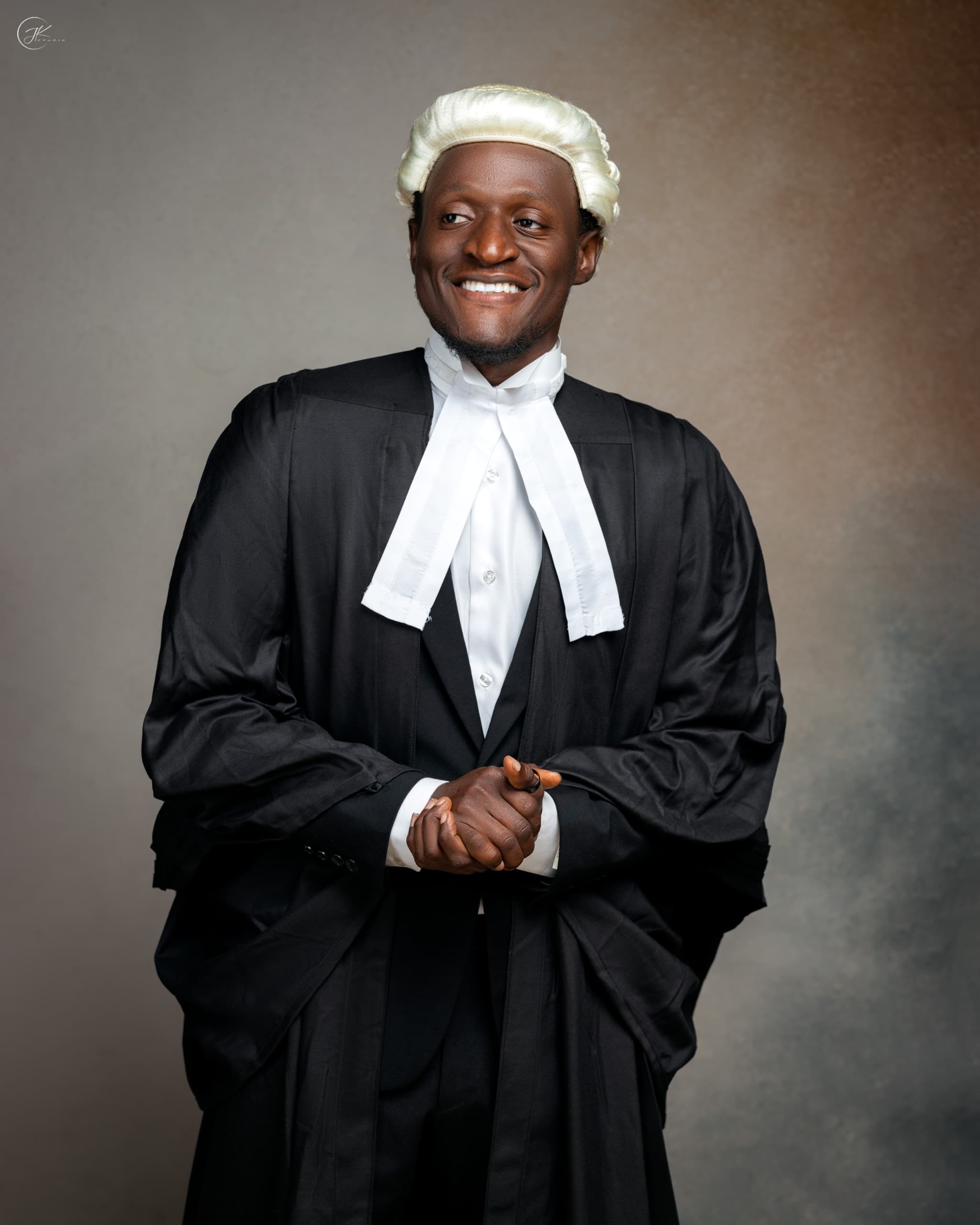
Welcome to the 30th edition of the DCS. Our guest is ‘a new wig to the Bar’ – Deaf lawyer, Nehemiah Danjuma. A couple of weeks ago, the Deaf community in Nigeria, and indeed, the nation’s social media space, was awash with celebrations and congratulatory messages when over 6000 new wigs were called to the Bar. As the only Deaf wig among the inductees, the 28-year-old caught the eye. Granted, Danjuma’s feat isn’t a first from a nationwide angle, but it is certainly one in a long time, besides being from Northern Nigerian. And this achievement becomes more significant being well and hard earned, plus providing a spur for an emerging army of Deaf wigs in coming years – in a country whose academic space is anything but conducive to winging Deaf dreams.
I first met Danjuma in 2022 during his undergrad days, then two years later while he wrote his final exams. Outgoing, personable – no airs. Fast forward to 2026, Danjuma is now a full-fledged lawyer, and the red carpet rolled out. Amidst all the glamour, yours sincerely convinced the young lawyer into a conversation of centring this journey of some 7+ years – warts and all.
We begin with a peek at his background.
Ten years old
I am Nehemiah Shanum Danjuma – I unofficially adopted the middle name “Shanum”, from my grandfather. My early years were in Samban Fathaik village, Jaba Local Government Area, Kaduna State. I grew up attending the village primary school, working at the farm and playing football. Deafness struck one night in 2009 with no prior illness. Then, I was ten years old. The diagnosis said meningitis; my hearing loss is profound.
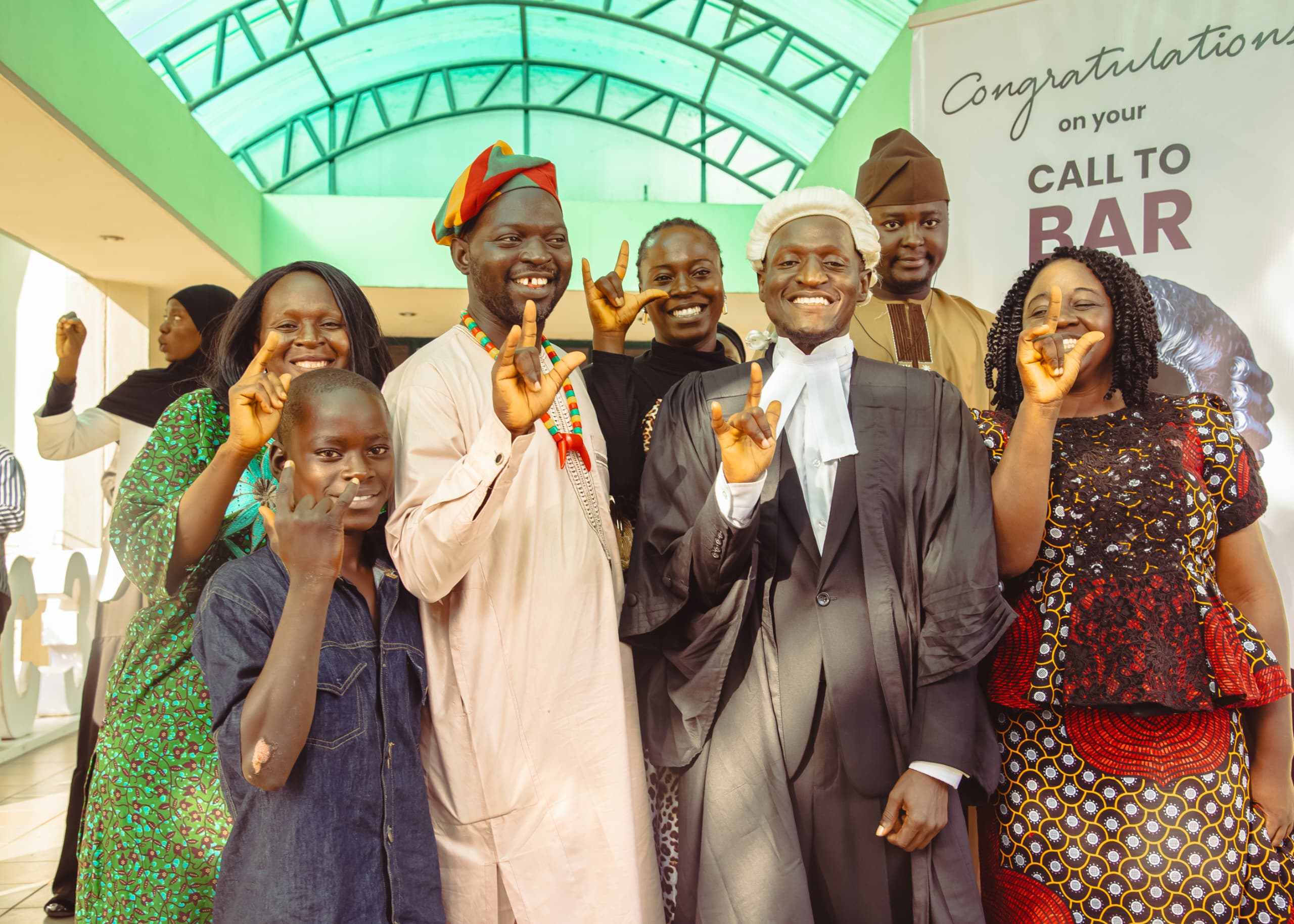
Danjuma looks back on his childhood with a special gratitude for family.
Family influence
My family has been very supportive throughout this entire journey. Starting when Deafness struck in 2009. I didn’t spend a long time at home like other deaf kids. That same year, I was enrolled in a Deaf School – Kaduna State Special Education School, where I learned sign language. From then on, my family has supported my education at every turn. My older brother, Theophilus, in particular, played a key role in my success. He’s one person who so much believes – encouraging, guiding and never doubting my seemingly crazy ideas and dreams! As a child, I drew inspiration from the famous black American neurosurgeon Ben Carson, whose books ‘Gifted Hands’ and ‘Think Big’ were my favourites.
‘YES’ – How it started
The year was 2015. Seventeen year old Nehemiah Danjuma was part of the Kennedy Lugar Youth Exchange and Study (YES) program – a high school exchange program in the United States. While there, he attended a YES workshop for students with disabilities, organised by Mobility International USA (MIUSA). Three things stood out for him at the workshop, namely – the role of law in guaranteeing social, civil, cultural and economic rights for persons with disabilities, the Americans with Disabilities Act (ADA), and the role of lawyers with disabilities and disability rights activists in advocating and using the law to protect and promote the rights of persons with disabilities. That was the first time he learned there were deaf lawyers.
Danjuma captures the soul of that moment thus:
“There are those rare moments in life when we get clarity about what we want to do with our lives, or to put it differently, discover our calling. That workshop was the moment for me. I found my calling. I was inspired to learn from prominent disability rights advocates like Susan Sygall and Judy Heumann. At the time, Nigeria didn’t have a disability law like the ADA, and I didn’t even know there were deaf lawyers.”
Months later, he would meet countryman Bunmi Aina, who is recorded as Nigeria and West Africa’s first Deaf lawyer. This meeting spelt stronger inspiration for young Danjuma. Back home, he set out on a degree in law, while joining in the push to have a Nigerian Disability Law like the ADA. Danjuma is now a lawyer and will be using that law to advocate for persons with disabilities.
The ‘becoming’ story – not a smooth ride
I ask Danjuma to share the cost of being a Deaf law student in a system that was not designed with Deaf people in mind – the barriers encountered and how he managed them. He remembers that:
‘It wasn’t a smooth ride. I first wrote UTME in 2017 and scored above the cut-off required to study law in my chosen university – University of Ilorin. Unfortunately, the school offered me Primary Education Studies (PES), instead. I rejected the offer and took a break from studying to rest. In 2018, I tried again, met the university’s admission requirements for a law program and was second time lucky. I began classes in January 2019, and it was quite a ride!
I do believe no dream is without some measures of hardwork, sheer determination and sacrifices. My entire journey was no different. We are seeing today a smiling face in a wig and gown. What they don’t see is the years of overnight reading, pushing through several semesters in university without an interpreter. They don’t see my initial seven weeks at the Nigerian law school without an Interpreter, the sheer determination, hard work and consistency to go through each phase of this ‘becoming’ story.
The support service arrangement at the University of Ilorin was limited to providing sign language interpreters for lectures. I encountered barriers to actively participating in extra-curricular activities. I went through the first half of law school without accessibility. I cannot put the sheer frustration of those initial seven weeks in words. I eventually got an Interpreter through an external partnership between Voice of Disability Initiative (VDI) and the Nigerian Law School.”
Were there times he questioned if he could make it through?
Give up? Never!
“There were moments of exhaustion and plain frustration, but giving up never crossed my mind. I take every challenge as part of the journey. I simply tell myself at every step of the way that it’s a matter of time and it will pass. That way, I enjoyed every bit of the journey itself, and not just focused on the destination. I have this mindset to enjoy and immerse myself fully in every experience. For me, every journey is an experience on its own and while waiting to get to the destination, I make the most of the journey.
One of his biggest regrets
But there’s one pain Danjuma says he can’t get away from.
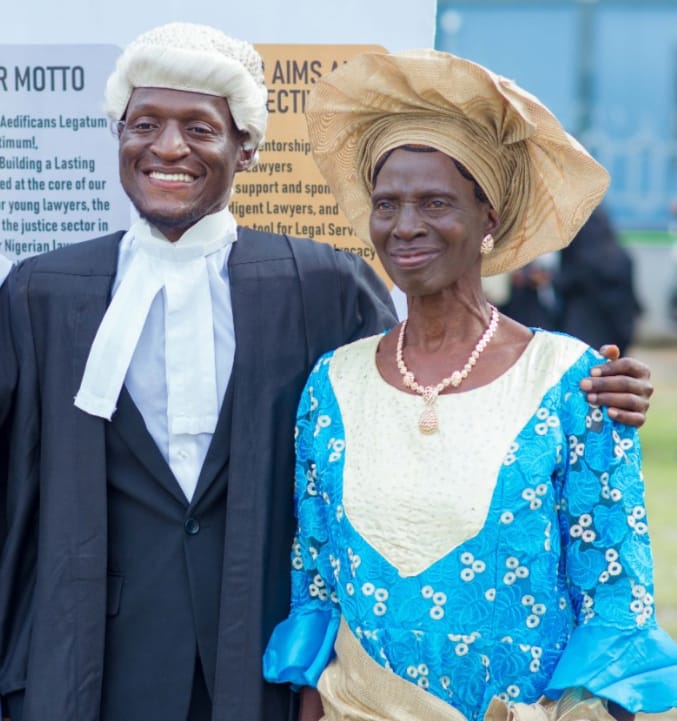
“Dad didn’t get to witness this milestone, and that’s one of my biggest regrets”
In his final year, the demands of academics kept him away from home for close to a year. His dad passed on during that period. You could feel the hurt in his remark:
“He didn’t get to shake my hand firmly and carefully inspect my LL.B. degree certificate like he would have done. That’s a quiet ache I carry in my heart.”
“Having a disability and doing well shouldn’t automatically be a source of inspiration”
Danjuma shares his perspectives when I point out how he now stands as inspiration for many in the Deaf community and beyond. I follow that observation with questions on how he views the ‘inspirational’ label and where he stands in the debate around calling people with disabilities ‘inspirational’, simply for doing things nondisabled people regularly do:
“I’m honoured to have my story considered a source of inspiration”, says Danjuma. “I don’t take that for granted. I think we all need a touch of inspiration every day, and I personally draw inspiration from people who have walked this path before me. Disability inspiration porn is indeed a thing. I think ignorance and stereotypes about the capabilities of persons with disabilities contribute to this. Yes, I believe if someone achieves something extraordinary, the achievement should be celebrated on its merits, and the challenges surmounted. This is to inspire others who may face similar challenges and to create awareness that could help future generations.”
So in my view, having a disability and doing well shouldn’t automatically be a source of inspiration.
Danjuma believes what constitutes ‘inspiring’ is a personal thing
“For me, what makes someone inspirational is their ability to influence other people along new ways of thinking, doing things, of seeing the world, and new dreams. In a way, an inspirational person makes me feel a certain kind of way that changes my perspective either about myself, my mindset, an issue, or a topic. The inspiration can be drawn from what they do, what they say and how they say it, or how they think.”
It is not always going to be exciting but.…
In a sober reflection on the journey, Danjuma acknowledges the encouragement, support and guidance received from individuals and organizations. And the young lawyer who now stands as a model to other Deaf students is determined to pay it forward. But he cautions:
“Pursuing a law degree and ultimately becoming a lawyer is a slow and long-term goal. It could take you anywhere from six to ten years. It is not always going to be exciting, but you can make the journey worthwhile
When I started this journey in 2018, I was the only Deaf law student in Nigeria. But as I complete this journey in 2026, there are currently four Deaf students in four different Nigerian universities pursuing their dreams of a degree in law. I have taken the initiative to create a group where we share ideas, support each other, share opportunities and have meaningful conversations around law and academics”
Danjuma says the impression he wants to leave with the upcoming Deaf person reading his story is; “know that your dreams are valid…and you will achieve it if you set you mind on it”
Will Danjuma be able to practise in Nigeria?
Curious about the judicial landscape in Nigeria and how inaccessible it is, I asked Danjuma if he would be able to practice in Nigeria.
He said, “if by ‘practice’ we mean litigation or courtroom advocacy, then yes, it’s on my bucket list. The Discrimination Against Persons with Disabilities (Prohibition) Act 2018 has not yet been tested in court. I intend to be involved in litigation that will secure judicial pronouncements on the Act and set precedents for generations to come.
“As for “how”; I will work with an interpreter. Not just any interpreter, but one who is versed in law and experienced in legal proceedings or law classrooms. I have worked with and trained some interpreters myself.”
Danjuma said in other jurisdictions like the US, there are dedicated courtroom sign language interpreters with specialised training. Nigeria’s sign language interpreting landscape hasn’t reached that level yet, but that is exactly why the work needs to start.”
He however considers himself to be fortunate because the bulk of legal practice is in writing. “If there is any indication of hope, it’s the fact that I excelled through university and law school despite the accessibility challenges. Beyond hope, I carry the capacity, skill, professional network, and courage to keep forging a path for myself and for my community in this career.”
Is disability a bad thing?
“No. Disability is not a bad thing. Disability is just a reflection of the complex layers of life and the diversities that come with it. However, disability can be challenging, expensive, and creates additional barriers and societal stereotypes which reflect a social order not designed with people with disabilities in mind.
I bring the conversation to a close by asking Danjuma to talk about the changes he wants to see in Nigeria’s legal education and justice system so the next Deaf law student doesn’t have to fight the same battles he fought.
He says he wants to see the Council of Legal Education and the Nigerian law school set up a dedicated disability support centre, equipped to provide supportive services for law students with disabilities in each of its campuses – sign language interpreters, accessible digital eBooks of the law school syllabus and other materials for blind students, mobility aids, among others. “Such a centre will ensure the streamlining of disability issues for efficiency,” he affirmed.
The DCS is a collaborative project with Madam Joy Bolarin, Executive Director, Jibore Impeccable Foundation, and anchored by Alexander Ogheneruemu (Disability writer)
Special acknowledgement to TOLA Foundation for backup support.