

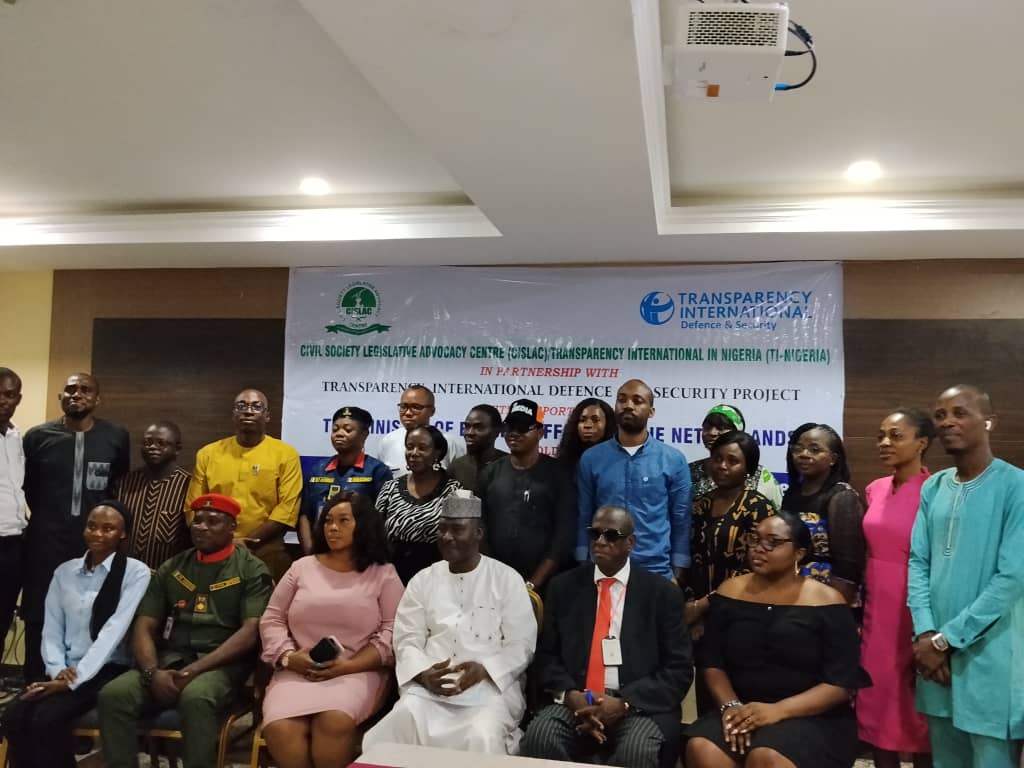
The Civil Society Legislative Advocacy Centre (CISLAC) and Transparency International Nigeria (TI-Nigeria), in collaboration with Transparency International’s Defence and Security Programme (TI-DSP), have emphasized the critical role of the media in exposing corruption and promoting accountability within Nigeria’s defence and security sector.
The call was made during a one-day workshop to enhance journalists’ investigative and reporting capacity.
Participants were drawn from across the media and civil society to discuss corruption in financial management, procurement, and operational activities within the security sector, while aiming to equip journalists with skills for evidence-based investigations and fact-driven reporting.
In his opening remarks, CISLAC’s Executive Director, Auwal Ibrahim Musa (Rafsanjani), decried the high level of mismanagement and lack of transparency in Nigeria’s security architecture.
He noted that poor oversight and corruption in defence spending have weakened the country’s ability to effectively address insecurity. “The issue of corruption and mismanagement in Nigeria’s security sector is a pressing concern,” he stated. “The diversion of resources meant for security personnel can have devastating consequences, including increased vulnerability to terrorist attacks and criminal activities.”
Auwal identified several potential focus areas for investigative journalists, including procurement processes and contract awards, recruitment and promotion practices, and financial management systems. According to him, “Partnering with international organizations like Transparency International Defence and Security, UK, can help address these challenges through shared learning and best practices.”
Auwal also referenced the November 11, 2025 incident involving the Minister of the Federal Capital Territory, Nyesom Wike, and a soldier, describing it as a reminder of the urgent need to protect the integrity and independence of security personnel.
“The incident has sparked widespread concern and outrage,” he said. “The behavior exhibited is unacceptable and reduces the integrity of public service. The call for the minister’s resignation is a reflection of the public’s demand for responsible governance.”
He stressed that to curb misconduct and abuse of power within the security sector, Nigeria must ensure accountability, promote discipline, and foster a culture of respect and civility among public officials and the armed forces.
“We must ensure that misconduct is punished, discipline is encouraged, and respect becomes the standard in our security institutions,” he added.
Jimoh Abubakar, CISLAC’s Programme Officer, delivered a presentation on Strengthening Investigative Journalism as a Tool for Promoting Accountability in the Defence and Security Sector. He highlighted the need for budget transparency within the security establishment. “In many countries, a significant portion of the defence budget is open to public scrutiny,” he explained. “While some information may be classified due to security concerns, the publicly available portion should be transparent and accessible.”
Abubakar noted that although Nigeria’s security sector operates under strict secrecy rules, it is crucial to strike a balance between confidentiality and transparency. “International standards dictate that certain information should be made available for public scrutiny, and Nigeria should adhere to these standards,” he emphasized.
In his session, Ahmed Rufai, a lawyer and human rights advocate, presented a paper on Human Rights Violations and Civilian Protection in Counterinsurgency Operations.
He discussed the vital role of the media in uncovering human rights abuses and ensuring the protection of civilians. Rufai stated that “journalists are vital stakeholders in the promotion, protection, and enforcement of human rights within Nigeria’s counterinsurgency operations,’ urging them to continue holding power to account while upholding professional ethics.