
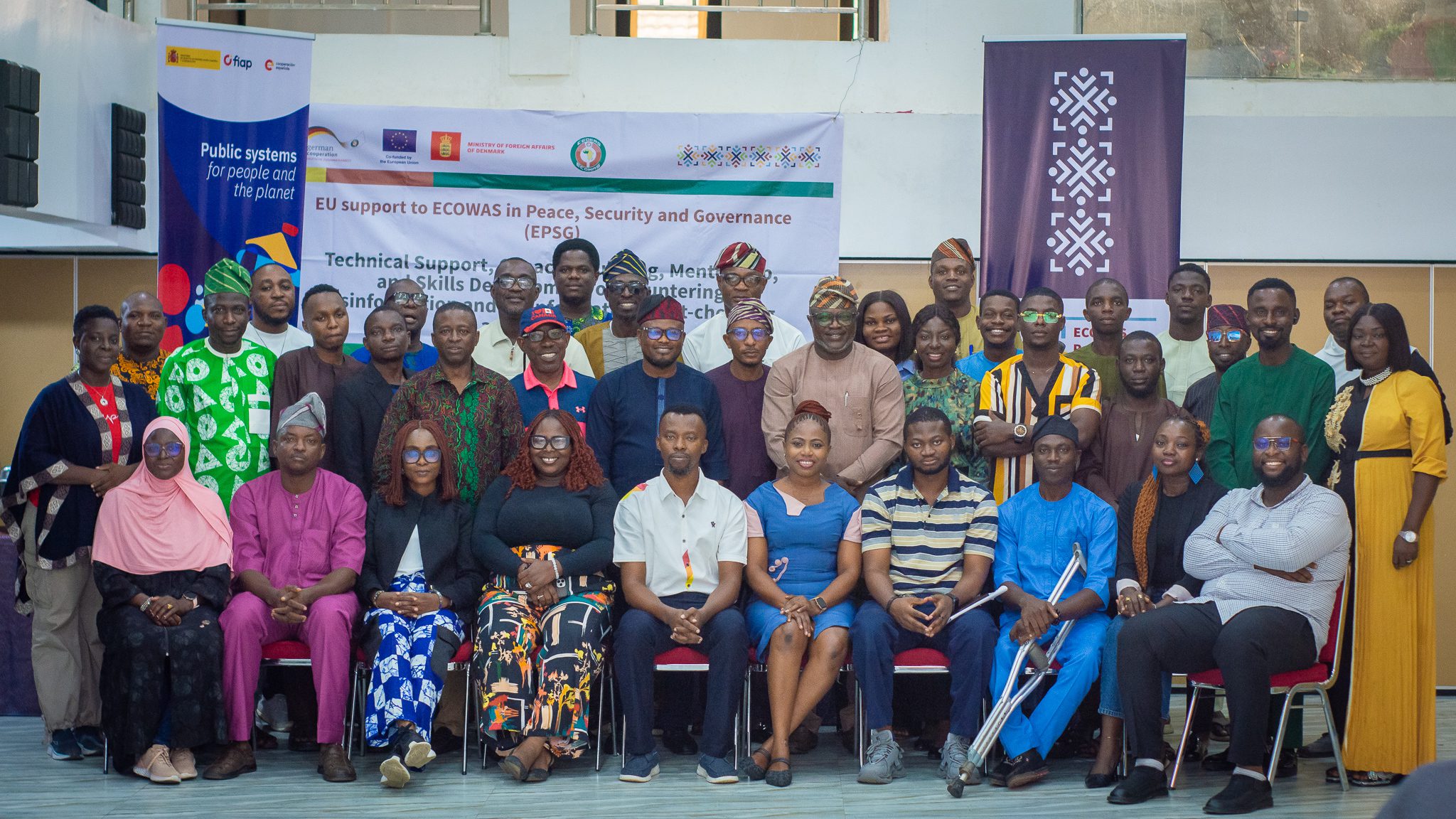
As the Nigerian 2027 general elections draw near, media practitioners, civil society organisations (CSOs), and factcheckers across the South East and South West regions of the country have been empowered with the skills to address the growing threat of electoral misinformation against vulnerable groups.
Tackling misinformation targeted at vulnerable groups, such as women voters and candidates, persons with disabilities and young people, who are at risk of electoral misinformation, was one of the objectives of the three-day regional workshop held in Lagos.
Organised by FactCheck Africa in collaboration with Fundación para la Internacionalización de las Administraciones Públicas (FIAP) under the EU Support to ECOWAS in Peace, Security and Governance (EPSG) Project, the workshop equipped participants with practical skills, toolkits and resources to factcheck and counter misinformation.
While delivering his welcome remarks at the workshop, Joseph Osuigwe, Technical Advisor, Mass Media and Civil Society at FIAP, explained that Nigeria is operating in an era where information flows faster than ever before, creating fertile ground for misinformation and manipulation.
“We are in a phase where information has become a powerful tool, but also a fertile ground for misinformation. A well-informed society is a well-armed society for democracy,” he said.
Osuigwe stressed that the media and civil society have a critical responsibility in shaping public understanding ahead of elections.
According to him, the project is providing technical support to media organisations and CSOs to strengthen ongoing initiatives on democratic and peaceful elections, promote public dialogue, and ensure that all stakeholders are equipped to respond effectively to false narratives.
“Everyone is a stakeholder in the election process. The actions we take now to improve information integrity will determine how peaceful and credible the electoral process becomes,” he added.
Mustapha Lawal, Researcher at FactCheck Africa, while explaining the objectives of the workshop, said, “the training aims to strengthen the technical, editorial and coordination capacity of Nigerian media and civil society organisations to produce, verify, and disseminate reliable information that supports democratic and peaceful elections.”
Lawal explained that the workshop was necessary because vulnerable groups are at greatest risk of electoral misinformation.
“Women voters and candidates face targeted online abuse; young people are both primary targets and primary amplifiers of digital falsehoods. Journalists operating in conflict-affected areas face compounded safety risks,” he added.
The workshop sessions were delivered by media experts and fact checkers such as Tonye Bakare, AFP Nigeria Correspondent (Lagos); Mustapha Lawal of FactCheck Africa; Lekan Otufodunrin, Executive Director of Media Career Development Network; Hannah Ajakaiye, Founding Editor, Facts Matter; and Kabir Adejumo, Researcher, Good Governance Africa.
Participants at the workshop acknowledged the training as rigorous and intense, which has provided them with the right skills to counter misinformation and disinformation, especially ahead of the 2027 general elections.
Participants were encouraged to embrace the campaign message, #CheckBeforeYouPost, as a practical response to the growing threat of election-related misinformation.