
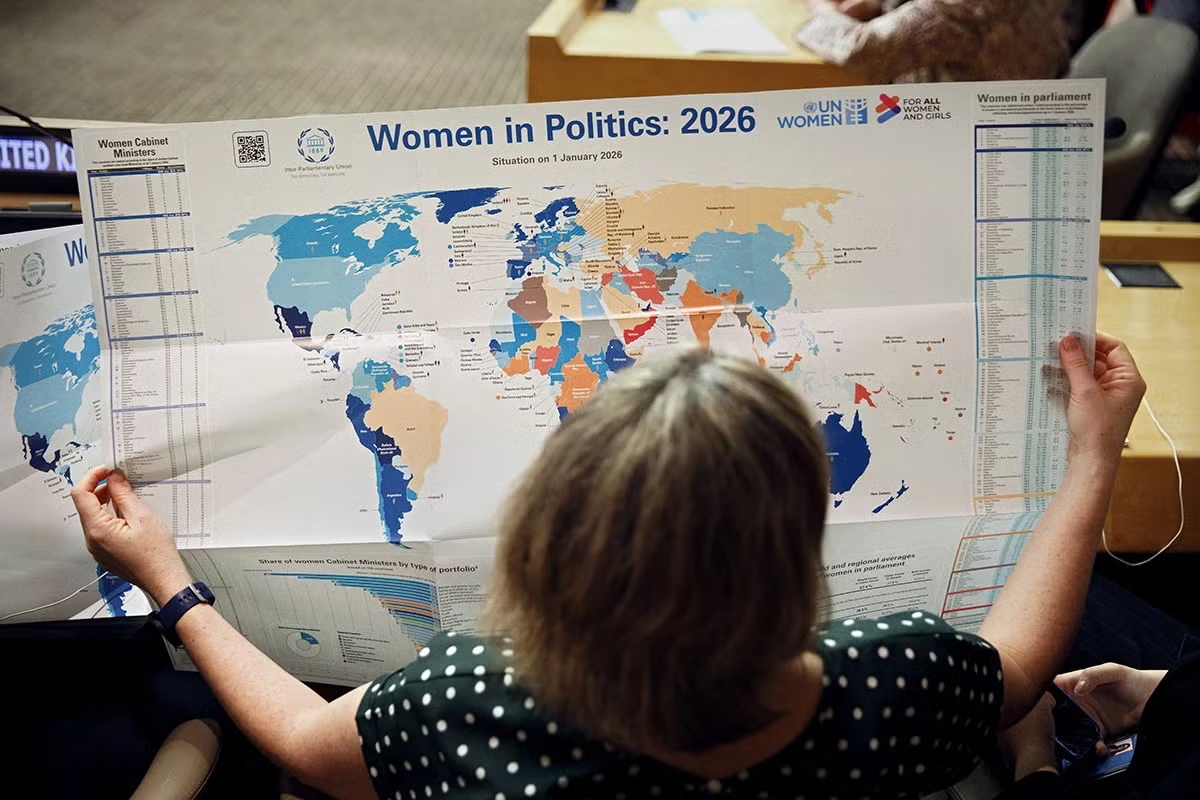
Gender equality will remain 171 years away at the current pace of progress, while institutions responsible for advancing women’s rights are losing political power, funding and influence, according to a new report by UN Women and the United Nations Department of Economic and Social Affairs (UN DESA).
The report revealed that women remain significantly underrepresented in political and economic decision-making as weakened gender-equality institutions and declining funding threaten decades of progress.
The Gender Snapshot 2026, released on September 18, 2026, warns that the global retreat from gender equality is measurable across institutions, political systems and economic decision-making, with progress towards the 2030 Sustainable Development Goals increasingly at risk.
The report found that one in three institutional mechanisms for gender equality has experienced a loss of institutional power over the past two years. About one in four have had their operating budgets cut, while nearly one in 10 have lost control over their budgets altogether.
Funding for gender equality has also fallen to its lowest level since 2021, with women’s rights organisations among those most affected. At the same time, 42 per cent of UN entities reported that their gender-equality efforts had weakened amid funding cuts.
Women remain excluded from key centres of power
The weakening of gender-equality institutions is occurring alongside persistent disparities in who holds political power.
Six in seven countries are led by men, while women continue to face financial, institutional and social barriers to entering political office.
In some countries, the cost of running for office can exceed 100 times the average per-capita income, creating a significant barrier to political participation. Women who do enter public life also face violence. The report found that in some countries, as many as eight in 10 women running for office experience violence in public life.
Even when women reach senior government positions, they remain underrepresented in portfolios with significant control over national security and economic policy.
Nearly nine in 10 defence ministers and more than eight in 10 finance ministers globally are men.
The imbalance extends beyond government. Women hold only six per cent of corporate chief executive officer positions globally and lead fewer than 20 per cent of the highest courts.
These figures leave major decisions affecting economies, law, employment, peace and security disproportionately in the hands of men.
No SDG 5 indicator on track
The report also warns that progress made over decades through political and legal reforms is increasingly being contested, with some gains being stalled or reversed.
None of the indicators under Sustainable Development Goal 5 (SDG 5), which focuses on gender equality and the empowerment of women and girls, is currently on track to be achieved by 2030.
“The evidence is clear: when women lead, societies are stronger, economies are more resilient and outcomes are better for everyone,” said Sima Bahous, Executive Director of UN Women.
Bahous said women’s equal access to decision-making power is essential to achieving meaningful gender equality.
“Equality cannot be achieved without equal access to power,” she said.
Li Junhua, United Nations Under-Secretary-General for Economic and Social Affairs, said the 171-year projection should not be treated as inevitable.
“The data leave no room for ambiguity: at current rates gender equality remains 171 years away,” Junhua said.
He described the gap as the outcome of choices reflected in data and called for greater investment in gender equality, institutions and statistical systems capable of tracking progress and holding decision-makers accountable.
A test for global leadership
The findings come as world leaders gather for the 81st Session of the United Nations General Assembly and as the UN moves towards selecting its tenth Secretary-General.
The position has never been held by a woman in the organisation’s 80-year history.
Against this backdrop, UN Women and UN DESA are calling for a reversal of what they describe as the political retreat on gender equality.
The organisations are urging governments to strengthen women’s participation in political and economic decision-making, adequately fund gender-equality institutions, protect women’s rights organisations and civic space, and ensure women have a meaningful role in decisions concerning economies, peace and security, technology and public life.
“Take measures to achieve inclusive participation by enabling women and girls from the most marginalized groups, including Indigenous women and girls, those from other ethnic minorities and women and girls with disabilities, to exercise leadership across all forms of decision-making.
“Extend gender-responsive budgeting and put comprehensive systems in place to track progress and impacts. Expand the adoption and effective implementation of permanent or temporary special measures, including legislated quotas targeting parity, with strong implementation mechanisms in elected offices, public service, the judiciary and corporate decision-making,” UN women advised.
The Gender Snapshot 2026 is based on more than 100 data sources and tracks progress for women and girls across all 17 Sustainable Development Goals.