
A coalition of national and international human rights, environmental, and social justice organisations has accused the Lagos State Government of carrying out what it described as “systemic, illegal, and cruel” forced evictions across waterfront and low-income communities, including Makoko, Oworonshoki, Ilaje-Otumara, Owode Onirin, and Baba Ijora.
In a joint statement released on Tuesday, the coalition said thousands of residents had been displaced through demolitions allegedly carried out without adequate notice, consultation, compensation, or resettlement plans.
They accused the state government of clearing valuable land for elite and private developments at the expense of the urban poor.
“What is unfolding in these waterfront and informal settlements is not urban renewal as claimed by the state; it is state-created homelessness, engineered through brute force and justified with shifting narratives.
“These demolitions overwhelmingly target the poor—fishermen and women, traders, women, children, the elderly, and persons with disabilities—who have neither the political power nor the economic means to resist,” the coalition said.
The groups noted that by destroying homes without alternatives, the state government has plunged thousands into acute humanitarian distress, exposing families to hunger, disease, illiteracy, violence, and death.
History of demolitions
According to the statement, the recent demolitions are part of a long-running pattern. The groups recalled the 2016–2017 evictions at Otodo Gbame, where more than 30,000 residents were displaced despite subsisting court orders. They also cited demolitions in Oworonshoki in 2023, Orisunmibare in February 2024, Otto in March 2024, and Oko Baba in September 2024.
In March 2025, demolition teams reportedly moved into Ilaje-Otumara and Baba Ijora, leaving over 10,000 people homeless. Residents were said to have fled as bulldozers razed homes, shops, and places of worship, with many losing their livelihoods and access to food.
Oworonshoki night demolitions
The coalition accused the administration of Governor Babajide Sanwo-Olu of carrying out unlawful demolitions in Oworonshoki, including an operation in October 2025 that allegedly took place late at night.
They claimed that officials of the Lagos State Government Task Force, the Ministry of Physical Planning and Urban Development, and the Lagos State Building Control Agency (LASBCA), accompanied by armed security operatives, demolished hundreds of homes from about 10 p.m., firing tear gas and injuring residents.
The groups said the demolitions proceeded despite an interim injunction secured on October 23, 2025, by human rights lawyer Femi Falana (SAN), restraining the state government and its agencies from further action in the community. They alleged that more than 10,000 people were displaced as a result.
Makoko demolitions
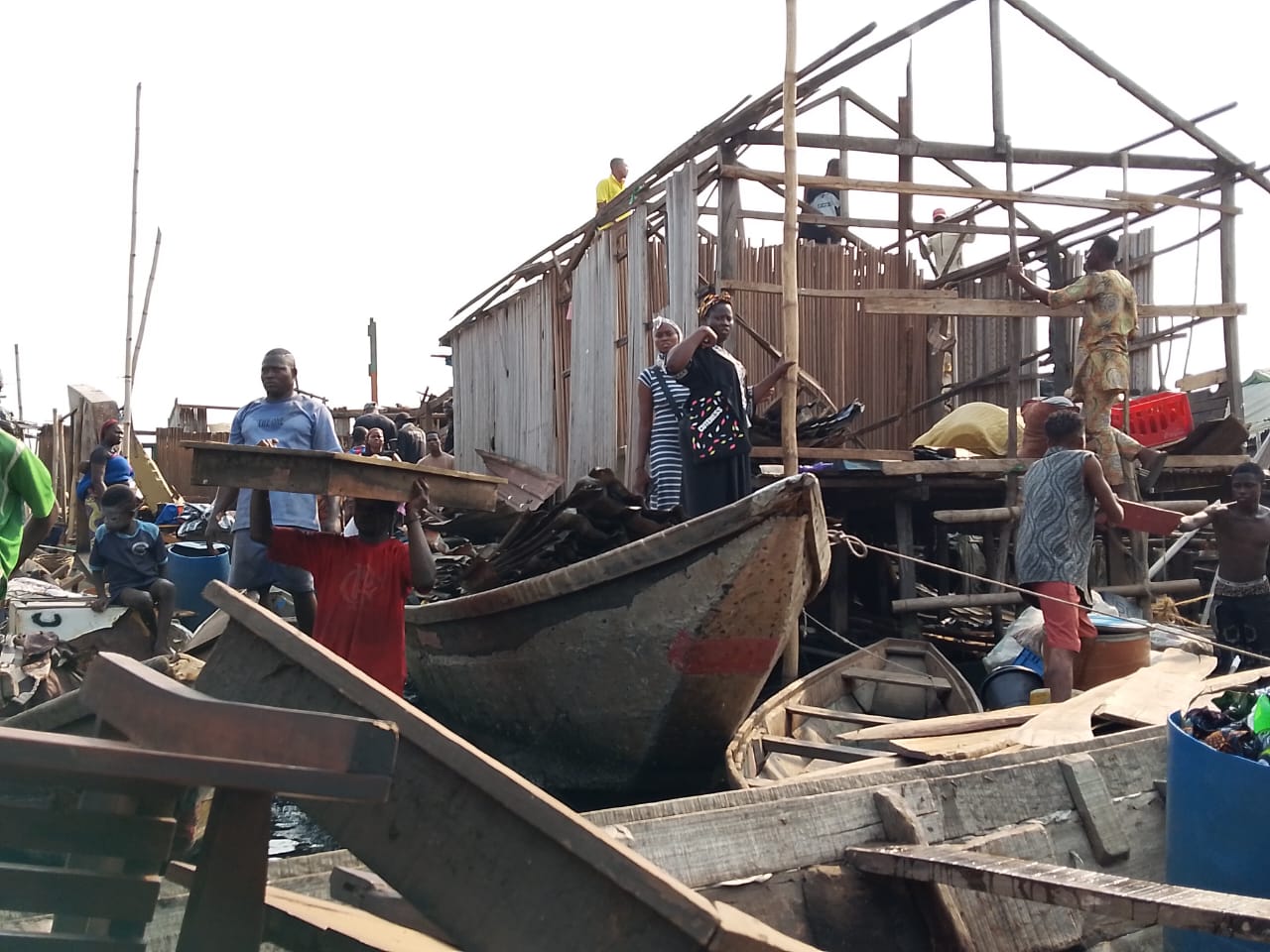
In Makoko, a historic waterfront settlement estimated to house over 100,000 people, the groups said demolitions began on December 23, 2025, displacing more than 10,000 residents and destroying over 3,000 homes.
They alleged that demolition teams, security personnel, and armed thugs repeatedly invaded the community, with some homes reportedly set ablaze while occupants were still inside. Tear gas was said to have been fired at women, children, and elderly residents.
The coalition claimed that about 12 people, including two infants, have died so far, naming a 70-year-old woman, Albertine Ojadikluno, and a five-day-old baby, Epiphany Kpenassou Adingban, among the reported casualties. Schools, clinics, and places of worship were also said to have been destroyed, forcing displaced families to sleep in boats, churches, school buildings, or in the open.
The Lagos State Government has maintained that eviction notices were issued years earlier, particularly for buildings under or near high-tension power lines. However, the groups argued that demolitions extended far beyond legally required safety setbacks, accusing the government of using safety concerns as a pretext for land acquisition.
Allegations of neglect and contempt of court
The organisations also accused the state government of weaponising decades of neglect to justify demolitions. They said communities now labelled as environmental hazards had long been denied basic infrastructure such as sanitation, potable water, healthcare, quality schools, and waste management.
They further accused the government of contempt of court, citing a 2017 Lagos High Court ruling that forced evictions without consultation violate the constitutional right to dignity. They also referenced an August 2025 judgment by Justice F.N. Ogazi of the Federal High Court in Ikoyi, which restrained the state and its agencies from demolitions in Makoko and other waterfront communities.
That judgment reportedly awarded ₦3.5 billion in damages against the Lagos State Government and the Nigeria Police Force for previous demolitions and the unlawful killing of a community leader. The coalition said the damages remain unpaid.
World Bank slum upgrade project
The statement also revisited the Lagos Metropolitan Development and Governance Project, a $200 million World Bank–financed initiative launched in 2006 to upgrade nine informal settlements, including Makoko.
According to the groups, a 2014 investigation found minimal impact in Makoko, and the World Bank later rated the project’s implementation as unsatisfactory. They noted that World Bank policy discourages displacement during slum upgrades, yet demolitions resumed shortly after the project ended.
Demands
The coalition issued a list of demands, including an immediate halt to demolitions, compliance with court orders, provision of emergency shelter, compensation for demolished properties and livelihoods, and a transparent, community-led resettlement plan. They also called for a public apology from Governor Sanwo-Olu and accountability for alleged abuses by state agents.
“Lagos cannot claim global-city status while treating its poorest residents as disposable,” the statement said, warning that development driven by displacement and violence is neither just nor sustainable.
The statement was signed by community leaders, activists, and civil society representatives, including Israel Idowu of the Makoko Waterfront Community, Betty Abah of CEEHOPE, Zikora Ibeh of CAPPA, and Hassan Taiwo Soweto of the #EndBadGovernance Movement.
As of the time of filing this report, the Lagos State Government had not issued an official response to the allegations.