
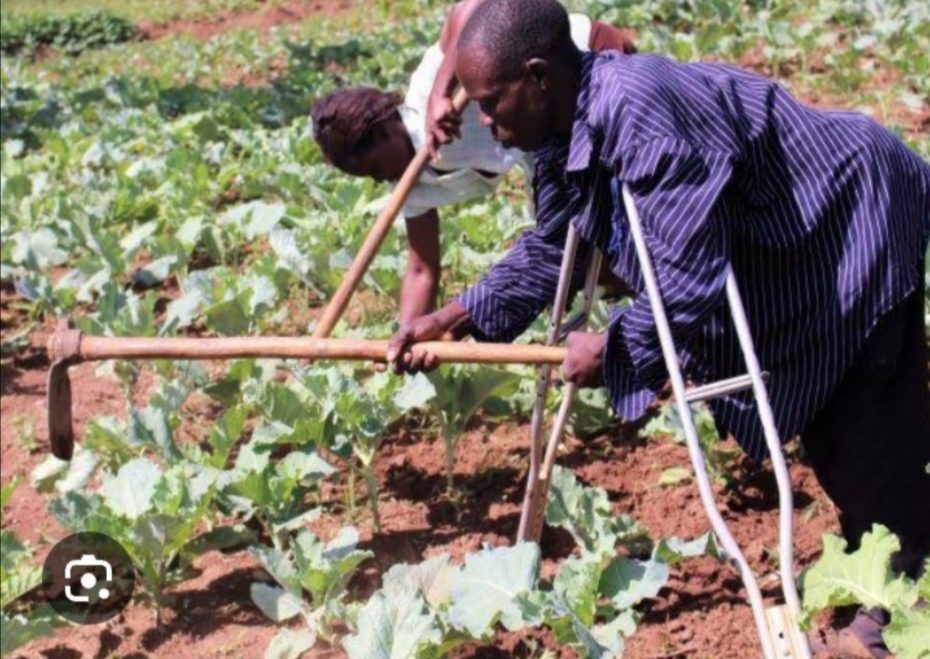
Oluwafemi Idowu Stephen stood inside his small poultry pen in Osogbo, counting with his hands what he could no longer count with his eyes. Several birds lay dead. Others were weak. He had not noticed the faulty drinker overnight, a simple tool that could have been replaced or mechanised if support had existed.
“I lost them because I couldn’t fix them in time; if I had proper equipment, this wouldn’t have happened,” he said
Stephen is blind. He farms poultry without adaptive tools, automated feeders, or safety equipment. Everything is done manually, by touch, memory, and guesswork.
“For someone like me, tools are not a convenience, they are survival,” he said. “When something goes wrong, it goes wrong very fast.”
He said losses like this are common but rarely discussed. Without mechanised support, routine tasks become dangerous, and small problems quickly turn into financial setbacks.
“One loss can wipe out months of work,” he said. “And nobody comes to ask how you will recover.”
Despite government promises of inclusion through programmes such as the Gender Equity and Social Inclusion (GESI) framework, Stephen said he has never received any agricultural support.
“They say persons with disabilities are included,” he added. “But when you are losing your livelihood because you have no tools, you realise those words are only on paper.”
Over ₦881 million remains unspent in Osun’s GESI budget for women, youth, and PWD farmers, as promises fail to translate into impact.
In 2024, the Osun State Government adopted the Gender Equity and Social Inclusion (GESI) framework, a policy tool designed to ensure that public spending deliberately reaches vulnerable groups across sectors, including agriculture.
The framework aligns with Nigeria’s broader commitments to inclusive development and the Sustainable Development Goals (SDGs), particularly SDG 1 (No Poverty), SDG 2 (Zero Hunger), SDG 5 (Gender Equality), and SDG 10 (Reduced Inequalities).
In its 2024 Citizens’ Budget, the Osun State Government reported that it earmarked ₦2.46 billion for GESI-related interventions across ministries and agencies.
Following a downward revision during the budget cycle, the final approved GESI allocation stood at ₦1.34 billion.
However, official budget performance documents show that implementation fell significantly short of this commitment.
According to the 2024 Osun State Budget Performance Report (Q4), only ₦462.8 million was eventually spent on GESI-linked programmes, representing 34.4 percent of the budget, while ₦881.6 million remained unutilised at the end of the fiscal year.
This shortfall is particularly concerning given the scale of agricultural interventions explicitly tied to GESI in the budget.
The Citizens’ Budget lists several agriculture-focused projects meant to benefit women, youth, and PWD farmers, including the procurement of tractors with implements, irrigation equipment such as rain-gun systems, fish-rearing empowerment kits, pasture and fodder production, and distribution of cocoa and oil-palm seedlings through agencies such as the Osun Agricultural Development Programme (OSSADEP)
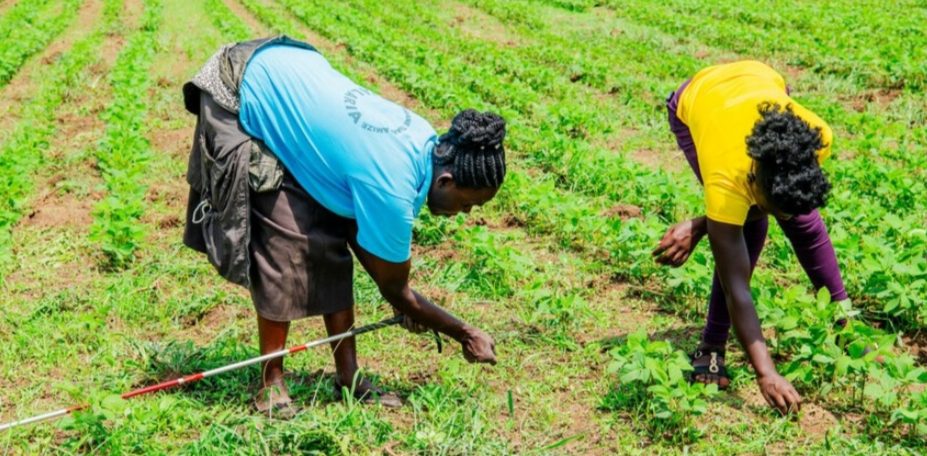
Despite these provisions, broader assessments of Osun’s 2024 budget implementation indicate that agriculture and social inclusion programmes were poorly executed.
A budget tracking report published in mid-2024 noted that releases to the agriculture sector were significantly lower than projections, raising early concerns about the state’s capacity to translate budgetary promises into tangible outcomes.
The implications of this underperformance are amplified by national data on agriculture and vulnerability. The National Bureau of Statistics (NBS) reports that agriculture employs over 70 percent of Nigeria’s rural population, with women accounting for nearly half of the agricultural labour force.
However, women farmers consistently record lower productivity due to limited access to land, mechanisation, and inputs, a gap that inclusive budgeting frameworks like GESI are meant to address.
Similarly, global development institutions have repeatedly stressed that targeted investment in vulnerable farmers improves productivity, income, and food security. The Food and Agriculture Organization (FAO) identifies access to tools, inputs, and inclusive extension services as critical to improving outcomes for women and marginalised farmers.
Against this backdrop, the failure to fully utilise over ₦881 million earmarked for inclusion raises fundamental questions about accountability. The absence of publicly available procurement records, distribution registers, and implementation reports makes it difficult to trace how the funds spent under GESI were applied, which locations benefited, and whether women, youth, and PWD farmers were reached at all.
Over 40 Million Households Depend on Farming, But Aid Remains Elusive
Nigeria’s rural economy. According to the National Bureau of Statistics (NBS), over 25 million Nigerians are employed in agriculture, accounting for roughly 30 percent of the national workforce.
More than 40 million households across the country engage in farming, making it the primary livelihood for most rural communities.
Globally, smallholder farmers like those in Osun constitute around 84 percent of farms, yet they operate on tiny plots and face severe constraints, producing about 35 percent of the world’s food despite limited resources (ScienceDirect, 2026) Studies show that access to mechanised tools, inputs, and targeted support can double or even triple productivity, particularly for women and youth farmers.
At over 60 years old, Iyabo Owolabi farms not because she still has the strength, but because she has no alternative. A resident of Okoende town who cultivates land in Igbajo village, she survives entirely on what she produces: palm oil, cassava flour, cocoa, and, when conditions allow, small plots of pepper.
Every stage of the work, harvesting, processing, drying, and packaging, is done manually.
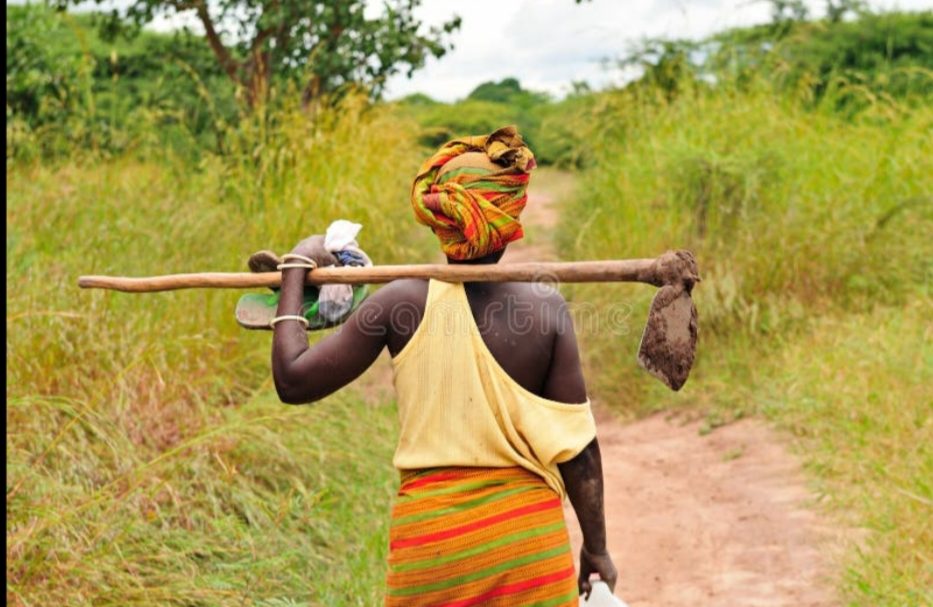
“There is no resting,” she said. “If I rest, there will be no food. If there is no food, how will I survive?”
For decades, Owolabi has depended on agriculture as her sole means of livelihood. Age, however, has transformed routine farm work into a daily struggle.
Tasks she once handled with ease now take longer and leave her exhausted. Processing cassava into flour requires hours of pounding and drying.
Palm oil production involves heavy lifting and prolonged standing. Cocoa farming demands strength she admits she no longer has.
“As my body is getting weaker, the work is getting harder,” she said. “But nothing has changed to help us.”
“They talk about women farmers on the radio and television, but nobody has ever come here.”
“We are still using our hands, and our hands are failing us.”
Despite being exactly the kind of farmer government policies claim to prioritize, an older woman, a smallholder producer, and a rural food processor, Owolabi says she has never received any form of agricultural support from the government. No machines. No seedlings. No processing equipment. No labour-saving tools.
Youths Say They Are Empty Promises
Olaide Olayiwola, 29, from Ada town, farms pepper in large quantities and produces cassava, but says government support promised to youths has never reached him.
“They told us agriculture is for youths and that we will be supported. We vote every election, but after voting, nothing comes to us.”
Olayiwola said he relies entirely on personal funds to run his farm, adding that the absence of inputs and support has stalled his plans to expand production, despite budgetary provisions meant to empower young farmers.
Oladipupo Oladapo, 39, from Igbajo Town, grows pepper in large quantities and produces cassava, relying almost entirely on his own resources.
“I went into farming hoping it would be a way to build my future,” he said. “They always talk about youth empowerment, about giving us tools and support. But for me, it is all words. Nothing has reached my farm, and I still have to pay for everything myself.”
Oladapo said the constant promises during elections leave him frustrated. “Before elections, they come here and say we will get help, that the youths will benefit. We vote, we trust, but after the campaign is over, you are left to struggle alone. It is like the government only remembers us when they want votes.”
He added that the lack of support affects both his productivity and income. “I could produce more, expand my farm, and even hire more people, but without tools or assistance, it is impossible. We are working hard, but the system keeps leaving us behind.”
Inclusion on Paper, Neglect on the Ground: Farmers See No Government Support
In Joriki, Igbajo village, Lekan Olawuyi, a farmer in his mid-50s, works the land with a leg fractured years ago and never properly healed. What his body can no longer do, money must. Every planting season, he hires labourers to handle the heavy work.
“If I don’t pay people to help me, there will be no farm,” he said. “And if there is no farm, I won’t eat.”
He said the cost of hired labour consumes most of his income. Yet, despite being a person with disability (PWD), a group of government programmes claim to prioritise, Olawuyi says he has never benefited from any agricultural support from either the state or federal government.
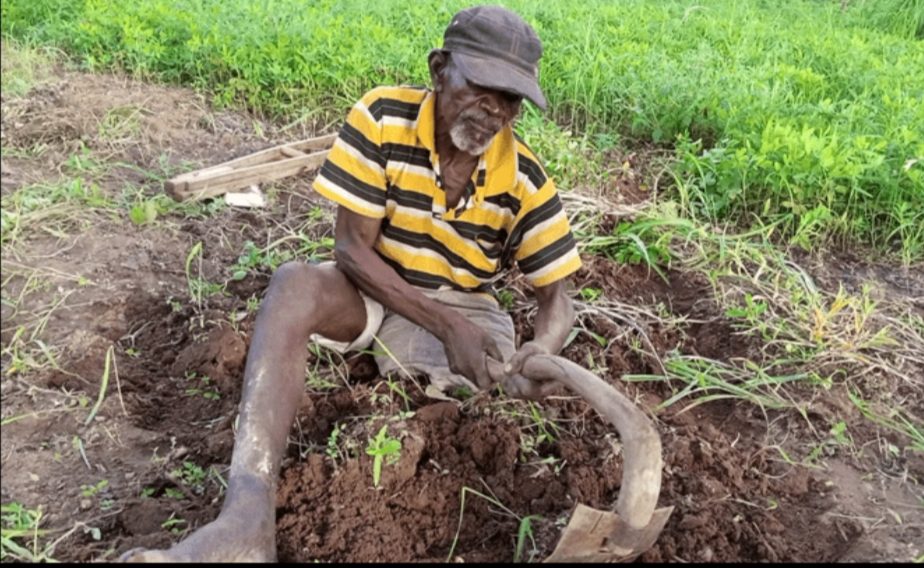
“During campaigns, they come here and promise us help, we vote, vote, vote. After the election, nobody remembers us.”
In the Aderin Community, Powerline area of Olorunda, Amoo Fasilat Omolara farms maize, cassava, and potatoes, and also runs a small-scale fishery and poultry operation. She said she received no government support in 2024 under any gender- or women-focused agricultural programme.
“I did not get anything,” she said.
Amoo said she relies on hired tractors and planters and sometimes borrows equipment from OSSADEP during the rainy season, a situation she says limits her productivity and income. She added that she is not aware of any GESI-funded support reaching women farmers in her community.
Sobalaje Samuel, a man in his early 70s from Iree Town, farms palm oil, cocoa, cassava flour, and pepper, relying heavily on manual labour and hiring workers every planting season. Age and the physical demands of farming have made self-sufficiency impossible.
“I pay people every year to help me farm,” he said. “If I don’t, nothing will grow, and I will not eat. But even with all these years of working the land, government support has never reached us.”
Samuel said promises of help have come repeatedly, especially during campaigns. “They come before elections and tell us there will be tractors, seedlings, and tools for people like us. We vote, vote, vote, but after elections, nothing happens. Even the roads in our community have not been fixed since Oyinlola’s administration. It feels like we are forgotten.”
He added that the absence of government assistance has made farming more expensive and exhausting, forcing him to spend a significant portion of his limited income just to survive. “We have been sidelined for decades,” he said. “They talk about inclusion, but in reality, it is all just promises and talk.”
Yinka Olaito, a PWD advocate, attributed the persistent exclusion of persons with disabilities (PWDs) from agricultural support to systemic government failure, stressing that the problem cuts across policy and implementation.
According to him, “while we may find it hard to believe, the case is always government failure in this area. This may be due to bureaucratic bottlenecks, policy inconsistency, or an officer who refuses to do his beat. Whatever the reason for failure, PWD farmers and others often bear the burden of this failure,” he said.
Speaking on government responsibility and the wider impact of neglect, Olaito said, “whether it is an obligation or implied, especially where the law is not so explicit, government must take the lead in creating an enabling environment for anyone to thrive in their chosen trade. At worst, the government should be a facilitator to ensure protection for PWD farmers.”
He added that the frequent neglect of PWDs in agricultural programmes reflects “ignorance or shallow knowledge, lack of political will, policy inconsistency and lack of intentionality,” warning that “when disability-inclusive agricultural support fails, PWDs suffer neglect and this, by extension, affects others and puts society at risk of food insecurity.”
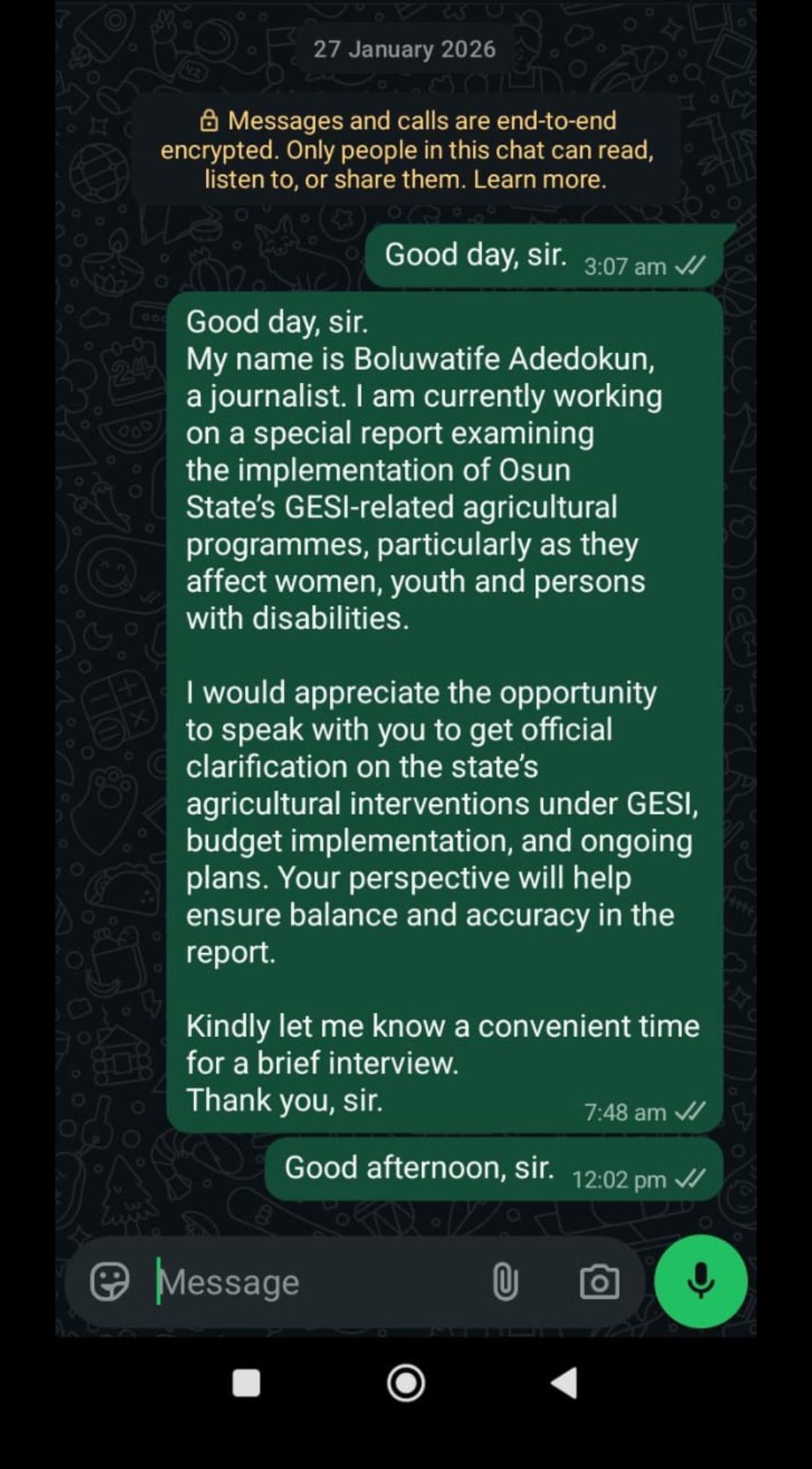
Efforts to get a response from the Special Adviser on Agriculture, Niran Atidade, were unsuccessful. Messages sent via WhatsApp went unanswered, and repeated calls went unanswered.
Similarly, Freedom of Information (FOI) requests sent to the Ministry of Agriculture and the Ministry
of Public Service requesting details of GESI programme implementation, procurement records, and fund disbursement received no response.