
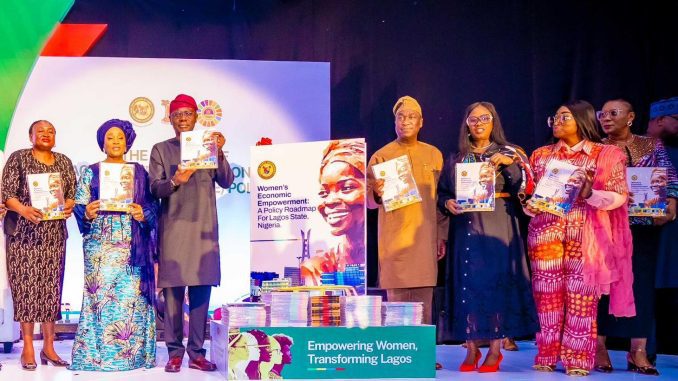
The Lagos State government has launched the domestication of the National Women’s Economic Empowerment (WEE), policy road map in order to address systemic barriers to women’s economic participation in line with global SDG goals to promote gender equality.
At the launch of the Lagos WEE policy roadmap, Governor Babajide Sanwo-Olu said the development would address structural barriers, foster multi-sectoral partnerships and leverage policy framework to unlock the full potential of its women for economic benefits and broader socio-economic development of the state.
Governor Sanwo-Olu said, “we’re not just launching a roadmap, we’re taking an initiative that will reflect the administration’s unwavering commitment to ensuring that gender equality and inclusive economic growth is not just something that we’re verbalizing, it’s something that we’re putting action into.
“And we’re working with all of you great women that have come out as champions, so that we can all design and walk this path together,” he added.
The representative of the Minister of Women Affairs and Social Development, Mrs. Agnes Abraham, urged the Lagos State government to embrace the national constitutional review and support the clamor for a special seat for women in governance, while decrying the four-point three percent women representatives at the National Assembly and House of Representatives.
Mrs Abraham stressed that “when women are absent from decision-making tables, issues such as maternal health, education access, family care systems, and gender-responsive budgeting are often inadequately addressed.
“As we launch this demonstration, I urge for increased budgetary allocation and institutional strengthening to drive this process with tangible results that uplift women and transform communities.”
Earlier in her welcome address, the Commissioner for Women Affairs and Poverty Alleviation, Mrs. Cecilia Dada, admitted that despite the economic vibrancy of Lagos, women still face substantial barriers in education, skill acquisition and participation in both traditional emerging labor markets and industries as well as agriculture.
Mrs. Dada emphasized that the WEE policy roadmap would focus on key areas to strengthen women’s financial inclusion and literacy, bridging digital divides through technology and innovation to address socio-cultural barriers with gender responsive governance and data-driven strategies.
“We see this roadmap as a launchpad to expand our vocational training programs, strengthen microenterprise support, foster public-private partnerships, and drive policy advocacy for women in the informal sector. When we empower a woman, we uplift a household, strengthen the economy, and build a more prosperous Lagos,” Mrs Dada added.
A forty-member Lagos WEE Policy roadmap champions were also inaugurated with representatives from both government and the public sector to drive the initiative for inclusive economic growth at the grassroots.
Source: Radio Nigeria/Yemisi Dada.