

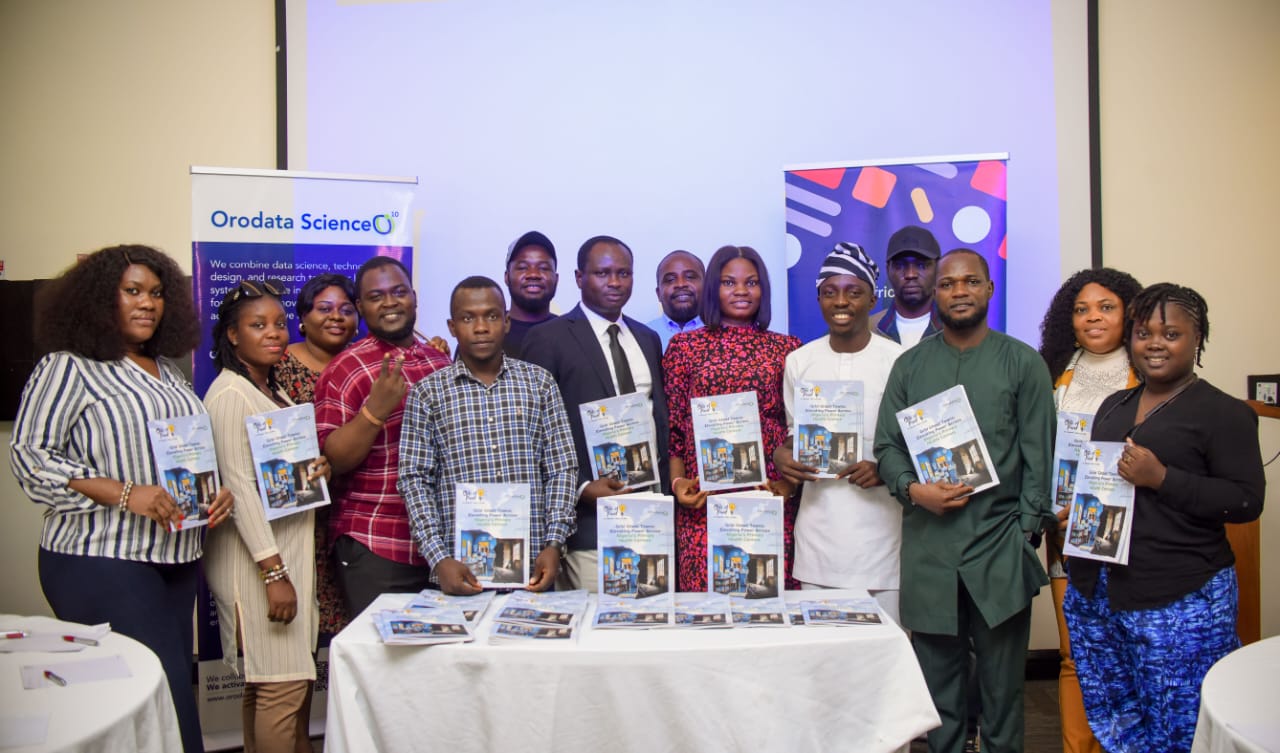
Orodata Science, in partnership with Africa Data Hub, has completed a three-month-long training for 10 newsrooms across Nigeria. The training, delivered by media professionals and veterans, aimed to strengthen the health desks of the selected newsrooms.
The training, which culminated with a hybrid close-out event and the launch of the Energy Report on Primary Health Centres across the country, featured a series of sessions such as data journalism, fact-checking, visualisation, solutions journalism, etc.
Delivering the opening remarks at the close-out, Mr John Eromosele, Country Operations Lead at Orodata Science, described journalism as a powerful tool and the newsroom as a hub for driving narratives and telling people-centred stories.

He highlighted the Africa Data Hub’s presence across West, East, and Southern Africa, and its ongoing work supporting health desks with story grants and data resources.
Eromosele noted the persistent challenge of accessing primary datasets and outlined how the organisation’s recently concluded six-week online intensive training programme was designed to bridge that gap.
He also referenced the CheckMyPHC portal, a project that mapped 1,500 primary healthcare centres across Nigeria’s six geopolitical zones and presented the findings in easily understandable formats.
According to him, “There are a lot of untold stories behind the data,” adding that the goal is to equip journalists with the skills to create simple, impactful visualisations that would help elevate their stories.
While facilitating the training session on data visualisation, Eromosele covered several modules, including Fundamentals of Data Analysis using spreadsheets, Data scraping from repositories, Introduction to Flourish, and Introduction to Datawrapper.

He emphasised the importance of data visualisation in modern journalism, explaining that visuals simplify complex information, build audience trust, and enhance credibility. He described Flourish as a “journalist-first tool” widely adopted in global newsrooms due to its ease of use and embeddable templates.
Participants were also introduced to Canva as a visual storytelling tool suitable for infographics, posters, social cards, and static visuals, particularly for social-first journalism.
“Flourish, Datawrapper, Canva, etc., are just means,” Eromosele said. “Always remember that the story is the real power. You are not just reporters; you are storytellers and catalysts for change.”
The event concluded with Orodata Science launching the 2024/2025 PHC Energy Report, titled ‘Grid Ghost Towns: Elevating Power Across Nigeria’s Primary Health Centres.’ The report highlights the deepening energy crisis across primary health centres in Osun, Anambra, Taraba, Sokoto, Cross River, and Benue, where unreliable grid supply, soaring diesel costs, and rising electricity tariffs continue to undermine healthcare delivery.
With average national grid output stuck between 3,500 and 4,500 MW for over 220 million Nigerians, the report warns that PHCs are increasingly dependent on expensive backup power, straining state budgets and limiting critical medical services.
Orodata notes that tailored state-level reforms and increased investment in decentralised renewable energy will be essential to strengthening Nigeria’s PHC systems.