
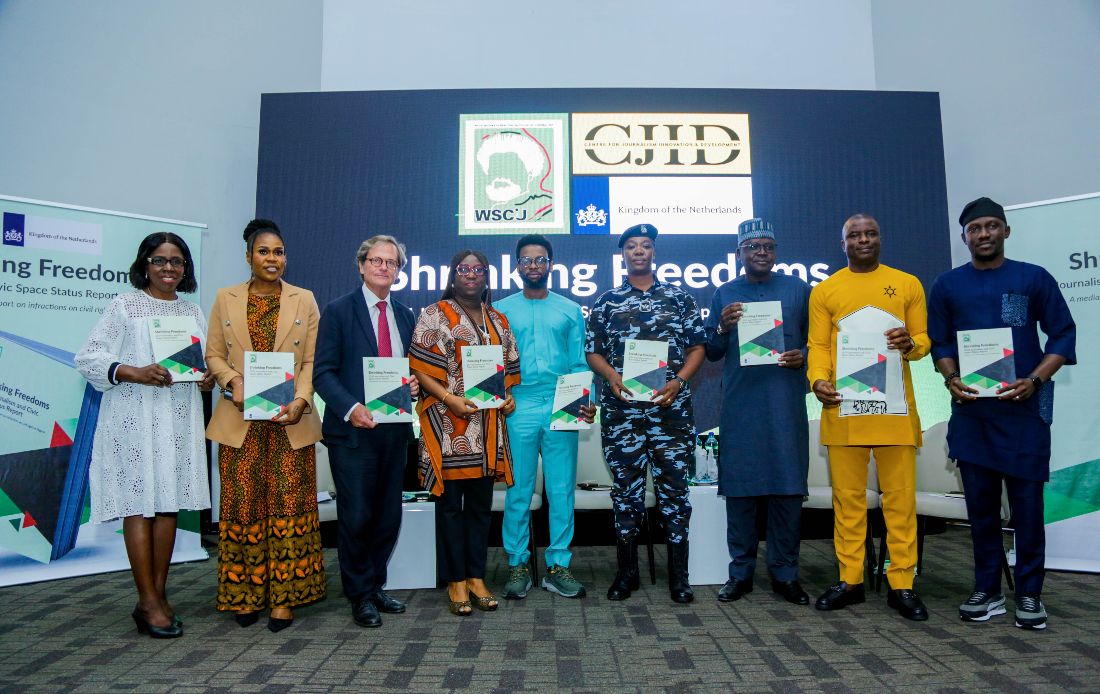
Nigeria’s democracy is teetering on the edge of repression, warned Professor Ernest Ereke, a political economist from the University of Abuja, during the public presentation of the 2024 Journalism and Civic Space Status Report by the Wole Soyinka Centre for Investigative Journalism (WSCIJ) in Lagos.
Titled “Shrinking Freedoms,” the report documented 103 civic space violations, reported 342 times in 2024, with journalists accounting for over half of all victims. The Nigerian Police were implicated in more than 65% of these cases, revealing persistent institutional weaknesses and unchecked impunity.
Professor Ereke, who reviewed the report, said the findings are “very disturbing,” warning that Nigeria’s democratic institutions are being “hijacked and privatised to serve private interests,” a phenomenon he described as “state capture in its most dangerous form.”
Fisayo Soyombo, founder of the Foundation for Investigative Journalism (FIJ) and one of the panelists, emphasized that threats to press freedom extend beyond physical harm.
“We often think about freedom only in terms of whether a journalist is alive or detained,” he said, “but true freedom is about whether journalists can report without fear of reprisals.”
Soyombo stressed that progress will remain elusive so long as the police remain “at the beck and call of politicians” and continue to show “a lack of basic understanding of rights.”
Other panelists, including Isa Sanusi, Country Director of Amnesty International Nigeria, and Abimbola Adebisi, Police Public Relations Officer, Lagos State Command, reinforced the urgency of protecting press freedom and rebuilding trust between the police, journalists, and the public.
Adebisi acknowledged communication gaps that often fuel mistrust, highlighting the efforts of the Police Complaint Response Units to address grievances.
“The police cannot do it alone,” she noted. “We need journalists to report responsibly and accurately to foster understanding.”
In her remarks, Motunrayo Alaka, Executive Director/CEO of WSCIJ, described the report as both “a mirror and a call to action,” urging collaboration between government, media, and civil society to preserve truth and democracy.
Bisan Habu, Partnerships & Grants Manager at CJID, thanked the WSCIJ and the Netherlands Embassy for their partnership, calling the collaboration “a statement of collective resolve to defend democracy and accountability and amplify the voices of those often unheard.”
Peter Keulers, Deputy Consul General of the Netherlands, commended WSCIJ’s evidence-based advocacy, describing civic space as “the oxygen of democracy.”
“When it shrinks,” he said, “democracy suffocates. We must defend the space where citizens speak, where the media holds power to account, and where democracy can truly breathe.”
The 2024 report, developed under the Civic Space Guard programme, builds on earlier editions, Hushed Voices and the Media’s Defence of Civic Space (2022) and Hushed Voices in an Election Year (2023), documenting recurring threats to civic participation and media freedom in Nigeria.
It highlights how both state and non-state actors contribute to the shrinking of democratic freedoms while underscoring opportunities for reform and advocacy.
The event brought together journalists, editors, academics, civil society actors, law enforcement officials, and diplomats, moderated by Amaka Okoye, editor at Deutsche Welle (DW). The discussions were robust and solution-oriented, reaffirming a shared commitment to safeguarding press freedom and civic space in Nigeria.