

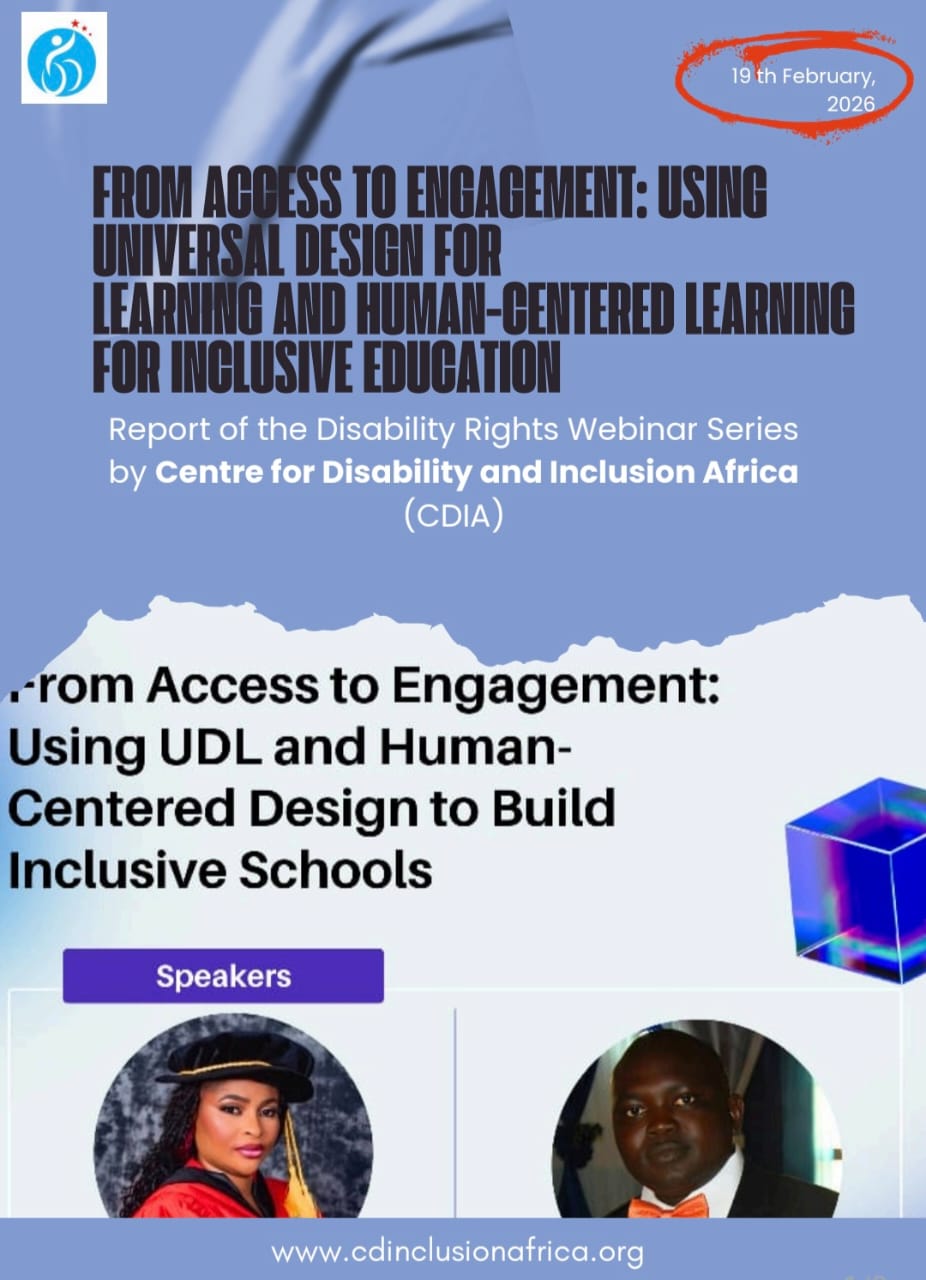
Inclusive education in Nigeria has long been framed around access getting children with disabilities into classrooms, building ramps, and adjusting policies. But a recent webinar hosted by the Centre for Disability and Inclusion Africa (CDIA) is urging educators and policymakers to confront a deeper question: what happens after access?
Held on February 19, 2026, the virtual session brought together teachers, education officials, administrators, and representatives of Organizations of Persons with Disabilities (OPDs). Its theme “From Access to Engagement: Using Universal Design for Learning (UDL) and Human-Centered Design (HCD) for Inclusive Education signals a subtle yet critical shift in thinking. Inclusion, participants were reminded, is not simply about presence; it is about participation, belonging, and learning outcomes.
Despite Nigeria’s policy commitments to inclusive education, the lived reality for many learners with disabilities remains uneven. Barriers persist: overcrowded classrooms, insufficient teacher preparation, weak policy implementation, and enduring sociocultural misconceptions about disability. Too often, interventions focus on reactive accommodations — adjustments made after difficulties arise rather than proactive design that anticipates learner diversity from the outset.
That distinction became a focal point of the discussion.
Dr. Mariam Akhere Akran, a special educator and Diversity, Equity, and Inclusion strategist, challenged one of the most common assumptions surrounding inclusion: that it is prohibitively expensive. Inclusive education, she argued, is less a budgetary dilemma than a leadership and mindset issue.
“Disability is part of human diversity, not a deficit,” she emphasized, drawing from both professional and lived experience. Schools, she suggested, already possess many of the tools needed for inclusion. What is often missing is intentionality designing learning environments that recognize variability rather than treating difference as an exception.
Her remarks resonated strongly with participants, particularly classroom teachers accustomed to working within resource constraints. The message was disarmingly simple: inclusion is not always about adding more; sometimes it is about doing things differently.
Central to this reorientation is Universal Design for Learning, a framework that encourages educators to plan for learner variability. Rather than assuming a “typical” student and retrofitting lessons for others, UDL promotes flexibility at the design stage.
The webinar highlighted UDL’s three guiding principles: providing multiple means of engagement to sustain motivation and participation; offering multiple means of representation so information can be understood in varied ways; and allowing multiple means of action and expression, enabling learners to demonstrate understanding through different formats.
The implications for classroom practice are significant. A lesson designed with UDL principles might combine visual, auditory, and interactive elements, while assessments might move beyond rigid written formats. Crucially, such strategies benefit not only learners with disabilities but entire classrooms.
Yet, speakers warned, design frameworks alone cannot resolve systemic challenges.
Mr. Paul Davou Fiou of the Plateau State Universal Basic Education Board’s Special Education Unit drew attention to a persistent blind spot in Nigeria’s inclusion efforts: the overemphasis on physical access. Infrastructure improvements and enrolment gains, while necessary, do not automatically translate into meaningful participation. “Access without engagement is not inclusion,” he noted, underscoring how many learners remain present but marginalised struggling to interact with curricula, teachers, or peers.
To bridge that gap, the conversation turned to Human-Centered Design, an approach that places learners’ experiences at the heart of educational reform. HCD urges educators and policymakers to design with students rather than merely for them, integrating the voices of children, parents, and communities.
In a context where stigma, trauma, and cultural perceptions often shape educational experiences, participants acknowledged the importance of context-sensitive solutions. Imported models, speakers cautioned, frequently falter when they fail to account for local realities.
Beyond classroom strategies, the webinar confronted the structural dimensions of exclusion. Overcrowded classrooms, insufficient teacher training, and weak accountability systems were identified as systemic constraints requiring policy-level responses.
Mr. Fiou outlined four strategic priorities: institutionalising Universal Design within curriculum reform, restructuring teacher training to embed inclusive design principles, establishing cross-government Universal Design Teams, and strengthening accountability mechanisms. Underpinning these proposals is a call for participatory governance — aligning ministries, educators, parents, and OPDs.
Policy coherence also emerged as a recurring concern. Participants stressed the need for a National Inclusion Framework capable of integrating design-based approaches like UDL and HCD while embedding monitoring and evaluation systems. Without credible mechanisms for measuring impact, inclusive education policies risk remaining aspirational rather than transformative.
The immediate outcomes of the webinar were modest but meaningful: heightened awareness of design-based inclusion strategies, robust participant engagement, and renewed multi-stakeholder dialogue. CDIA plans to disseminate the session recording to extend its reach.
Still, the broader significance of the conversation lies in its reframing of inclusion itself.
For decades, discussions around disability and education in Nigeria have been dominated by questions of entry who gets into school and under what conditions. The CDIA webinar suggests that the next frontier is experience: who participates, who thrives, and whose voices shape learning environments.
Inclusion, the speakers insisted, is not achieved at the school gate. It unfolds daily in classrooms, curricula, relationships, and institutional cultures. Moving from access to engagement demands more than policy declarations; it requires a reimagining of how education systems are designed, delivered, and evaluated. If the webinar’s central message holds, Nigeria’s inclusive education journey may hinge less on grand reforms and more on a quieter but profound shift: recognising learner diversity not as a challenge to be managed, but as a reality to be designed for.