
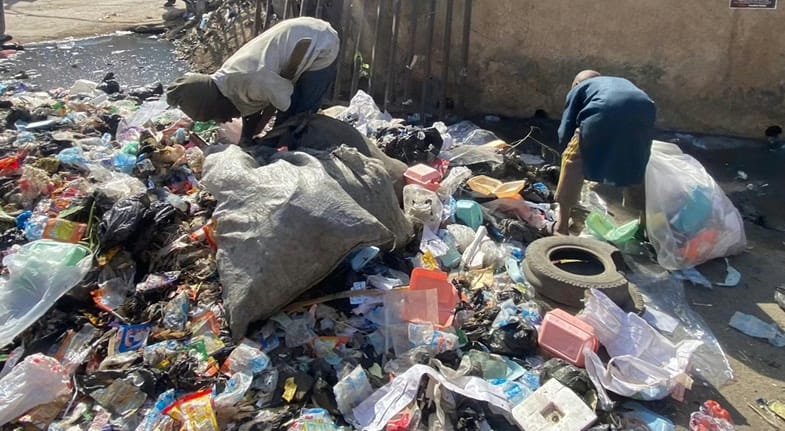
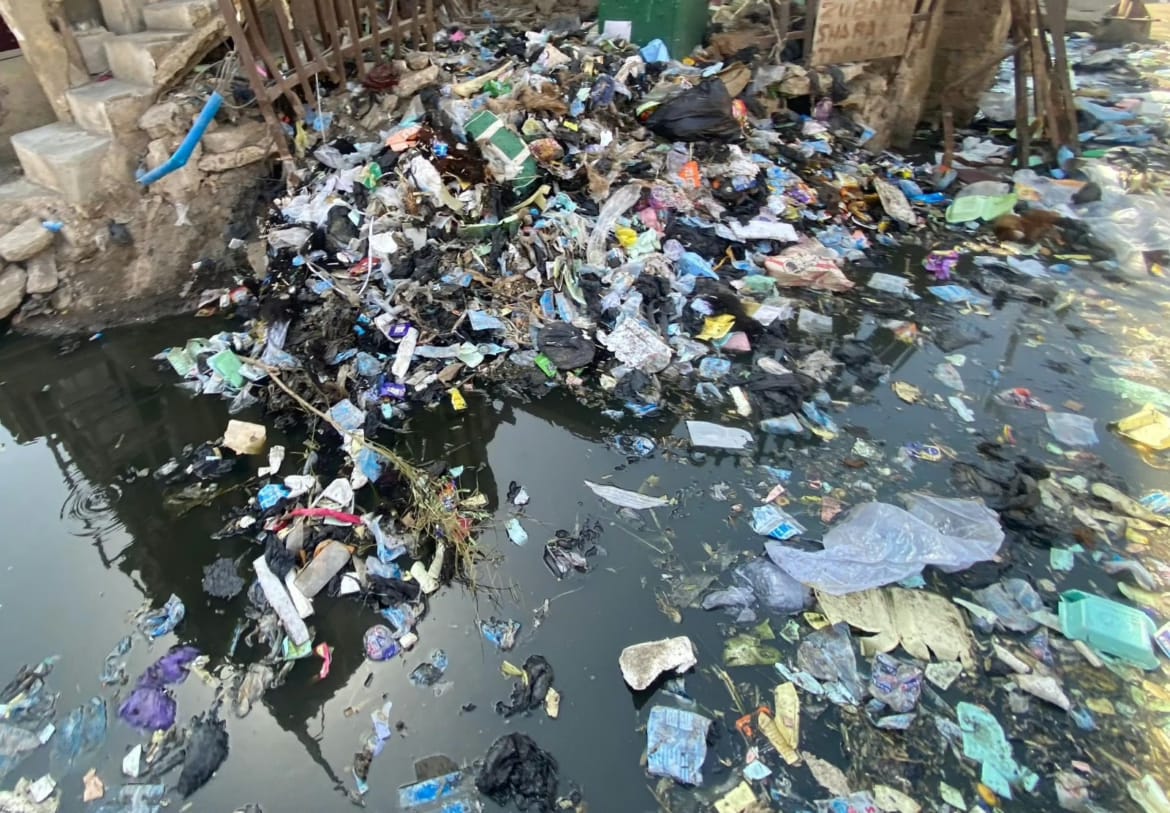
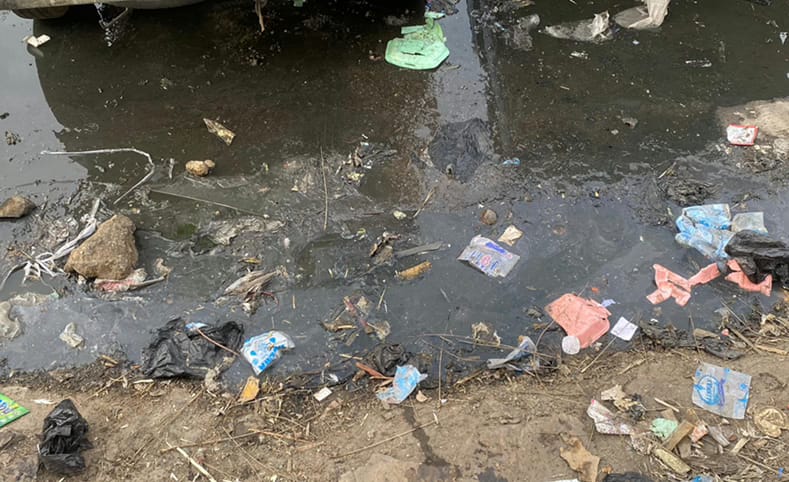
Rotting waste piles, clogged drainage lines, and foul odors have now taken over Muhammadu Abubakar Rimi Market, aka Sabon Gari Market, one of Kano’s busiest commercial hubs.
Despite traders paying mandatory sanitation levies intended to keep the environment clean, Stephen Enoch’s investigation reveals a troubling pattern of poor waste management, disputed fee collections, alleged double payments, and resistance to cleanup efforts.
Sani Abubakar, 64, has traded at Sabon Gari Market for over 15 years. Age and long exposure to poor sanitary conditions have left him exhausted and helpless.
Sitting in his shop on a bright afternoon, surrounded by flies and a foul smell, he described the market as a long cycle of neglect characterized by poor waste management.
According to him, the persistent dirt and unmanaged waste have become so normalized that many traders no longer expect improvement.
“Most times, this market is always dirty, as you can see. It has been like this since I started selling here more than 15 years ago, and nothing has really changed.
“I have stopped eating food in the market because it usually gets contaminated by the flies that you can see here, and it causes me to be ill, so I avoid eating here,” he told Stallion Times.
The businessman said he paid 18,000 naira for sanitation last year.
Abubakar revealed that the fear of retaliation from market officials prevents him and other traders from speaking out or demanding accountability from market authorities.
He believes the power imbalance leaves small traders vulnerable.
“If you say anything to them or you confront them, they will come after you. I don’t want that, which is why I am enduring it.
“I am old now and cannot fight for my rights. The authorities are very powerful, and I don’t want trouble.
“What I do now is just come, sell my goods, and go back home. I don’t even worry about the dirtiness again.
“Don’t take a picture of me or my shop, please,” he told this reporter.
Alleged Systematic Extortion
Odelia Chidi, a trader in the market, describes what he believes is a coordinated extortion pattern disguised as sanitation fee enforcement.
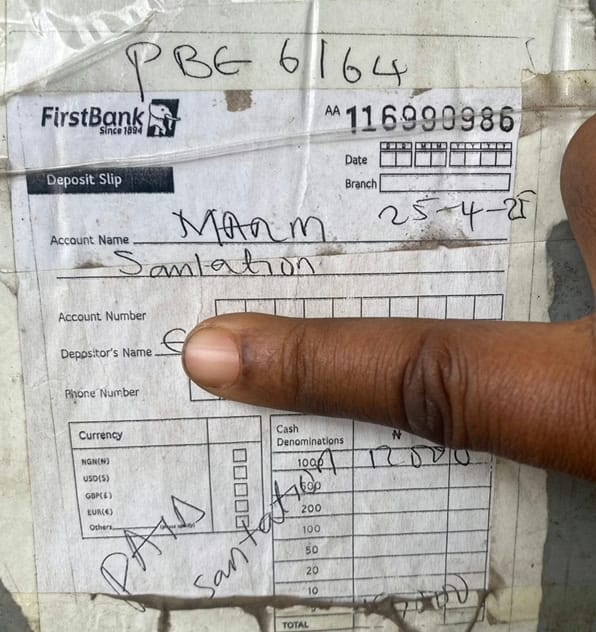
According to her account, she paid N12,000 for sanitation last year to individuals she recognized as operating alongside market officials.
“I received a receipt at the point of payment. But a few days later, my shop was locked by enforcement personnel who insisted I hadn’t paid my sanitation fee.
“I was so filled with rage that I walked to the officials’ office ready to make trouble.
“On tendering my receipt, they told me that I paid to the wrong people and that my receipt was invalid.
“To reopen my shop, I had to pay another N12,000 again, doubling the cost to N24,000 for the same service year,” she said
According to the trader, she has seen the “Fake” fee collectors working with the market officials many times, but when she went to the officials’ office, they temporarily disappeared.
“They move together in this market. How are traders supposed to know who is real and who is not?
“I believe that they know these people but are shielding them. I sense that I was systemically extorted,” she alleged.
She alleged that when she tried to trace those who first collected the money, they temporarily disappeared, only to later reappear around the market premises in the company of individuals she identified as market leaders.
Another trader, Maman Isa, confirmed what Ordelia said. According to her, the unverified operators work openly in the market while the officials look the other way.
She said: “I also paid N12,000 to the same category of collectors, only my shop was locked for ‘non-payment. The market officials said I paid the wrong people.”
Air Pollution Causing Health Hazard
For Obi Chukwu (not a real name), running a small shop used to be a shared responsibility with his wife.
Side by side, they sold goods, attended to customers, and took turns stepping out to secure better deals within the market. Their partnership kept the business afloat.
But that changed after their baby was born.
Now, Chukwu runs the shop alone, not by choice, but by fear.
Just a few steps from his storefront sits a growing heap of waste, just along the France Road section of the market.
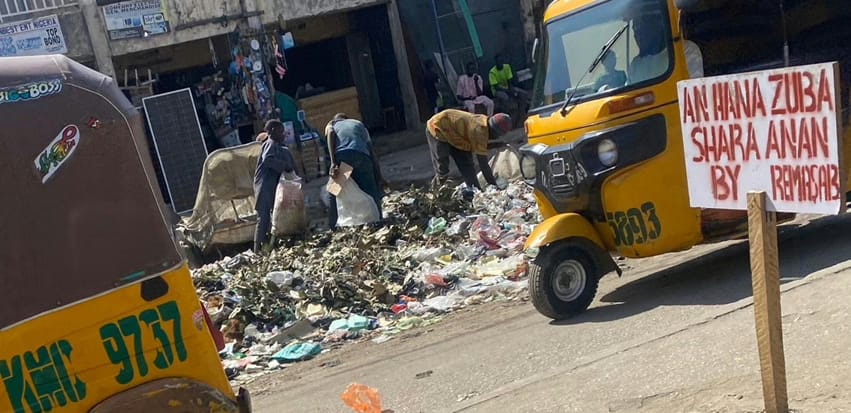
Acting on medical advice, he and his wife decided their newborn must not be exposed to the polluted air around the market.
“Since she gave birth, my Wife stopped coming because the air pollution caused by the waste can cause serious health problems for the baby.
“The decision to keep both of them at home has come at a cost because there is no one to hold the shop when business deals need to happen at a different location.
“I now only depend on walk-in customers, and they are becoming fewer because of the heap of waste.
“People don’t like to come near when the waste is piled up,” he explained.
He also revealed that attempts to resist the dumping in daylight have led to confrontation and consequences.
Locked Up By The Police For Confronting Illegal Waste Dumping
It was around the last quarter of 2025 that Frank Timi (not real name) had to bail out his apprentice from the Police station with N10,000 after his apprentice confronted a person who was adding to the pile of waste in front of his store.
According to Timi, “My boy was so angry about the polluted area that when he saw an informal waste collector coming to dump waste in front of the shop, he forcefully confronted the person.
“The confrontation was so much that it drew the attention of people around, who calmed the situation.
“In a moment, the police arrested my Boy, and I had to bail him out with N10,000.
“The police told me that I have no right to confront those who are heaping waste in that location.
“Anytime we confront those boys who carry waste from inside the market and dump it here, they always say that they were directed by the authorities to dump the waste there.
“The painful thing about this situation is that even after cleaning the environment in the afternoon, a new heap of waste appears in the morning.
“If we try to stop them from piling waste here in the afternoon, it is a problem for us, and we are suffering. This is unfair,” he told this reporter.
Both Chukwu and Timi are afraid to give their real names because they fear that if market officials read this report and identify them, they could be in trouble.
Market Officials Respond
According to Gambo Mohamed, the Staff Officer in charge of Sabon Gari Market, the sanitation levy charged to traders reflects the real costs of daily cleaning operations, waste evacuation, and security, not extortion, as some traders allege.
He stated that the approved sanitation fee is N12,000 per year, broken down monthly.
In response to reports that some traders pay N24,000 annually, Mohammed clarified that the extra charge is not for sanitation.
“The other 12,000 is for security, as the market maintains about 120 security personnel who are paid monthly to protect shops and goods.
He also disputed claims that the large refuse heaps seen at certain dump points come from inside the market.
“That heap of waste that is along the road is not from the market. It’s from Sabon Gari residential areas. They bring their waste at night and dump it there.
“The waste generated by traders is mostly light materials such as sachet-water, nylons, and packaging nylons,” he said.
Mohammed dismissed accusations that officials know the individuals who collected sanitation and issued fake receipts to traders last year.
“This waste dumping from nearby neighborhoods has been a challenge for more than 20 years,’ he added.
He estimated that the market has more than 10,000 shops, though no precise figure is available because new shops emerge weekly or monthly.
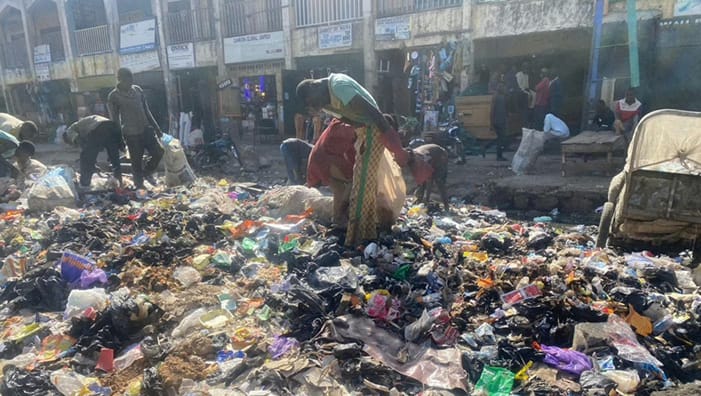
Ado Haruna Muhammad, Public Relations Officer of the Sabon Gari, Singer, and Galadima Market Management Board, said recent reforms have expanded sanitation tools and staffing, but serious operational challenges still undermine refuse management in the market.
He said the current administration increased the number of refuse collection drums and introduced dedicated transport for waste evacuation.
When asked about the poor waste management system in the market, vis-à-vis the sanitation fees, he said:
“Before this administration, refuse was overwhelming in Sabon Gari market.
“The Managing Director bought more than 1,000 drums and placed them inside the market. We also bought five vehicles specifically only for carrying refuse,” he stated.
However, he admitted that the workforce remains insufficient relative to the market’s size.
“There is still a shortage of workforce, but we have employed more people. Under the sanitation department, we now have more than 150 staff,” he disclosed.
According to the PRO, cleaners work daily, sweeping and moving waste into drums before vehicles arrive to haul it away.
He explained that most sanitation workers are casual staff paid monthly stipends.
“They are casual workers. Some earn N23,000, N25,000, or about N30,000 per month,” he revealed.
When asked why the market management has yet to stop the indiscriminate dumping of refuse in certain areas of the market, he said: “Sabon Gari residential area is very close, and many residents bring their refuse to the market because they know it will be packed from here.
“We are creating new policies and increasing staff so the market will be cleaner and more conducive,” he said.
Sanitation Funds vs Spending
Based on data from market authorities, with over 10,000 shops paying N12,000 per year for sanitation, the total sanitation revenue comes to N120,000,000 per year.
When broken down monthly, that amounts to roughly N10,000,000 from sanitation levies alone.
This shows that the sanitation pool is financially significant on paper, given the number of shops and the fixed annual levy per trader.
On the workforce side, the market authority reports that 150 sanitation workers earn between N25,000 and N30,000 per month.
Using a midpoint estimate of N27,500, the total monthly wage cost equals N4,125,000.
Over a full year, that becomes N49,500,000 spent on sanitation worker stipends.
Comparing the two sides, estimated yearly sanitation revenue (N120m) minus estimated yearly worker cost (N49.5m) leaves about N70.5m for tools, evacuation logistics, supervision, waste transport, administration, and other sanitation operations.
What happens to the remaining estimated N70.5million?
The chart below visually compares total yearly revenue versus estimated yearly worker pay.
Sabon Gari Market Isn’t Capable of Handling Its Waste – REMASAB
Dr. Muhammad S. Khalil, Managing Director of the Kano Refuse Management and Sanitation Board (REMASAB), stated that the sanitation challenges at Sabon Gari market persist largely because the market authority lacks the capacity and equipment to manage the volume of waste it generates daily.
According to him, the management of Sanitation in the Sabon Gari market is under the jurisdiction of the market authority.
“They don’t have the machinery and capacity to handle the increasing waste generation in these markets,” he stated.
He explained that REMASAB intervenes regularly to prevent a breakdown of public health conditions.
“On a daily basis, we send machines to evacuate waste dumped on the roads. We don’t collect any money from them. It is fully funded by the state government,” he said.
Dr. Khalil revealed that REMASAB proposed a structured solution under its Public Sector Participation (PSP) model, assigning private waste contractors to manage refuse in the markets, but the offer was declined.
“We had meetings with the market management and proposed allocating a private company that can perfectly handle the waste issue, but they refused. They felt like we were snatching their mandate,” he told Stallion Times.
To address indiscriminate dumping, he said the agency is now turning to stricter enforcement through a mobile sanitation court.
“We have started the mobile court, a nd we punish offenders. Sometimes you need a carrot and stick approach, but now, it is time to use the stick.”
This report was done with support from Civic Media Lab.