

As climate shocks intensify across sub-Saharan Africa, smallholder farmers remain among the most vulnerable. Nigeria, home to over 38 million agricultural workers, according to the National Bureau of Statistics, continues to face severe climate impacts, including erratic rainfall, rising temperatures, violent floods, and land degradation. In communities like Gwagwalada in the Federal Capital Territory, these changes threaten food security, incomes, and rural stability. Against this backdrop, the “Climate Accelerator Program” convened stakeholders and farmers this week to advance a model that places citizens, especially farmers, at the center of climate adaptation planning and public budgeting.
The event, themed “Strengthening Climate Adaptation through Participatory Budgeting at the Local Level,” brought together dignitaries, development partners, government officials, and farmers from Gwagwalada communities. The project is implemented by the DEAN Initiative in partnership with Gwagwalada Area Council, with funding support from People Powered, a global organization promoting inclusive democracy.
Speaking at the forum, Alhaji Muhammed Saba, Council Secretary of Gwagwalada Area Council, said the council has “set the pace” in deepening citizen participation in governance. He noted that the commitment shown by the council chairman made it possible to embrace the Open Government Partnership (OGP) approach, which he described as “an innovation conceived to help governance achieve success with citizens’ satisfaction and participation.”
Saba explained that the essence of the process is to ensure that community needs are reflected in the council’s projects. According to him, the council’s responsibility now is to integrate the farmers’ five-point climate adaptation priorities into the coming budget cycle. While he cautioned that “not all five may receive full prominence,” he emphasized that collaboration with external partners remains critical. “No government can meet all constraints alone, no matter its resources,” he said, adding that the OGP framework allows individuals and corporate partners to support targeted local projects.
Founder of DEAN Initiative, Mr. Semiye Michael, stated that the project was designed to bring climate action “to the domestic arena where the most affected people live.” He explained that farmers, who feed the nation, face climate shocks that ripple across communities. Michael noted that the participatory budgeting process enables citizens to articulate how climate change affects them and work with government to allocate financial resources in response.
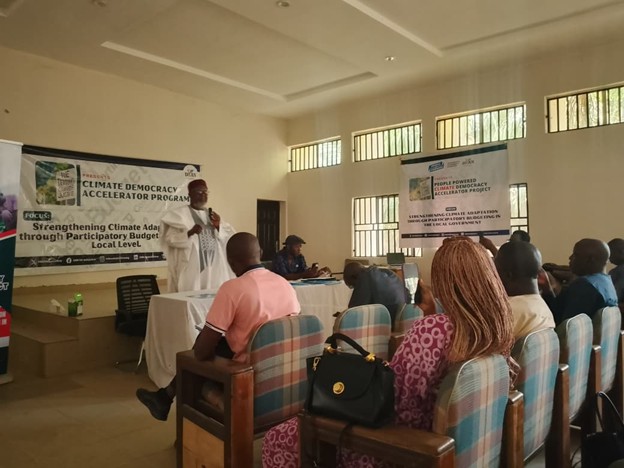
He added that democracy must move beyond voting alone. “Citizens should have the power to vote for elected officers, but also to vote for the projects that directly affect their lives,” he said. Michael described the moment as “a landmark” in strengthening grassroots climate governance.
Representing the farmers, Mrs. Rakiya Mamman, a woman farmer leader, highlighted the challenges confronting local farmers—ranging from unpredictable weather patterns to lack of timely access to farm inputs. She stressed the insecurity farmers often face during harvest seasons due to herder–farmer conflicts, citing Paiko community as an example. She thanked DEAN Initiative for equipping farmers with knowledge on climate responses, saying the program had helped them understand what actions to take during climate disruptions.
Project Lead for the Climate Democracy Programme, Mr. Taiwo Ojo, explained that the program aims to ensure that budgeting is no longer done in isolation. He said the initiative collected climate priorities from smallholder farmers across Paiko and Ndupa communities and worked with civil society to redesign them into a formal proposal. According to him, the goal is for these priorities to be considered in the 2026 local government budget, thereby giving citizens meaningful power over decisions that shape their livelihoods.
“Engaging citizens in budget creation builds trust,” Ojo said, noting that it also strengthens ownership of public projects and enhances long-term sustainability.
Farmer Ayuba Azuzo expressed optimism that the process would bring positive change to local agriculture. He noted that the training equipped them with solutions to farming challenges and pledged to transfer the knowledge to fellow farmers. Azuzo encouraged both the DEAN Initiative and the Area Council to “continue supporting farmers to make agricultural activities easier.”
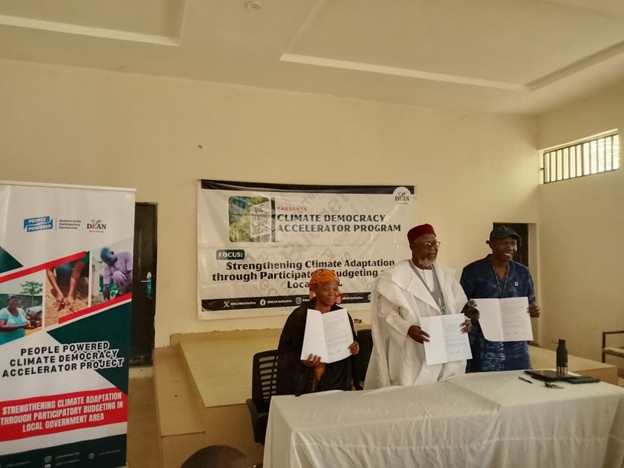
The event concluded with a symbolic signing of the participatory climate budgeting implementation document, a milestone that officially binds both citizens and government to the agreed priorities. The document was signed by Alhaji Muhammed Saba, representing the Gwagwalada Area Council; Mrs. Rakiya Mamman, representing the farmers; and Mr. Semiye Michael, founder of DEAN Initiative. The act signified mutual commitment to embedding climate adaptation measures into local governance, ensuring that the voices of farmers shape the policies that affect their resilience.