
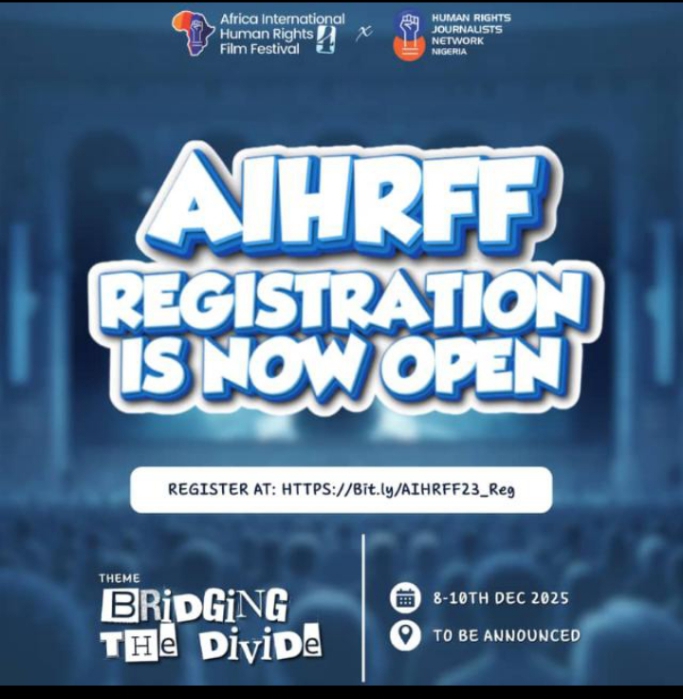
Organisers of the Africa International Human Rights Film Festival (AIHRFF) have announced that the fourth edition of the annual event will take place from Monday to Wednesday, December 8–10, 2025, in Lagos. The festival, which has grown into one of the continent’s most significant gatherings on human rights advocacy, will bring together filmmakers, activists, journalists, and policymakers.
This year’s festival will operate under the theme “Using Films to Bridge Divides,” with a lineup that includes keynote addresses, film screenings, panel sessions, special appearances, and a closeout ceremony. Organisers say the agenda is strategically designed to use the power of visual storytelling to highlight human rights abuses and proffer solutions.
According to the schedule, opening activities, film screenings, and panel discussions will take place on Monday and Tuesday, December 8 and 9, 2025, at 1A Adekunle Owobiyi Close, off Nob Oluwa, Ogba, Lagos.
These sessions will feature prominent voices in human rights, including frontline activists, filmmakers, journalists, regulators, and policymakers.
The final day of the festival, which includes specialised master classes and the official closeout event, will be held on Wednesday, December 10, at the British Council, 20 Thompson Avenue, Falomo, Ikoyi, Lagos. The closeout session will coincide with the global commemoration of the United Nations Universal Declaration of Human Rights, marked annually on December 10.
Announcing the event, Founder and Festival Director Comrade Kehinde Adegboyega described the festival as “the biggest convergence of human rights activists, filmmakers, and stakeholders on the continent.” He said participants continue to “lend their skills and voices to amplify multiple issues of abuses around the world.”
The announcement was contained in a statement issued by Shakirudeen Bankole, Communications and Strategy Lead for the Human Rights Journalists Network, the umbrella body overseeing the Africa International Human Rights Film Festival. The statement highlighted the festival’s mission to inspire global action by documenting abuses in vivid detail.
Adegboyega noted that the human rights violations to be spotlighted include police brutality, official corruption, abuse of office, the weaponisation of poverty and social services, gender-based violence, repression of free expression, censorship of the press, criminalisation of peaceful protests, and rising authoritarianism. He stated that human rights filmmakers serve as activists and development advocates who “help expose and illuminate dark places where unfathomable human rights abuses are taking place.”
He emphasised the importance of film in human rights documentation, saying, “Audio-visual storytelling remains the most reliable and vivid way to document human rights abuses. It is self-evident and incontrovertible.” Adegboyega added that this is why the festival continues to train practitioners through its master classes, with the goal of expanding “the ecosystem of civil and rights advocates.”
The organisers expressed their commitment to growing a new generation of filmmakers and advocates who will continue to use film as a tool for justice, accountability, and social change.