

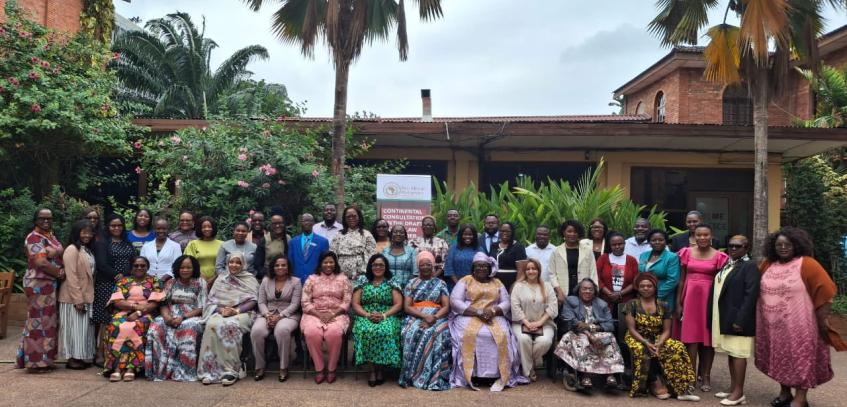
The West Africa regional consultation engagement on the Draft Model Law on Gender Equality and Equity by the Pan-African Parliament (PAP) commenced today in Accra, marking a pivotal step in harmonising legislative frameworks across the continent to promote gender justice and inclusion.
The PAP Model Law on Gender Equality and Equity aligns with the Pan-African Parliament’s commitment to advancing gender equality and equity across Africa. It recognises that harmonising legislative frameworks is essential to this goal and reflects the PAP’s mandate under Article 11(3) of the Protocol to the Treaty Establishing the African Economic Community relating to the Pan-African Parliament, which empowers the PAP to “work towards the harmonisation of laws of the Member States of the African Union.”
Speaking at the opening ceremony, the Minister for Gender, Children, and Social Protection, Hon. Dr Agnes Naa Momo Lartey, said the Draft Model Law demonstrates “commitment and readiness to promote gender justice, equality, equity and empowerment, thereby ensuring that no one is left behind in the development agenda of Africa.”
She added that the gathering provides a platform to assess the current status, reflect on progress made, and confirm commitment to making the full implementation of the Draft Model Law a national priority when finalised and passed to close the gender gap on the continent.
She thanked the PAP Committee on Gender, Family, Youth and People with Disability for creating the platform for the regional discourse.
Dr Lartey also highlighted Ghana’s progress in promoting gender equality and equity, noting that the country “continues to strive to create a stable, united, inclusive and prosperous country where all individuals have an equal voice and opportunity by integrating gender concerns into policy frameworks.” She pointed to legislative and policy frameworks developed to address gender inequality in Ghana.
On her part, Hon. Mariam Dao-Gabala, Chairperson of the PAP Committee on Gender Equality, Family, Youth and Persons with Disabilities, said the draft model law aims to be a catalyst for harmonising best practices while respecting the sovereignty of member states.
She described the Model Law as a “strategic necessity, offering a common, adaptable, and progressive reference framework, in line with international standards and African values and cultures.”
“This model law is not a rigid text. It is dynamic, and its strength will lie in the diversity of voices that have contributed to it. That is why your presence here is so crucial. Your feedback, your insights into the local context, and your concrete proposals will help strengthen the legitimacy, relevance, and applicability of this draft,” Dao-Gabala said.
She further disclosed that the Draft Model Law was initiated in 2023 and has already been the subject of consultations in Lusaka for Southern Africa, Nairobi for East Africa, and N’Djamena for Central Africa.
“Today, it is West Africa’s turn to be heard, to share its specificities, experiences, and expectations. Your opinions and contributions will be essential to enriching this text. We will conclude this process with a consultation in North Africa, in Morocco, before proceeding to the final adoption of the document during the regular session of the Pan-African Parliament scheduled for November 2025,” she added.
Recall that at the Second Session of its Sixth Parliament, the Plenary of the Pan-African Parliament, by Resolution PAP.6/PLN/RES/14/NOV.22 of October 2022, approved a proposal by the Permanent Committee on Gender, Family, Youth and People with Disability to develop a Model Law on Gender Equality and Equity.
The Model Law is intended as a soft-law instrument that Member States of the African Union can use or adapt to improve their legal, institutional, and regulatory frameworks on gender equality and equity, in line with relevant global and African Union instruments.
A draft was reviewed in Yaoundé in May 2025 and introduced in the PAP Plenary in July 2025. The ongoing consultations aim to incorporate perspectives from across the continent before final adoption.