
Millions of Nigerians continue to grapple with hunger, joblessness, and inadequate shelter as the country records disturbingly low scores in fundamental economic and social rights, according to new data released by the Human Rights Measurement Initiative (HRMI).
The findings, part of HRMI’s 2026 global assessment, highlight that despite the nation’s resources, basic needs remain painfully out of reach for vast numbers of citizens, with little improvement recorded over the years.
The data also revealed that Nigeria continues to fall short in protecting the economic, social, civil, and political rights of its people, with persistent gaps in access to basic needs and fundamental freedoms.
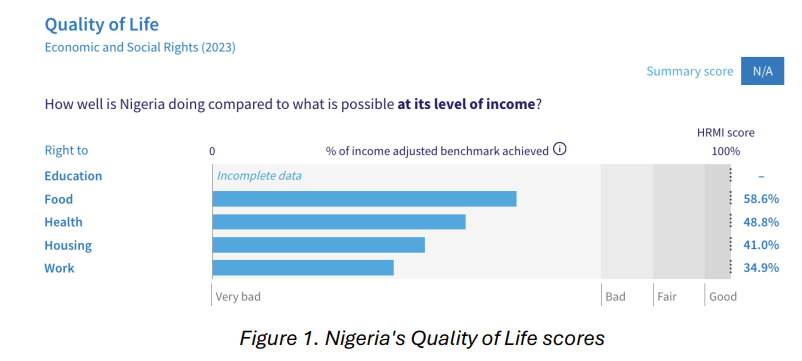
According to the findings, Nigeria’s scores for the right to food, health, housing, and work all fall within the very bad range, demonstrating that the country has yet to meet its immediate obligations on economic and social rights.
The data showed that Nigeria scored 58.6 percent on the right to food, 48.8 percent on the right to health, 41.0 percent on the right to housing, and 34.9 percent on the right to work.
The right to work recorded Nigeria’s lowest score at 34.9 percent, reflecting persistent barriers to full economic inclusion and access to decent work opportunities across the country.
HRMI Co-Executive Director Thalia Kehoe Rowden described the rights measured as fundamental and called on Nigerian leaders to make significant changes to improve the quality of life for citizens.
“The rights we measure are absolutely fundamental. Nigeria’s leaders will need to make significant changes to improve their people’s quality of life. Better lives for its people are within its grasp, if leaders choose to take action,” Rowden stated.
The data revealed that Nigeria’s score of 5.8 percent for ensuring the right to quality education ranks as the second lowest in the world, indicating that the country is achieving only a fraction of what it is capable of at its current level of per capita income.
On the right to health, HRMI noted steady but very slow progress over the past two decades, with uneven results across different metrics.
The data showed that Nigeria’s reproductive health score of 22 percent remains significantly lower than its adult health score of 57.1 percent and child health score of 67.2 percent.
Nigeria recorded a summary score of 5.9 out of 10 for Safety from the State, indicating continuing challenges in protecting citizens from arbitrary arrest, forced disappearance, extrajudicial execution, and torture and ill-treatment.
Human rights experts who participated in HRMI’s research identified human rights advocates, people suspected of political violence or terrorism, and journalists as being particularly at risk of rights violations from the state.
On Empowerment rights, Nigeria scored 5.6 out of 10, reflecting continuing challenges in protecting civil liberties including the rights to assembly, opinion, political participation, and religion and belief.
The data indicated that rights protections have remained roughly stagnant since 2023, with little improvement in the protection of fundamental civil liberties.
According to human rights experts, members of political opposition parties were identified as being at risk of rights violations, including the People’s Democratic Party, the African Democratic Congress, the National Democratic Party, and the Labour Party.
Rowden emphasised that the new scores should serve as a call to action for Nigerian authorities to address the deprivation of basic rights.
“The new scores must be a call to action. The current situation unnecessarily deprives many people of their basic rights. Nigeria has the wealth available to ensure much better lives for many more of its people,” she said.
The findings form part of HRMI’s Rights Tracker, a global project that systematically measures the human rights performance of countries worldwide.
The 2026 dataset provides scores on 14 civil and political rights for more than 50 countries covering the years 2017 to 2025, along with annual data on five economic and social rights for 200 countries from 2000 to 2023.
HRMI noted that its data is used by a wide range of organisations including Amnesty International, the World Bank, and the United Nations, and is freely available on the Rights Tracker, a certified Digital Public Good.
The organisation stated that it believes what gets measured gets improved, emphasising the importance of systematic human rights measurement in driving accountability and progress across countries.