

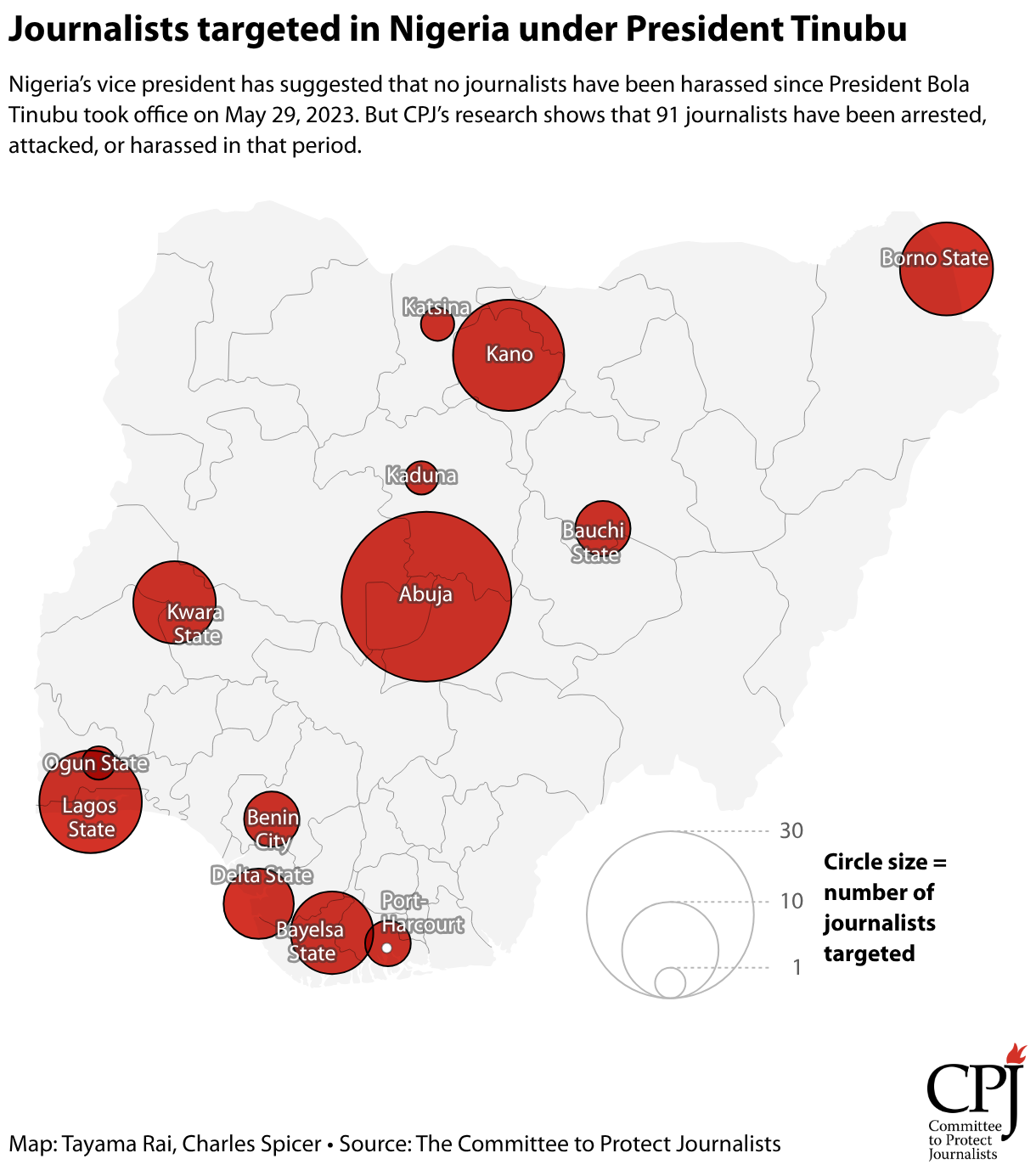
The Committee to Protect Journalists (CPJ) has released a detailed research documenting the arrest, attack, and harassment of 91 journalists during President Bola Tinubu’s three-year tenure, directly contradicting government claims that no such abuses have occurred.
The findings were published on Wednesday, marking three years since Tinubu’s inauguration on May 29, 2023.
CPJ also published an interactive map detailing incidents involving journalists across 12 Nigerian states and the national capital, Abuja, revealing a pattern of press freedom violations that the government has repeatedly denied.
The government’s denial of press freedom violations emerged in February when Vice President Kashim Shettima suggested to members of the Nigerian Press Council that no journalists have been harassed since Tinubu took office.
“For the past three years, have you heard of any harassment of journalists?” Shettima asked, describing Tinubu as a friend of the media who promoted an environment conducive for journalists to work without harassment.
In response to CPJ’s questions in late May, presidential spokesperson Sunday Dare stated via messaging app that the Tinubu administration has no record of unresolved infringements on journalists’ rights, adding that any cases of arbitrary arrest or assault would be investigated promptly.
However, CPJ’s research presents extensive evidence contradicting these official positions, documenting specific incidents of journalist harassment across the country.
According to the research, four journalists, Karina Adobaba-Harry, Nurudeen Akewushola, Adefemola Akintade, and Precious Eze Chukwunonso were arrested, attacked, or harassed at least twice on separate occasions.
Another journalist, Bernard Akede, experienced harassment or attack on three separate occasions during the period covered by the research.
Angela Quintal, CPJ Africa Director, described the government’s denial as an attempt to erase documented abuses from public consciousness and evade accountability.
“The Nigerian government’s suggestion that there has been no harassment of journalists since President Tinubu took office indicates an ambition to erase these abuses from the public consciousness and evade its responsibility for ensuring accountability,” Quintal said.
She emphasized that if authorities refuse to acknowledge attacks on the press and the prevailing impunity, they cannot claim to respect journalist safety and the public’s right to know.
In April, CPJ and five local press freedom groups sent a public letter to Tinubu addressing Vice President Shettima’s comments and providing detailed evidence of attacks during his tenure.
The letter also noted that Nigerian officials had previously made false claims and mischaracterizations about the press freedom situation in the country.
The government has not responded to the April letter.
Karina Adobaba-Harry, one of the journalists documented in CPJ’s research, reacted to the government’s denial in a video interview with the organisation.
“When the Nigerian government says the sky is blue, you should go outside and check again,” Adobaba-Harry said, highlighting the disconnect between official statements and the lived experiences of journalists in the country.
CPJ’s interactive map represents a comprehensive effort to document press freedom violations during Tinubu’s tenure, providing specific details about each incident and identifying patterns of harassment across the country.
The research underscores ongoing concerns about journalist safety in Nigeria and the government’s apparent reluctance to acknowledge or address documented violations.
The findings come amid broader concerns about media freedom in Nigeria and the challenges journalists face in reporting on governance and national issues without fear of harassment or arrest.