

Persons with disabilities in Nigeria have announced plans to move beyond voter participation and begin contesting elective positions across the country.
They accuse the political system of relegating them to symbolic appointments while excluding them from real positions of power.
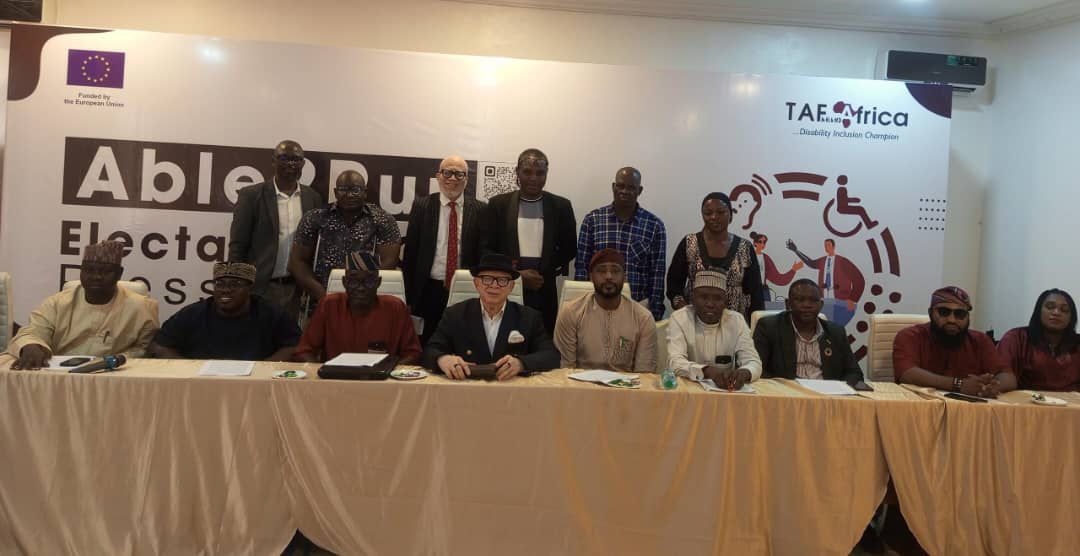
The declaration was made on Tuesday in Abuja during the launch of the “Able2Run: Electability Campaign,” organized by The All-rights Foundation Africa with support from the European Union under its democratic governance programme in Nigeria.
The initiative aims to increase political representation for persons with disabilities and encourage them to seek elective offices at all levels of government.
Jake Epelle, Chief Executive Officer of TAF Africa, said PWDs have spent years demanding inclusion in the electoral process but are now shifting focus toward occupying political offices themselves.
“For too long, persons with disabilities have been agitating for the opportunity to participate in the electoral process. But we are going from the point of participation, which we haven’t achieved holistically, to being allowed to run,” Epelle said.
He argued that Nigeria’s democracy continues to sideline millions of persons with disabilities despite their numerical strength, claiming their estimated population exceeded the total votes secured by President Bola Tinubu in the 2023 presidential election.
“Democracy in Nigeria is currently missing nearly 35 million voices. We make up a demography larger than the total votes that decided the last presidential election,” he said.
Epelle criticized what he described as tokenism in political appointments involving persons with disabilities, insisting that most positions occupied by them are ceremonial and lack real influence.
“For too long, more than 99 percent of the positions we occupy have been more or less like charity. We are tired of being given this tokenism of a special assistant. We have a special assistant to the president who will probably never see the president until he leaves office. So we do not have a voice,” he stated.
He challenged political parties to show genuine commitment to disability inclusion by creating pathways for persons with disabilities to contest elections.
“All the political parties, I want to hold you to a task. Tell me one agenda, one manifesto that you have rolled out that speaks to giving opportunity for persons with disabilities to compete with others for elected positions,” he said.
Epelle urged persons with disabilities to stop limiting themselves to supporting political candidates and instead actively seek offices themselves.
“Participate to emerge. Don’t participate just to support the candidate,” he added.
While commending the Independent National Electoral Commission for introducing inclusion frameworks, he said more work is needed to guarantee transparent and credible elections.
“We want a transparent election. We want an election where the winner will actually win. We want an election that is void of insecurity,” he said.
Esrom Ajanya, Senior Programme Manager at The Kukah Centre, described persons with disabilities as a major political constituency capable of influencing elections if properly mobilized.
Citing data from the World Health Organization, Ajanya said approximately 16 percent of the global population lives with one form of disability or another, adding that the figure translates to about 34.9 million people in Nigeria.
“This number represents not only a significant demographic constituency, but also a powerful electoral force capable of influencing political outcomes and shaping governance at every level,” he said.
Ajanya lamented the low level of representation of persons with disabilities in elective offices, noting that a national study conducted by TAF Africa on political participation between 1999 and 2025 showed that only four persons with disabilities held elective positions across federal, state and local government levels during the period.
“This represents less than 0.1 percent of all elected positions in Nigeria,” he said.
He added that no woman with disability held elective office during the same period, describing the development as evidence of deep-rooted exclusion based on both gender and disability.
Ajanya disclosed that more than 99 percent of political positions occupied by persons with disabilities are appointive rather than elective.
“While appointments remain important, the dominance of such positions raises legitimate concerns about tokenism rather than genuine political inclusion driven by equity, competence, and democratic participation,” he said.
He noted that despite constitutional protections and the provisions of the Discrimination Against Persons with Disabilities (Prohibition) Act 2018, barriers such as inaccessible polling units, poverty, discriminatory attitudes, communication challenges and exclusion within political parties continue to hinder participation.
Ajanya said TAF Africa, with support from the European Union, has launched a national mentorship and coaching programme for aspiring politicians with disabilities.
According to him, the initiative will establish virtual political hubs across Nigeria’s six geopolitical zones and provide mentorship for at least 180 aspiring politicians with disabilities.
“Participants will receive training in leadership, strategic communication, campaign financing, voter mobilization, political negotiation, media engagement, and inclusive governance,” he said.
He called on political parties and the electoral commission to strengthen disability inclusion policies and make political structures accessible.
“Nigeria cannot claim to be truly democratic while millions of citizens remain politically invisible. The time has come to move from symbolic inclusion to substantive representation. The time has come to build a Nigeria where persons with disabilities are not merely spoken for, but are elected to speak for themselves,” Ajanya said.