

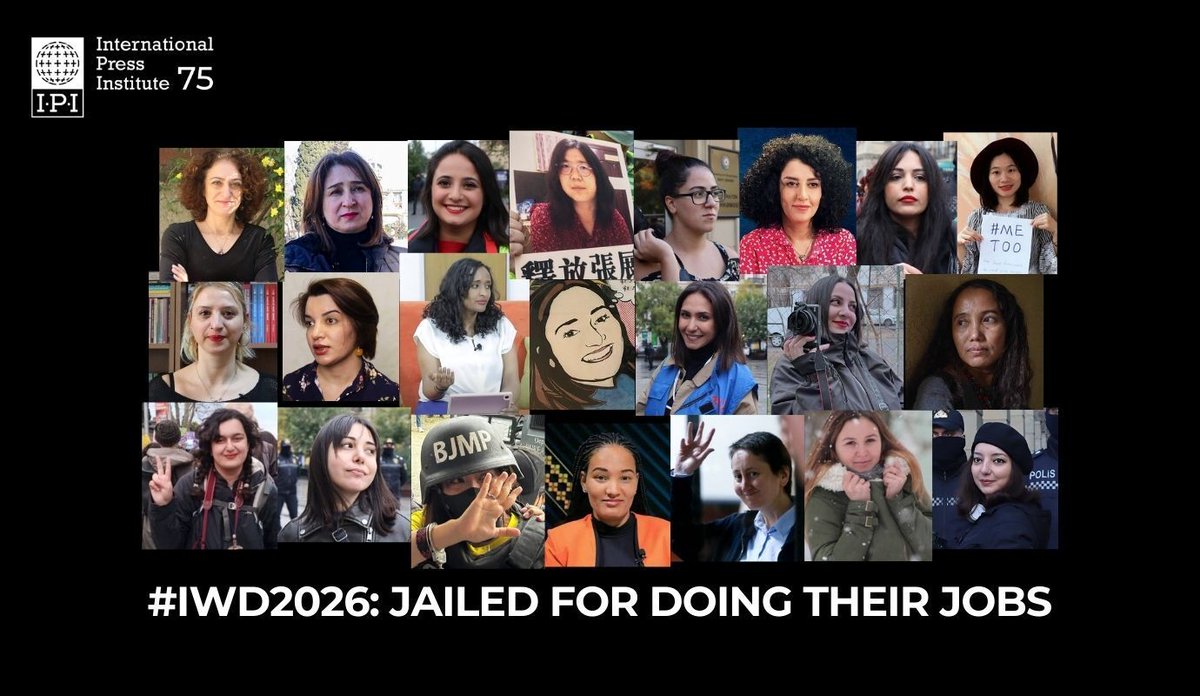
On International Women’s Day 2026, the International Press Institute (IPI) has spotlighted the stories of women journalists imprisoned around the world, warning that when those who hold power to account are put behind bars, society loses.
According to the organisation, the imprisonment of journalists around the globe has been on the rise for years as governments worldwide weaponise the law to jail those who dare to hold the powerful to account with independent reporting.
Data from the Committee to Protect Journalists shows that 50 women journalists were behind bars around the world in 2025, with the majority jailed in the past several years. Women journalists, IPI noted, face a host of gender-based threats and risks, while resources and mechanisms to support and protect them are often inadequate.
A 2025 report by UNESCO on the state of freedom of expression around the world found that women are disproportionately targeted by attacks both online and offline, most commonly perpetrated by the subjects of their investigations.
IPI said governments around the world regularly weaponise state criminal justice systems to arrest, harass and jail journalists reporting on politically sensitive topics. This strategy, often described as “lawfare,” relies on legislation aimed at fighting cybercrime, terrorism and “fake news” to target journalists and censor independent news and information.
Cases cited by IPI include Azerbaijan, where, under the Aliyev regime, journalists reporting independent news about the government are commonly charged with financial crimes such as currency smuggling and tax fraud. In Georgia, authorities imprisoned Mzia Amaglobeli, the first woman journalist to be jailed in the country’s 34 years of independence.
In China, one of the world’s top jailers of journalists, authorities frequently fabricate charges against members of the media in retaliation for reporting on sensitive social and political issues, including corruption, public health, and the treatment of women.
IPI also highlighted cases linked to conflict. 26 Ukrainian journalists are currently being held by Russian forces on charges, including terrorism and espionage. Testimonies from journalists released from captivity describe systematic mistreatment and torture, which, in the case of Victoria Roshchyna, led to the death of a Ukrainian journalist in Russian custody.
In Ethiopia, journalists were arbitrarily arrested in April 2023 as tensions in the Amhara region escalated into violent conflict, while in Iran, authorities have long used arrests, intimidation, and internet shutdowns to drive out independent reporting.
The organisation noted that women journalists imprisoned around the world frequently face gender-based mistreatment behind bars, including sexual harassment, rape threats, denial of medical treatment, and overcrowded detention conditions.
IPI said pervasive legal irregularities are also common in many cases, with journalists subjected to extended pretrial detention and trials that last for years as authorities delay proceedings.
“Women journalists produce some of the most impactful, important, and courageous reporting both inside conflict zones and out, covering critical political, economic, and human rights issues,” IPI said, warning that silencing their stories limits quality news reporting about issues that directly affect the public.
Despite international commitments to ensure journalists are free and safe to do their jobs, the organisation said many governments are demonstrating a lack of political will to defend independent media as a pillar of free societies.
IPI said it stands in solidarity with women journalists imprisoned around the world and will continue to fight for their release and the release of all journalists unjustly held behind bars.
“Journalism is not a crime,” the organisation stated.