

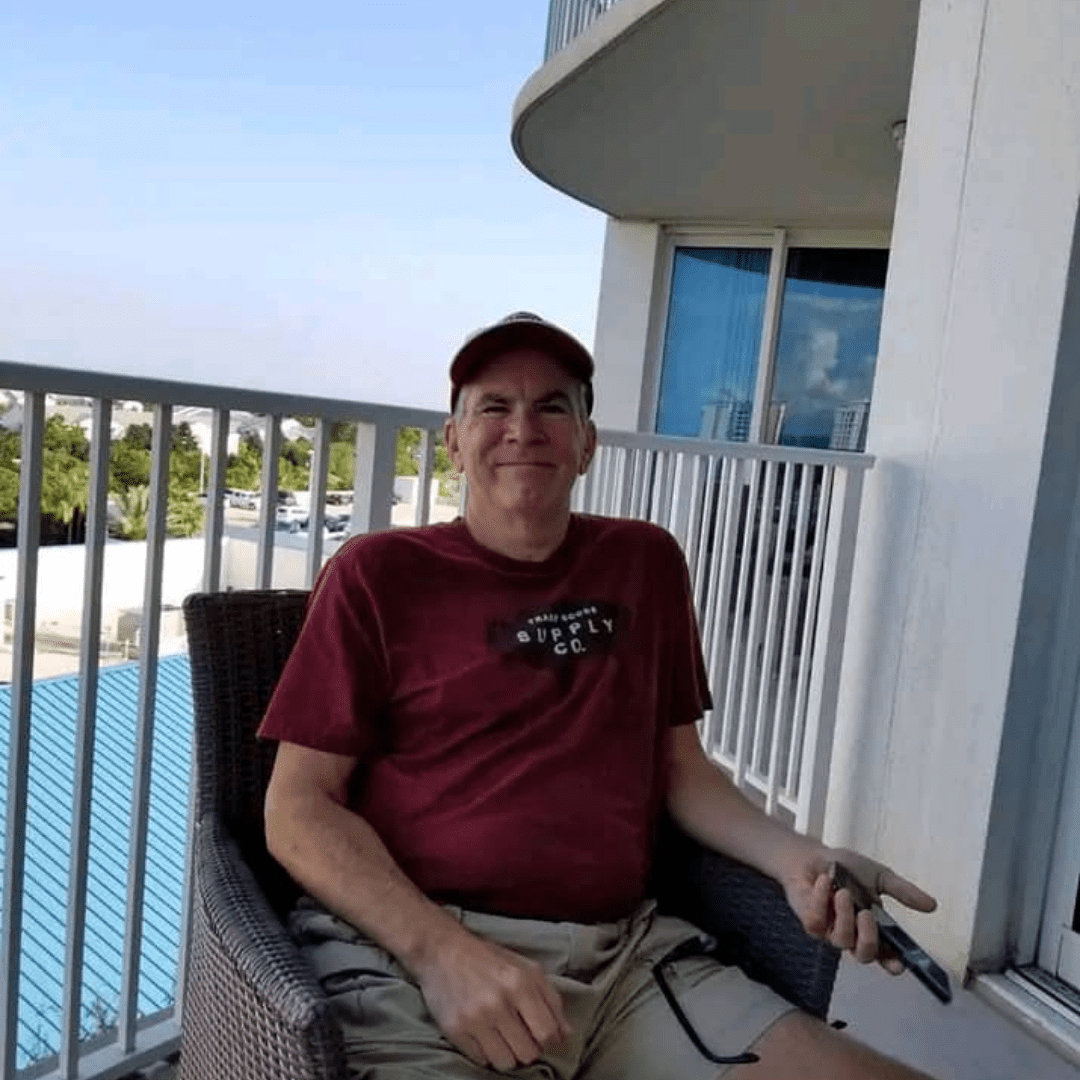
Dear readers,
Cheers to a Merry Christmas and Happy 2026 in advance!
The series went on an unanticipated break. Bouncing back was a struggle, but, thankfully, here we are – rolling out the year with the 27th episode. Our guest champion, Larry Thomas Landrie, has Hereditary Spastic Paraplegia (HSP) – a rare genetic disorder affecting the nervous system and causing progressive weakness and stiffness in the legs. He has some degree of hearing loss, too.
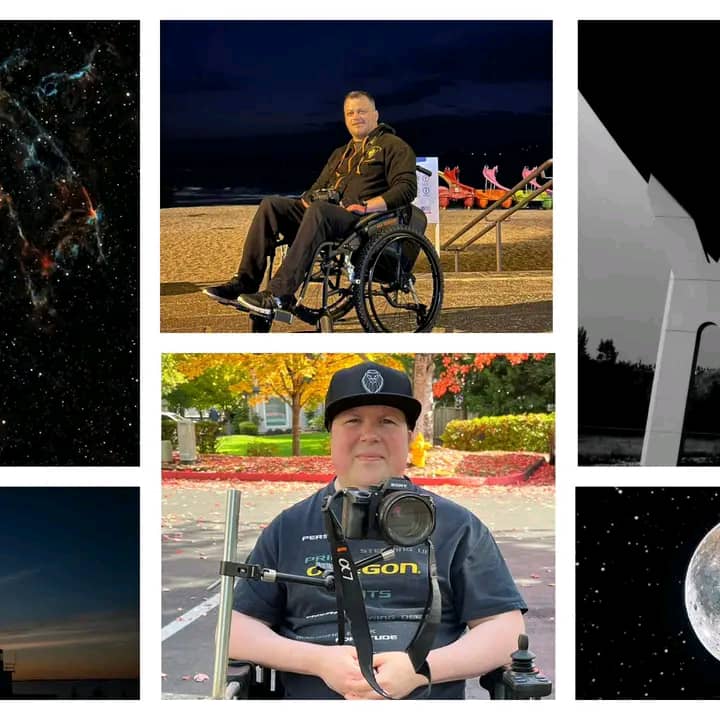
Larry is remarkable in his commitment and active participation in disability causes. Now in his 70s, and receiving hospice care, he is the oldest (yet one of the most participatory members) of the Disability Justice Media Network (DJMN), where we met. He also heads the Disabled Photographers of the Planet (DPOP), a Facebook group of photo enthusiasts running into the hundreds. In this interview, conducted over phone chat, Larry brings his characteristic, crisp humor and enduring lessons from over seven decades of lived disability experience to the narrative.
“For me, adapting meant just playing along with it, I am ready to fade into my own parade” – Larry Landrie
Background
Born in August 1952, in the ‘Glass City’ of Toledo, Ohio, United States, Larry recalls having close shaves from infancy.
‘I almost died of pneumonia when I was six months old. My aunt, who was in nursing school, rigged up an oxygen tent at home to keep me alive.’
Job demands at Western Union where his father worked, meant the family had to move from one city to another – first to West Covina, California, where young Larry finished kindergarten. From there, they moved towards the coastal area of San Jose, Portland, before finally settling in Seattle, Washington.
I was born with it
Despite being born with Hereditary Spastic Paraplegia, caused by a bad gene, Larry observes that there was no formal diagnosis – not until his sixties, when he had an esophagectomy – a surgery that removes all or part of the oesophagus. But the symptoms had always been there, right early. In his words: “I experienced clumsiness, awkward gait, urinary urgency, vision/hearing issues, hammer toes, and clonus – then my walking began to deteriorate, with a lot of pain.”
Adapting meant playing along
When I asked the usual question of how he adapted to disability during those early years, Larry’s response was one-off:
“For me, adapting meant just playing along with it.”
And that was through stumbling and falling all the time. ‘There were trial periods with various assistive devices to help with deteriorating mobility – cane, walking stick, walker, wheelchair, and scooter’, he recalls. While playing along with the pain, Larry managed to finish high school and then a bit of junior college before venturing into the world of work.
A Conscientious Objector
Larry had a very versatile career, holding a string of jobs. From a humble start as a plankton sorter at the National Oceanic and Atmospheric Agency (NOAA), and then took up caregiving roles at the Lutheran Nursing Home, where he was posted as a conscientious objector. Larry moved to the Department of Veteran Affairs (VA), where he worked his way through a string of roles, including tech, up to the position of Project Manager. He shares his work experience with an infectious optimism you could almost touch.
“My first real job was caring for a quadriplegic man. I would arrive early at his house and put him together, brushing his teeth, shaving, and getting him dressed. He was a veterinarian, and I would load him in a big van and drive to his clinic. When I took the VA job, little did I know it would become a forty-year career. I started as a pharmacy aid and advanced to lead tech and purchasing agent. But I would realise that blue-collar janitors were making thousands more than me.
“So, I became a warehouse worker and advanced to Foreman. We would eventually implement groundbreaking software, which led me to slip over into information resources management. I would advance quickly with my programming and got a call from Birmingham, Alabama, to become a national programmer. My programming work was very successful, and I had found my niche. I was then asked to be the technical lead for the Master Patient Index project.
“This was a huge effort by a small team of highly skilled programmers. I was named Project Manager, and this would be my greatest VA achievement. I wound down my career in Customer Support with forty years of service and a healthy retirement.”
Definitive moments in the journey – I can’t live like this!
I interviewed Larry while he was in hospice, slowly navigating towards the end of life. I asked, ‘Were you able to master your disability?’ What were some of your memorable encounters?’ In the ensuing response, the septuagenarian opens up on struggles with moments of vulnerability along the journey:
“As I look back, there was a moment in my recovery from that esophagectomy when I cried and said, ‘I can’t live like this’. We sought psychiatric help and medications. While I learned to take ownership of my changed body, I still struggled and felt I was a terrible burden to my family. I took all my pills and came very close to killing myself.”
He is, however, grateful to folks at the DJMN and others who rallied around during that difficult phase.
He closes with a powerful testimony to the impact of community during his most vulnerable moments:
“Since then, my life has become full of positive memorable encounters, and it does my heart good.”
My disabilities have made me more humble
That’s how Larry puts it when I asked if being disabled has in any way rubbed off virtues.
“I look at the folks in Disabled Photographers of the Planet and say, ‘what’s my problem?’ I read what people are going through in my HSP groups, and I’m thankful for all I have.”
When I mentioned how he met the inescapable phenomenon of discrimination, Larry didn’t go into specifics, he didn’t point fingers. Instead, he took the high road of gratitude for the people around him.
“I have been very fortunate when it comes to discrimination. I have always managed to do what I wanted – thanks to my wife and the friendly folks along the way,” he said.
However, my lived experience with disability, including anchoring the DCS tells me it goes deeper, so I fire a closer question: what were your biggest obstacles? I had him! Larry knew I am deaf, and he responded in a way I could readily identify with:
“Alex, you can relate to this obstacle. Communication is critical between the patient and caregiver. My hearing aids were almost five years old. I couldn’t hear my wife, and it was driving her crazy. We got new hearing aids, with insurance helping a bit. Voila, I could hear again, and my wife’s sanity was temporarily restored.”
In essence, what Larry meant is that disabilities that impede communication are about the most frustrating to live with. It’s interesting to hear what Larry says next – a classic admonition any person with disability can benefit from:
“Every caregiver loses it once in a while. From ‘why can’t you hear me’ to ‘I guess I just can’t have nice things’, hurtful comments happen… I try not to take them personally or overreact.”

A large black man scooped me up like a child
Learning to laugh at some of the things we encounter as disabled people is one of the healthiest ways to dissolve stress. These things aren’t always funny – in fact, sometimes, they border on the outright embarrassing. It takes an open mind to find humor even in the awkward. But it’s a good antidote that it is, I always look forward to that moment during this series, when we are able to look back and laugh at ourselves.
Larry shares his:
It wasn’t very hilarious at the time, but as I look back it’s pretty funny. We were at a ballgame and trying to navigate the dispersing crowd. Jan (my wife) was pushing me in the wheelchair as we proceeded on a downhill slope. I broke free of her and was freewheeling. I thought she caught u,p so I stopped steering. Suddenly, I was headed right over a curb when I realised she wasn’t back there. So, I go flying off that curb and flying out of that wheelchair – landing on the pavement! A large black man scooped me up like a child and put me back in the chair. The crowd around us was horrified and wanted to help, but my wife and I just needed a moment.
Closing charge – They find their voice!
At a time when disability rights and much of its gains over the years are being wrecked by the President of our country, I asked Larry what he thinks of the future and coming generations of persons with disabilities. His response echoes defiance and hope:
“I think the young people, have had it and aren’t going to settle for passive resistance,” says Larry. “I foresee a tsunami of backlash to this terrible Trump time of undoing Diversity, Equity and Inclusion (DEI). Y’all better look out for the next generation of disabled. They will find their voice and have their day.”
Larry’s favorite quotes are ‘Bloom where you are.’ ‘I’m ready to fade into my own parade.’
The Disability Champions Series, a collaborative project with madam Joy Bolarin, Executive Director, Jibore Foundation, is anchored by Alexander Ogheneruemu (Disability blogger). Special acknowledgement to T.O.L.A Foundation for backup support.