
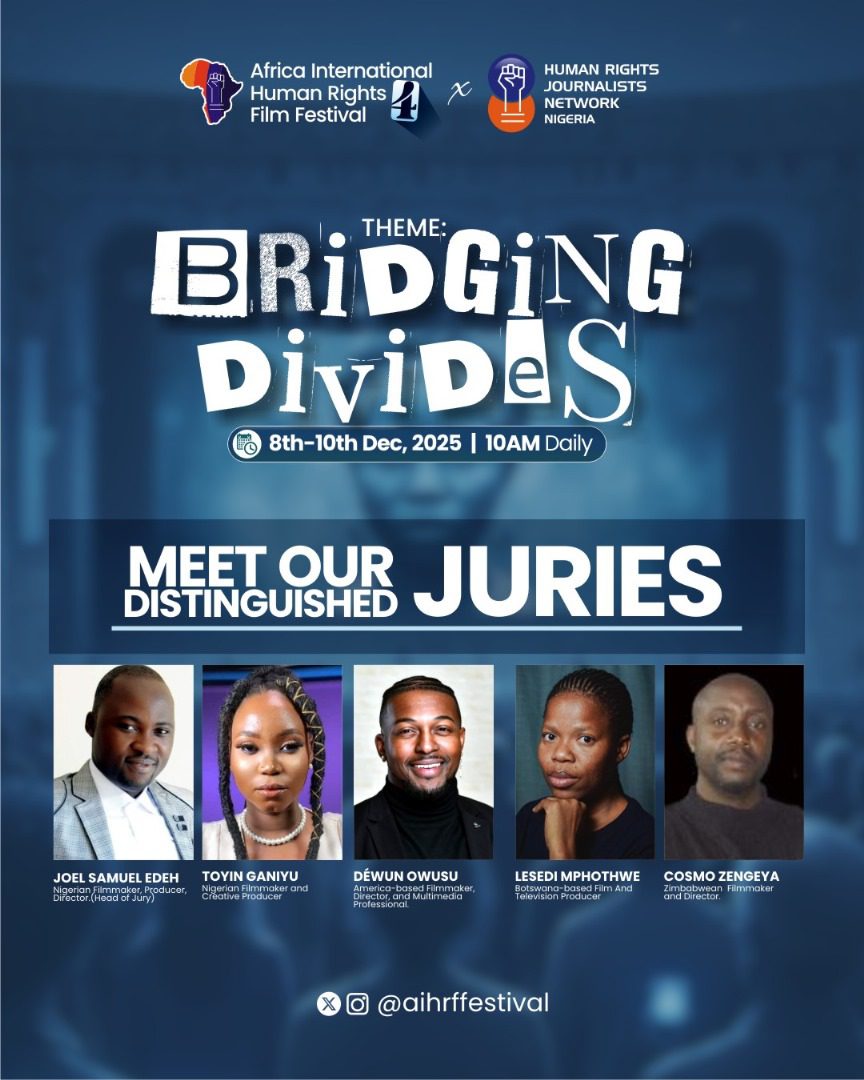
The 4th Edition of the Africa International Human Rights Film Festival (AIHRFF) officially opened in Lagos with 74 films selected from a total of 154 entries submitted by filmmakers across 71 countries.
The festival, which runs for three days, showcases documentaries, short films and features addressing some of the most pressing human rights violations across continents.
In a statement signed by the Communications and Strategy Lead, Shakirudeen Bankole, the Convener and Festival Director, Mr. Kehinde Adegboyega, noted that the entries reflected broad continental representation with the exception of Australia, highlighting the global scale of human rights concerns. “We are deeply worried,” he said, stressing that “all marginal gains recorded through advocacy and audacious insistence of the people on their fundamental human rights appear lost or retrogressed to unrelenting culture, fueled by social injustice and repressive and authoritarian government and ruling elites.”
Adegboyega said the submissions collectively reveal a grim global reality. “Overall, the festival’s submission pattern exposes a grim reality. Human rights violations are not only local but global, with all the continents and regions of the world caught in the web. We have to do better,” he said, emphasizing the need for collective action to protect human dignity.
A breakdown of the classifications shows that civic and political rights accounted for the largest share of submissions at 30 percent (48 entries), followed by films on forceful migration and trafficking at 20.6 percent (33 entries). Gender rights made up 13.1 percent, disability rights 11.9 percent, child rights 10.6 percent, climate and environmental justice 10 percent, urban development and forced eviction 3.1 percent, while digital rights recorded the least representation with just one entry.
The festival’s data paints a troubling global picture, as the high number of entries on violations indicates rising severity and spread of abuses. Europe submitted the highest volume of cases, followed closely by the Americas, Africa and Asia. Europe’s entries were led by France with 10 submissions, followed by Italy and the United Kingdom with eight each, Spain with six, Russia with five and Germany with four, pointing to a pattern of persistent violations despite strong human rights institutions.
The Americas ranked second, driven largely by the United States with 12 entries. Canada and Brazil contributed five films each, while Colombia submitted three. Mexico and Argentina had two entries apiece, reflecting concerns over systemic discrimination, police brutality, migration crises and other injustices across the region.
Africa featured prominently with Nigeria submitting 10 entries, followed by South Africa with four and Sudan with two. Other countries represented include Tunisia, Senegal, Namibia, Madagascar, Morocco, Egypt, Cameroon and Burundi. These films spotlight state repression, gender-based violence, conflict and systemic institutional failures across the continent.
Asia also made a strong showing with 22 entries, including seven films from Turkey, two each from India, Israel and Hong Kong, and others from Japan, South Korea, Iran, Yemen, China, the Philippines, Tajikistan and Jordan. Many of the films documented severe violations ranging from surveillance and censorship to ethnic persecution, conflict-linked atrocities and cross-border abuses.
Project Manager of the festival, Ifeoluwa Peter, noted that the opening film, Spain Is Not Different, reflects entrenched patriarchal norms and societal stereotypes that continue to suppress women’s rights.
“From this film and many more to be screened in the next three days of the festival, you all would have firechats on how these films mirror divides in the society,” she added, urging attendees to engage deeply with the issues presented.