
Civil Society Organisations, community networks, youth groups, trade unions and grassroots movements across Africa have called on governments to halt ongoing water privatisation initiatives and strengthen public water systems to ensure equitable access and build climate resilience.
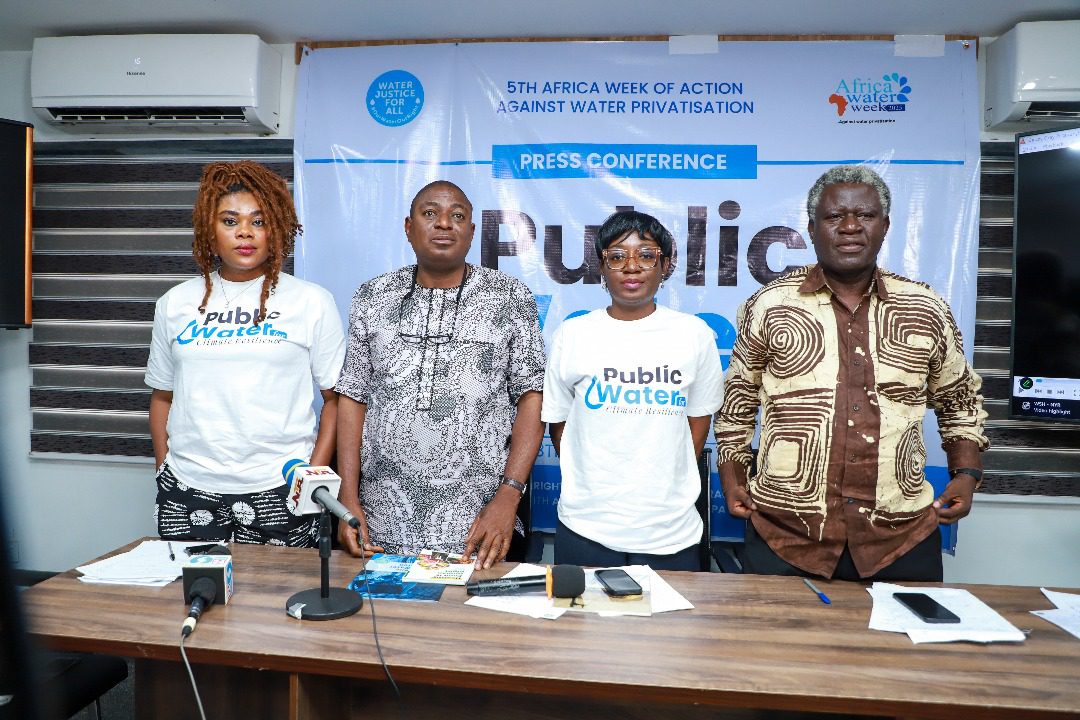
The demand was made at a press conference to commence the Fifth Africa Week of Action Against Water Privatisation, organised by the Our Water Our Right Africa Coalition (OWORAC) in partnership with the Africa Make Big Polluters Pay (MBPP) Coalition. The event, themed “Public Water for Climate Resilience,” was hosted by the Corporate Accountability and Public Participation Africa (CAPPA).
Mr. Akinbode Oluwafemi, Executive Director of CAPPA, stated that the United Nations General Assembly had in 2010 adopted a historic resolution recognising “the right to safe and clean drinking water and sanitation as a human right that is essential for the full enjoyment of life and all human rights” but noted that “this right is under threat in Africa by a twin problem of both government failure and nature’s response to man’s devastating use of the environment.”
He bemoaned the growing pressure to privatise water systems and hand control of this essential resource to profit-driven corporations at a time when the continent needs stronger, publicly accountable systems to guarantee universal access, we are seeing, despite overwhelming public opposition.
Oluwafemi added that “to privatise water in an era of escalating climate shocks is to compound vulnerability and institutionalise inequality.”
He also welcomed the United Nations Special Rapporteur on the Human Rights to Safe Drinking Water and Sanitation, Mr. Pedro Arrojo-Agudo, whose presence, he noted, affirmed the global dimension of the struggle for public water.
In his address, Arrojo-Agudo affirmed that water privatisation has failed in many countries around the world. He emphasised the need for countries to adopt Public-Community Partnership strategies to promote democratic water governance and empower communities to manage their own water resources.
He also highlighted the need to prioritise families and communities, especially women, who bear the burden of ensuring household access to water.
Ms. Fatou Diouf of the Senegal Water Justice Network described water privatisation as “the organised theft of the common good,” noting that Africa’s climate crisis has turned water scarcity into a humanitarian and political challenge.
Diouf added that while water privatisers see profit, the impact is a whole lot worse for communities because “we see rural women walking kilometres to fill a bucket, young people leaving their villages because the wells have run dry, and water-borne diseases returning where water has been handed to private control.”
Also speaking at the event, Mr. Leonard Shang-Quartey, Coordinator of the Africa Water Justice Network (AWJN) in Ghana, said the continent was witnessing a regression in access to safe drinking water despite the bright hopes of the proponents of privatisation.
“The promises of private operators have failed. Instead of improved access, we are seeing rising tariffs, exclusion of poor communities, and worsening inequality,” he said.
Representing Corporate Accountability, Mr. Neil Gupta warned that multinational water corporations, backed by financial institutions from the Global North, were aggressively expanding control over Africa’s water systems.
He stated that the scale and speed with which privatizers have been able to expand their control of water systems has been greatly facilitated by Global North institutions.
Neil Gupta thereafter stressed that “defending water is defending life itself.”
Making reference to water privatisation in Lagos, Niger, Zikorah Ibeh, the Assistant Executive Director at CAPPA demanded that the Lagos State Government pause all the Privatization plans, and open up the ongoing Public-Private-Partnerships with different multinationals for independent audits by CSO groups and community members.
Other speakers at the press conference include Sefa Ikpa, Programme Officer, Water Campaign at CAPPA, who delivered the joint press statement signed by 13 organisations across Africa and the United States of America, and Professor Adelaja Odutola Odukoya, Dean, Faculty of Social Sciences, University of Lagos, who described Public-Private-Partnership as legalisation of robbery.
The week-long campaign, holding from October 13–18, 2025, will feature coordinated actions across several African countries to highlight the environmental, economic, and social costs of water privatisation and to promote alternatives rooted in public financing and accountability.