

Seven years after dating, Opeyemi Aduragbemi and her man decided in 2020 that it was time to take the huge step towards becoming husband and wife.
For someone who abstained from sexual intercourse during the dating period, the 29-year-old had looked forward to exploring sex with her husband but she was disappointed by her body’s reaction to it.
“Do you know I usually mutter prayers every night for my husband not to initiate sex or just cuddle?” Aduragbemi asked rhetorically.
Unaware of what the problem could be, the mother of one made various efforts to find a solution to her predicament.
“I have seen different gynaecologists and even licked sweeteners. If I like, I do foreplay and it enters my brain, as soon as penetration wants to start, I go off.”
After much persuasion from this reporter, Aduragbemi finally gathered courage to have a conversation with her mother about FGM.
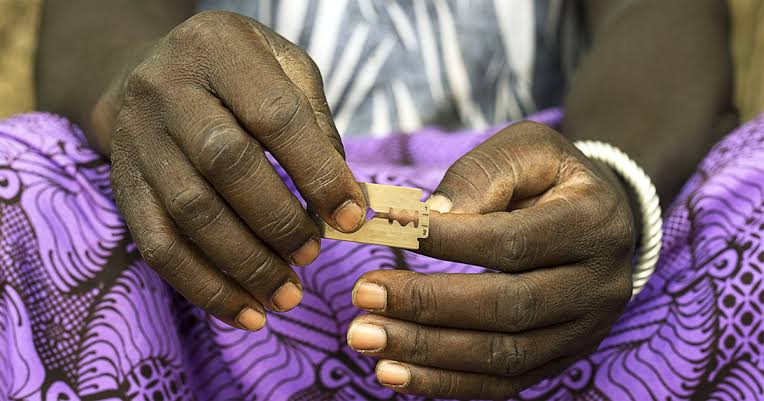
The World Health Organization (WHO) describes FGM as all procedures that involve partial or total removal of the external female genitalia for non-medical reasons. It says the long-term effects of the practice are sexual problems, which includes pain during intercourse and decreased satisfaction.
Aduragbemi put a call through to her elderly mother, and she (her mum) told her she was cut when she was a child. Almost two years after an unsatisfied sex life, the young mother recently got an explanation for why she has not been able to fully enjoy sexual intercourse.
“I’m just angry at myself that I’m just finding out the reason today. I used to think it was a disorder,” she lamented bitterly.
Although Aduragbemi knows about FGM and has joined a number of organisations to campaign against the practice, she didn’t think it was important to know her status.
“I didn’t expect my mum to buy into the idea of cutting me because she is learned. She must have been lured into accepting it,” Aduragbemi said.
The past few years have seen an increasing determination of many NGOs working effortlessly to tackle FGM in Nigeria. Social media has also offered new opportunities to educate and advocate an end to FGM, yet a lot of young people seem disconnected from the conversation.
A Twitter poll to find out the knowledge of young women about FGM showed that 98 per cent of 64 people know about the harmful practice,
Do you know what FGM is?
— ‘Sola Abe (@OlorunnisolaAbe) March 3, 2022
57 percent of 49 people knew they were cut while 43 percent revealed they don’t know their status, 76 per cent of 37 votes, however, noted that they are willing to ask their parents to know if they were cut.
Do you know if you were cut?
— ‘Sola Abe (@OlorunnisolaAbe) March 3, 2022
Would you like to find out if you were cut?
— ‘Sola Abe (@OlorunnisolaAbe) March 3, 2022
According to 95 per cent of the 57 people that voted, their knowledge of FGM is enough to convince them that the practice is harmful
Is your knowledge of FGM enough to convince you that the practice is harmful?
— ‘Sola Abe (@OlorunnisolaAbe) March 3, 2022
Unbothered
Even though 24-year-old Taiwo Momodu had heard about FGM for “the longest time,” the young woman didn’t bother to know her status.
“It didn’t occur to me to find out. I just didn’t feel like I had been cut. Hearing about FGM sounded like something so distant and far from my reality,” she explained.
The Coordinator of the Girdle Project, an online initiative advocating against FGM, Sylvia Chioma, described the attitude of young people towards FGM as “youthful exuberance of knowing all when they know so little.”
“Many young people don’t know or feign ignorance about FGM. When I started this advocacy, I was met with stiff opposition from young people telling me that FGM is a thing of the past but just this month, UNICEF said Nigeria is the third country in the world with the highest prevalence of FGM,” Chioma said.
She said many young people were, however, surprised when they realised their former stance was wrong.
“A lot of them have come back to say they are shocked FGM is still a ‘thing’ in Nigeria. They are shocked for the reasons they are cut,” she added.
After Momodu’s conversation with this reporter, she had a conversation with her mother who revealed that she was not cut.
“I wouldn’t have liked it if I was cut. I think I’d have felt violated because someone who has nothing to do with my body made a major decision in ruining my sex life,” she said.
‘I never knew it’s something serious’
The first time Olamide Olatunde heard about FGM was in 2015. She remembered her cousin’s husband always complained about her attitude towards sex.
Shortly after then, the topic was discussed in a women’s meeting at her mosque.
A woman asked for advice about cutting her 15-year-old daughter, as FGM was a ritual performed in her husband’s family. Another woman, however, advised against it, blaming FGM for her repugnance for sex which is causing a problem in her marriage.
Despite having come across the subject matter twice, Olatunde did not pay any attention to it nor did she try to learn about it until this reporter recently called on women to share their stories.
In a bid to make her understand the issue, this reporter sent her links to FGM stories.
“I never knew it’s something serious like this. I used to think that my cousin was not calm whenever her husband reported her. This one I read is shocking,” Olatunde said.
Buoyed up by what she read, the 25-year-old mustered the courage to ask her mother about her status.
“She said she did not do it for us, except her first daughter. She said she stopped it after she heard that FGM is not good. With all I read, to God be the glory, e no reach my side.”
What is your status?
A medical doctor and executive director of Value Female Network ( VFN), Costly Aderibigbe, emphasised the importance of women and young girls knowing their FGM status, noting the health implications of the harmful practice.
According to her, a lot of women and girls are going through different sexual and reproductive health issues but do not know why it’s happening to them.
She narrated the story of a friend who was always down with recurrent urinary tract infection and was ignorant of the reason until she found out she had undergone the Type II of FGM.
FGM Type II, also called Excision, is the partial or total removal of the clitoris and labia minora with or without cutting the labia majora.
Aderibigbe said, “For young women that are from communities where FGM is prevalent, they don’t have to wait till they are about to give birth or get married before they find out if they were cut or not.
“I encouraged the women that work in my organisation to find out their status, and it was shocking to some of them that they were cut. That helps them prepare ahead and seek help if they need to.”
According to the medical doctor, the effective way to make women interested in knowing their status is to educate them on the harmful effects of FGM.
Narrating the story of a lady who was battling clitoral cysts and didn’t know why, she said it was after she heard about FGM that she found out she was cut and sought medical intervention.
“Just by being consistent with community outreaches, sensitising people about the harmful effects of FGM, women and girls tend to want to know their status. Through that, some of them get involved in the campaign to ending FGM,” Aderibigbe said.
She recalled a 2018 outreach targeted at adolescents that she organised in a local community in Osun State.
According to her, after the invited speaker addressed the girls, many of them realised that their external female genitalia looked different.
“What happened was that the speaker described what the normal female genitalia looks like. Following that session, most girls wanted to know whether theirs was normal, and a lot of them got to know through that process that they had been subjected to FGM,” Aderibigbe said.
Education is the key
The VFN executive director, however, insisted that knowing one’s status alone is not enough to eradicate FGM.
Aderibigbe said it has to be combined with correct information about the harmful practice.
Making a reference to women who confirmed they were going through one or more complications of FGM and still insisted on cutting their daughters, she said, “Education is the only way to convince such people as FGM is very deep and an integral part of human.”
According to her, the most important factor in eradicating FGM is individual’s conviction and commitment to abandon the practice which can only come from the place of knowledge.
Chioma agrees with Aderibigbe as she insists that only education can effectively help eradicate FGM.
“This might sound strange but sincerely, I support the legislature against FGM but I don’t believe it can stop FGM – except education!”
Rachael Arowolo, the team lead at Wapa Africa, a platform bridging intergenerational gaps in sexual and reproductive health and rights, stressed the need to ensure that FGM education is beyond the surface.
“When young people don’t know about FGM or have a limited understanding of why it should be stopped beyond the fact that it is not good, ending FGM becomes a 50/50 chance. Anything and anybody can change their opinion and their stand about the harmful practice, especially if it is from a perceived trusted source like their parents,” she said.
Chioma highlighted the kind of approach to take to effectively educate people about FGM.
“Education is about breaking down the myths or misconception of the so-called gains of FGM. With education (sensitisation), you can point out the religious-cultural myths, complications and criminality of FGM. Education is not to condemn, but convince them,” Chioma said.
Aderibigbe said, “For women and girls to be a part of the end to FGM is for them to be empowered with the right information about it; to know that FGM is wrong; the effect and how to take a stand.
“With that knowledge, they can then make an informed decision to protect themselves and others.”