
CLAIM: Only 7% of Nigerian youth possess basic ICT skills.
VERDICT: Misleading
BACKGROUND: The World Youth Skills Day is annually celebrated on July 15, as declared by the United Nations General Assembly (UNGA) in 2014. It aims to celebrate the strategic importance of equipping young people with skills for employment, decent work, and entrepreneurship. This year’s theme, marking the 10th anniversary of the declaration by the UNGA, focused on youth empowerment through Artificial Intelligence (AI) and digital skills.
Meanwhile, in commemoration of the 2025 World Youth Skills Day, a media alliance group published a statement calling for “a nationwide action aimed at tackling Nigeria’s youth digital skills deficit.” The statement, published on online websites here, here, and here, claimed that only 7% of Nigerian youth possess basic ICT skills, citing ‘recent statistics’ and urging “key sectors of society to step up: Federal, State, and Local Governments to Strengthen digital education policies, scale programs such as the 3 Million Technical Talent (3MTT) initiative, and integrate AI and ICT training into both formal and informal education systems.”
Information and Communication Technology (ICT) may be defined as the use of technology for communication and information processing. Therefore, ICT skills refer to any direct interaction with technology, including turning on a computer, using hardware to print and copy documents and using digital cameras to capture photographs or video footage.
Other ICT skills include the ability to switch on a computer, log in and connect to the appropriate platforms and programmes, using ICT hardware to scan, print and copy documents, Using a digital camera to capture photographs or video footage, editing images using computer software (like Adobe Photoshop), using popular software packages, such as Microsoft Office, to create, edit and save documents, using a search engine (such as Google or Bing) to find information, browsing and posting on social media accounts (such as Facebook, Twitter or LinkedIn), using computers and the internet safely, for example, keeping personal information private, and avoiding viruses, identity theft and other online threats, working knowledge of the languages used in coding and programming, such as HTML, CSS and JavaScript, sending and receiving information using data-sharing applications and cloud storage systems, for example, Google Drive or Dropbox.
The claim asserted that only an insignificant 7% of the population of Nigerian youth have basic ICT skills. The statement, already being shared online and garnering views and comments, indicated a deeply complex national issue, suggesting that over 90% of the country’s youth population cannot use basic ICT-related platforms. However, is this claim true? We checked.
VERIFICATION:
To ascertain the veracity of the claim by NOMA, we conducted a keyword search of recent statistics or surveys that analysed ICT literacy among Nigerian youths. Findings revealed a 2021 Multiple Indicator Cluster Survey (MICS) and National Immunisation Coverage Survey (NICS) conducted by the National Bureau of Statistics (NBS) as part of the Global MICS Programme developed by UNICEF in the 1990s as an international multi-purpose household survey programme to support countries in collecting internationally comparable data on a wide range of indicators on the situation of children and women. The report, published in August 2022, surveyed 1,850 clusters and 37,000 households in the 36 States and the Federal Capital Territory (FCT), Abuja, as well as the six geo-political zones of Nigeria.
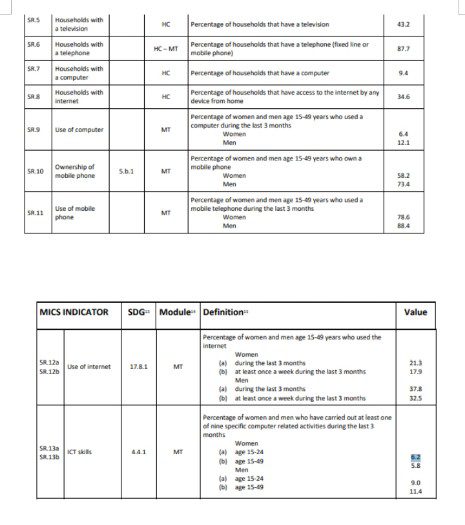
Findings from this survey revealed that the percentage of women and men aged 15-49 years who used a computer during the last 3 months (the duration in which the survey was administered) was 6.4% and 12.1%, respectively, while the percentage of women and men aged 15-49 years who used a mobile telephone during the last 3 months (the duration in which the survey was administered) was 78.6% and 88.4%, respectively.
Also, the percentage of women aged 15-49 years who used the internet during the last 3 months was 21.3% and at least once a week during the last 3 months was 17.9%, while for men of the same age during the same timeframe, the percentage stands at 37.8% and 32.5%. The MICS also revealed that the percentage of women and men who have carried out at least one of nine specific computer-related activities (highlighted in pages 642-643 for women and 684-685 for men) during the last 3 months includes:

Please note that these timeframes cover the period during which the survey was administered. The full MICS report can be accessed here.
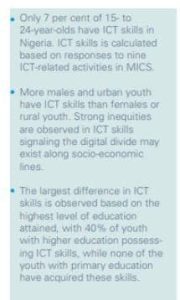
Further findings also revealed a 2023 Nigeria Education Fact Sheet published by the United Nations Children’s Fund (UNICEF) in April 2024, which analysed learning and equity using NBS’s MICS data of 2021. Again, the survey highlighted that ICT skills are measured based on whether an individual carried out computer-related activities in the three months preceding the MICS survey. Findings from the Fact Sheets revealed that only 7% of 15- 24-year-olds have ICT skills in Nigeria. Further findings suggested that the largest difference in ICT skills is observed based on the highest level of education attained, with 40% of youth with higher education possessing ICT skills, while none of the youth with primary education have acquired these skills.
The full Nigeria Education Fact Sheets report can be accessed here.
CONCLUSION
After reviewing findings from the 2021 Multiple Indicator Cluster Survey (MICS) and National Immunisation Coverage Survey (NICS) conducted by the National Bureau of Statistics (NBS) and the 2023 Nigeria Education Fact Sheets published by the United Nations Children’s Fund (UNICEF) in April 2024, it is determined that the claim that only 7% of Nigerian youth possess basic ICT skills made my the Nigeria Online Media Alliance (NOMA) is misleading as it interpreted the findings of both surveys out of context and left out the findings that specified that the percentage only applies to youths aged 15-24, while the findings also indicated that 40% of literate Nigerian youth possess basic ICT skills. Therefore, the claim is false and misleading.